Jacob Zuma Meeting with Fugitive Gupta Brother Called a 'Middle
Cabinet Minister Khumbudzo Ntshavheni slammed the encounter between the former president and the businessman at the heart of the state capture scandal as

World correspondent
Reports on international affairs, diplomacy, and humanitarian developments with an emphasis on official statements, multilateral institutions, and regional context.
Editorial responsibility: Lead reviewer for geopolitics, international institutions, and crisis coverage
Primary source: BBC World News. Full source links and update notes are below.
Fast summary
Start here
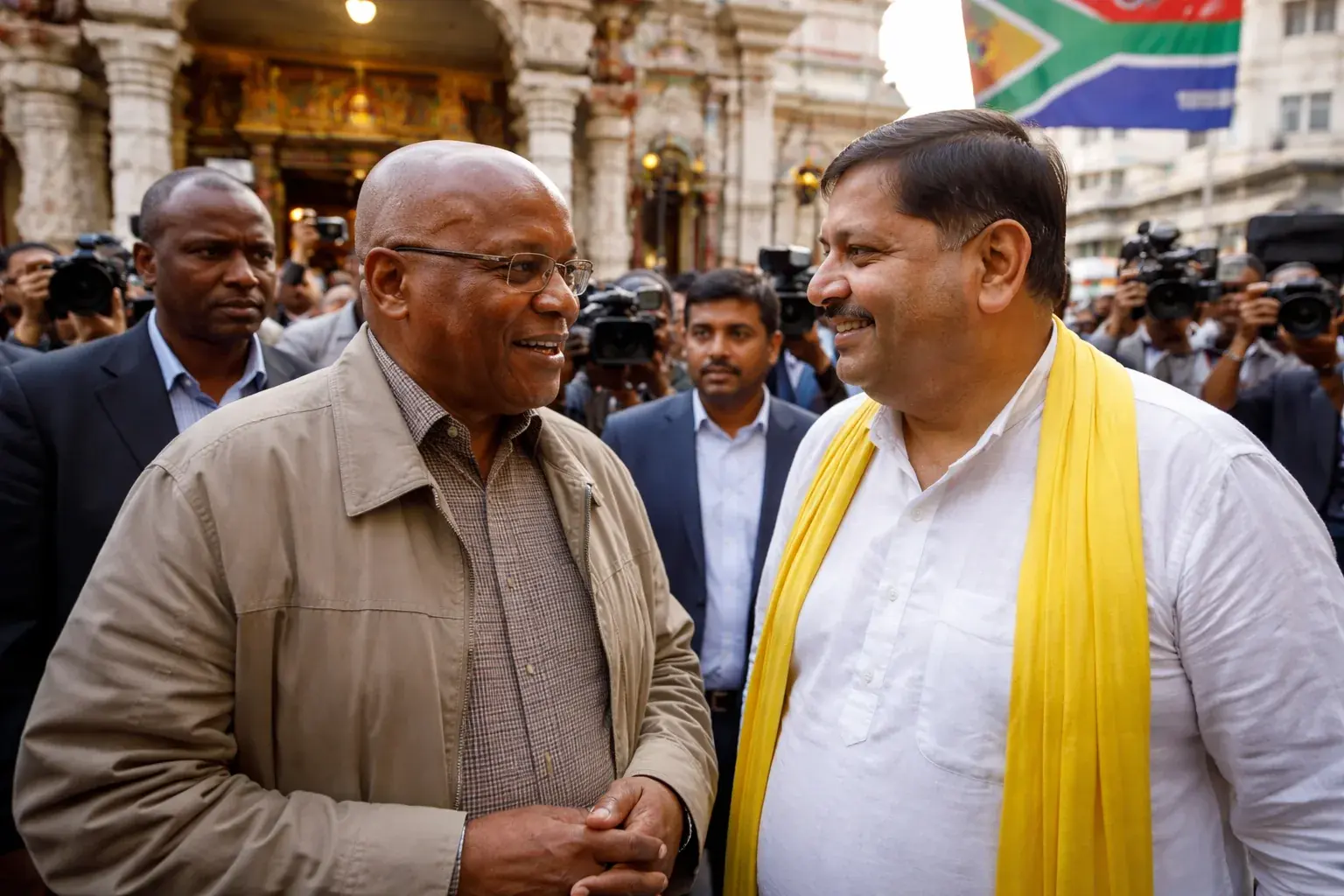
- A photograph surfaced showing Jacob Zuma and Ajay Gupta at an Indian temple, sparking immediate condemnation from the South African government.
- Minister Khumbudzo Ntshavheni described the meeting as an unapologetic 'middle finger' to citizens who lost money through the Gupta brothers' corruption schemes.
- International Relations Minister Ronald Lamola announced an investigation into the meeting and the presence of the South African High Commissioner at the event.
What happened
Jacob Zuma, the former President of South Africa, has once again entered the center of a political firestorm following the publication of a photograph showing him alongside Ajay Gupta. The image, which was initially circulated through Indian media outlets, captures the two men together at a temple in India. The meeting has provoked an immediate and vitriolic response from the current South African administration, which spent years attempting to dismantle the influence of the Gupta family and their business empire. Cabinet Minister Khumbudzo Ntshavheni publicly denounced the encounter during a press briefing on Friday, asserting that Zuma's actions constitute a profound disrespect to the South African public. The administration views the meeting not merely as a social call but as a defiant gesture against the legal and ethical reforms initiated after Zuma was forced out of office in 2018.
What's new in this update
The most striking and controversial aspect of this development is the involvement of official diplomatic channels. Reports indicate that the South African High Commissioner to India, Anil Sooklal, accompanied Jacob Zuma to the meeting with Ajay Gupta. This presence has been described as a disgrace by Minister Ntshavheni, suggesting a potential breach of protocol or a conflict of interest within the nation's diplomatic corps. In response to these revelations, International Relations Minister Ronald Lamola has confirmed that the government will launch a formal investigation into the circumstances surrounding the meeting. Lamola further characterized Zuma’s activities in India as the operation of a parallel foreign policy, implying that the former president is acting outside the authority of the current state and undermining official international relations.
Key details
The controversy is deeply rooted in the 2022 Zondo Commission report, which detailed a systematic effort to redirect state resources for private gain, a process commonly referred to as state capture. The commission concluded that Jacob Zuma frequently acted at the direct behest of the Gupta family, particularly in the appointment of key economic officials and ministers. A primary example cited in the report was the 2015 dismissal of Finance Minister Nhlanhla Nene, who reportedly refused to facilitate the Gupta family's specific business interests. He was replaced briefly by Des van Rooyen and later by Malusi Gigaba, both of whom were identified by the commission as being friendly to the family's agenda. Furthermore, the commission detailed how the state-owned power utility, Eskom, was compromised by putting Gupta-aligned executives in leadership positions. The recent temple meeting serves as a physical reminder of these connections, which cost the South African economy billions in lost revenue.
Background and context
Jacob Zuma served as South Africa’s president from 2009 until he was forced to resign by the African National Congress (ANC) in 2018 amid mounting corruption allegations. His tenure was defined by his close relationship with the three Gupta brothers—Atul, Rajesh, and Ajay—who immigrated to South Africa from India in the 1990s. As the state capture investigation gained momentum, the brothers fled the country in 2018, eventually settling in the United Arab Emirates. While South African authorities have sought their extradition, a UAE court rejected a request for Atul and Rajesh in 2023. Although the South African arrest warrant for Ajay Gupta was cancelled in 2019, he remains a central figure in the allegations of massive fraud. Zuma has consistently denied all allegations of wrongdoing, often characterizing the legal actions against him as politically motivated lawfare designed to prevent his political return.
What to watch next
The immediate fallout will likely focus on the internal investigation into High Commissioner Anil Sooklal and whether any disciplinary actions will be taken within the Department of International Relations and Cooperation. Politically, the timing of the meeting is significant as Zuma prepares for a potential return to national governance. After his newly formed uMkhonto weSizwe (MK) party secured approximately 15% of the vote in the 2024 elections—contributing to the ANC losing its outright majority for the first time since 1994—Zuma has reportedly indicated he would stand for re-election in the next cycle. Observers will be monitoring how this renewed association with the Gupta family affects his support base. While it reinforces the narrative of corruption for his critics, Zuma’s core supporters often view his defiance as a sign of strength against a perceived elite establishment. The MK party's strategy in the coming months will be critical to South Africa's evolving coalition-based political landscape.
Why it matters
The meeting reignites concerns over the 'state capture' era and highlights Zuma's continued defiance of the political establishment as his MK party gains influence.
Read next
Follow this story through the topic hub, more world coverage, and the latest updates.
Weekly briefing
Get the week's key developments in one concise email.
Get a fast catch-up on the biggest stories, the context behind them, and the links worth your time.
Cadence
Weekly, for a quick catch-up
Coverage
AI, business, world, security, sports
Format
Clear takeaways and useful context
Request the briefing
Leave your email to open a prepared request and get on the list for the weekly briefing.
About the byline
World correspondent
Leila Haddad covers world affairs, diplomacy, and humanitarian crises, with a focus on how fast-moving international developments affect public policy, conflict response, and cross-border institutions.
Sources and methodology