Rescuers Free Man from 140 Tonnes of Rubble Eight Days After
After more than 100 hours of precision digging, international teams rescued Hernán Gil, a security guard who survived in a concrete pocket beneath a

World correspondent
Reports on international affairs, diplomacy, and humanitarian developments with an emphasis on official statements, multilateral institutions, and regional context.
Editorial responsibility: Lead reviewer for geopolitics, international institutions, and crisis coverage
Primary source: BBC World News. Full source links and update notes are below.
Fast summary
Start here
- Hernán Gil survived for eight days within a reinforced concrete security booth that shielded him from 140 tonnes of debris.
- A coalition of rescuers from seven nations, including Chile, Mexico, and the United States, collaborated on the technically difficult extraction.
- The official death toll from the June 24 twin earthquakes has reached 2,595, with tens of thousands still missing across the region.
What happened
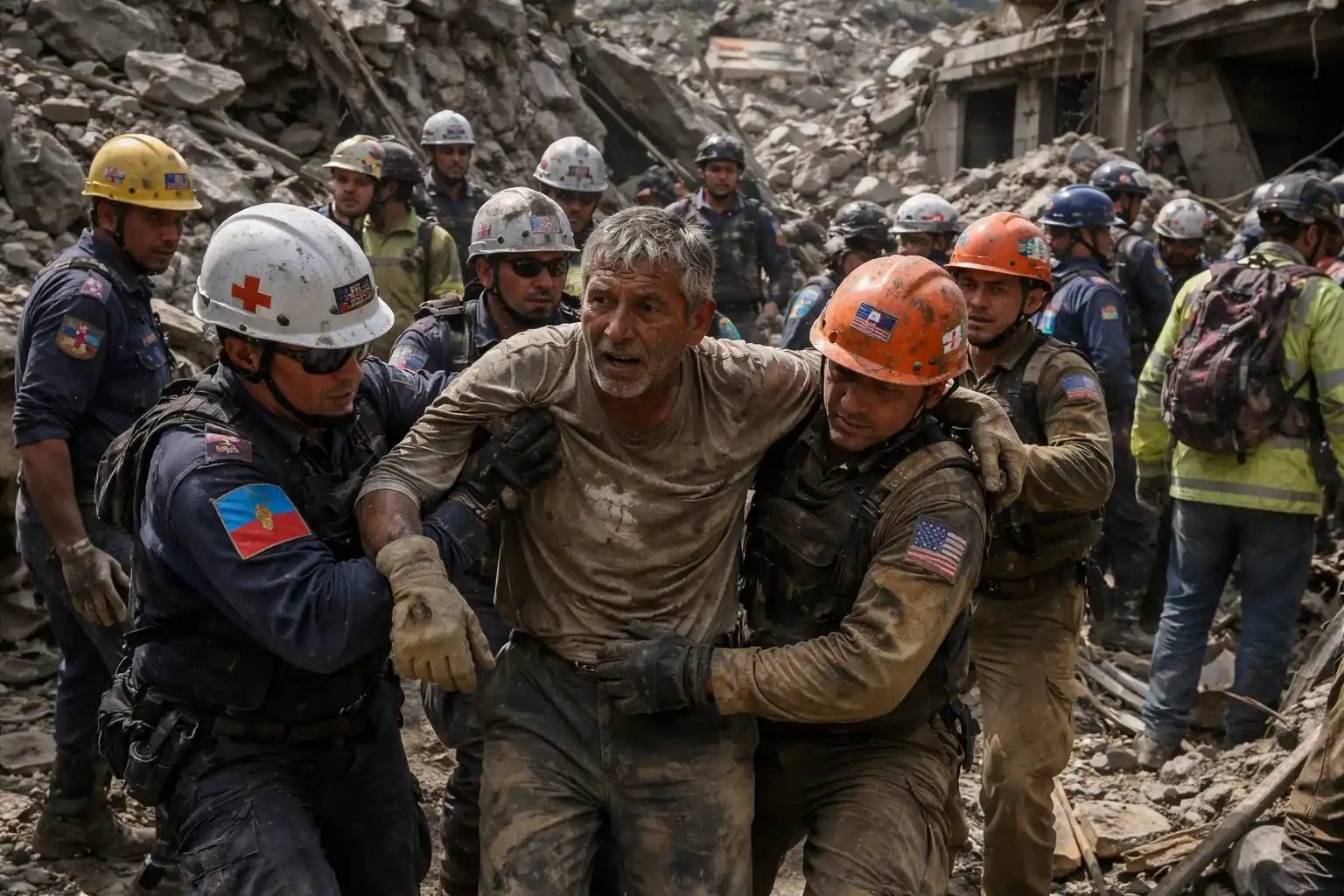
In a remarkable feat of endurance and technical precision, rescue teams in Venezuela successfully extracted Hernán Gil from the remains of a collapsed building in Catia La Mar. Gil, a security guard, had been entombed for eight days following the catastrophic twin earthquakes that struck the nation on June 24. The rescue occurred more than 100 hours after search teams first detected signs of life beneath a staggering 140 tonnes of concrete and twisted metal. The operation, described by veteran firefighters as one of the most complex in recent history, involved cutting through dense layers of debris while stabilizing the surrounding ruins to prevent further collapse. Gil’s survival is being hailed as a miracle by local authorities and international observers alike, providing a brief reprieve from the grim recovery efforts continuing across the affected region. His ability to survive without serious injury under such extreme weight is attributed to the small concrete booth where he was stationed at the time of the collapse.
What's new in this update
The latest reports from the site detail the final hours of the extraction, which saw rescuers from across the Americas collaborating to pull Gil to safety. According to Allan Madrigal, a paramedic with the Costa Rican Red Cross, Gil emerged from the ordeal in surprisingly good condition. Despite the deprivation and the immense pressure of the surrounding rubble, Gil remained conscious and even maintained a cheerful demeanor throughout the final stages of the dig. He reportedly conversed with rescuers about his family and even requested specific flavors of hydration drinks as they worked to widen the access shaft. Medics had previously managed to provide him with water and an intravenous drip through a small aperture, which likely played a critical role in maintaining his health and morale during the final 100 hours of the rescue operation. His extraction was met with emotional celebrations from the multinational team that had worked around the clock to reach him.
Key details
The technical specifics of the rescue reveal the extreme dangers faced by both the survivor and the search teams throughout the week-long effort. Gil was located in a small concrete security booth situated in the basement parking area of the Galerias Playa Grande mall. This booth acted as a protective shell, preventing the full weight of the collapsing 140-tonne structure from crushing him instantly. However, the location made reaching him incredibly hazardous for the specialists on site. Rescuers had to construct temporary access ducts, which suffered several partial collapses during the process due to the unstable nature of the ruins. Teams from Venezuela, Chile, Costa Rica, El Salvador, Mexico, Portugal, and the United States utilized specialized cameras and acoustic sensors to monitor Gil's condition and guide their movements. At one point, a camera feed showed Gil wearing a face mask and goggles provided by rescuers to protect him from the thick dust generated by the drilling and excavation.
Background and context
The twin earthquakes that struck on June 24 have left a trail of devastation across coastal Venezuela, specifically impacting the Catia La Mar area. As of Thursday evening, official figures place the death toll at 2,595 individuals, though that number is expected to rise significantly as search efforts transition into recovery phases. Tens of thousands of people remain missing, and the scale of the structural damage in the affected zones is unprecedented for the region. This disaster has prompted a massive international humanitarian response, drawing in specialized Urban Search and Rescue (USAR) teams from around the world. The complexity of the urban environment, characterized by high-density construction and precarious terrain, has made the search for survivors particularly grueling. For many of the international responders, such as the Costa Rican team, this mission represents a significant professional and personal milestone in the face of immense human suffering and environmental chaos.
What to watch next
While the rescue of Hernán Gil provides a much-needed morale boost, the focus remains on the thousands still unaccounted for in the wake of the quakes. Authorities are expected to continue searching for signs of life in other high-priority locations, though the 'golden window' for finding survivors has largely closed after eight days. In the coming days, the Venezuelan government and international aid agencies will likely shift more resources toward providing long-term shelter and medical care for the displaced population. Additionally, there will be an ongoing assessment of structural integrity in buildings that remain standing but may have been weakened by the initial shocks and subsequent aftershocks. For the international rescue teams, the debriefing from the Catia La Mar operation will likely provide vital data on surviving within 'pockets' of rubble, which could inform future disaster response protocols globally and improve outcomes in similar urban collapse scenarios.
Why it matters
The successful rescue of Hernán Gil serves as a rare success story in a mounting humanitarian crisis and demonstrates the critical importance of international cooperation in urban search and rescue operations.
Read next
Follow this story through the topic hub, more world coverage, and the latest updates.
Weekly briefing
Get the week's key developments in one concise email.
Get a fast catch-up on the biggest stories, the context behind them, and the links worth your time.
Cadence
Weekly, for a quick catch-up
Coverage
AI, business, world, security, sports
Format
Clear takeaways and useful context
Request the briefing
Leave your email to open a prepared request and get on the list for the weekly briefing.
About the byline
World correspondent
Leila Haddad covers world affairs, diplomacy, and humanitarian crises, with a focus on how fast-moving international developments affect public policy, conflict response, and cross-border institutions.
Sources and methodology