Families Scour Rubble as Death Toll from Venezuela Quakes Rises to
As international rescue teams arrive in the devastated coastal state of La Guaira, thousands remain missing under the ruins of collapsed buildings after

World correspondent
Reports on international affairs, diplomacy, and humanitarian developments with an emphasis on official statements, multilateral institutions, and regional context.
Editorial responsibility: Lead reviewer for geopolitics, international institutions, and crisis coverage
Primary source: BBC World News. Full source links and update notes are below.
Fast summary
Start here
- Twin earthquakes of magnitude 7.2 and 7.5 struck Venezuela on Wednesday, leaving at least 1,430 dead and an estimated 50,000 missing.
- The coastal state of La Guaira has suffered catastrophic damage, with local residents using bare hands and shovels to search for survivors in the ruins.
- International aid from Mexico, Spain, the United States, and the United Kingdom has arrived to assist overstretched national rescue teams in the critical first 72 hours.
What happened
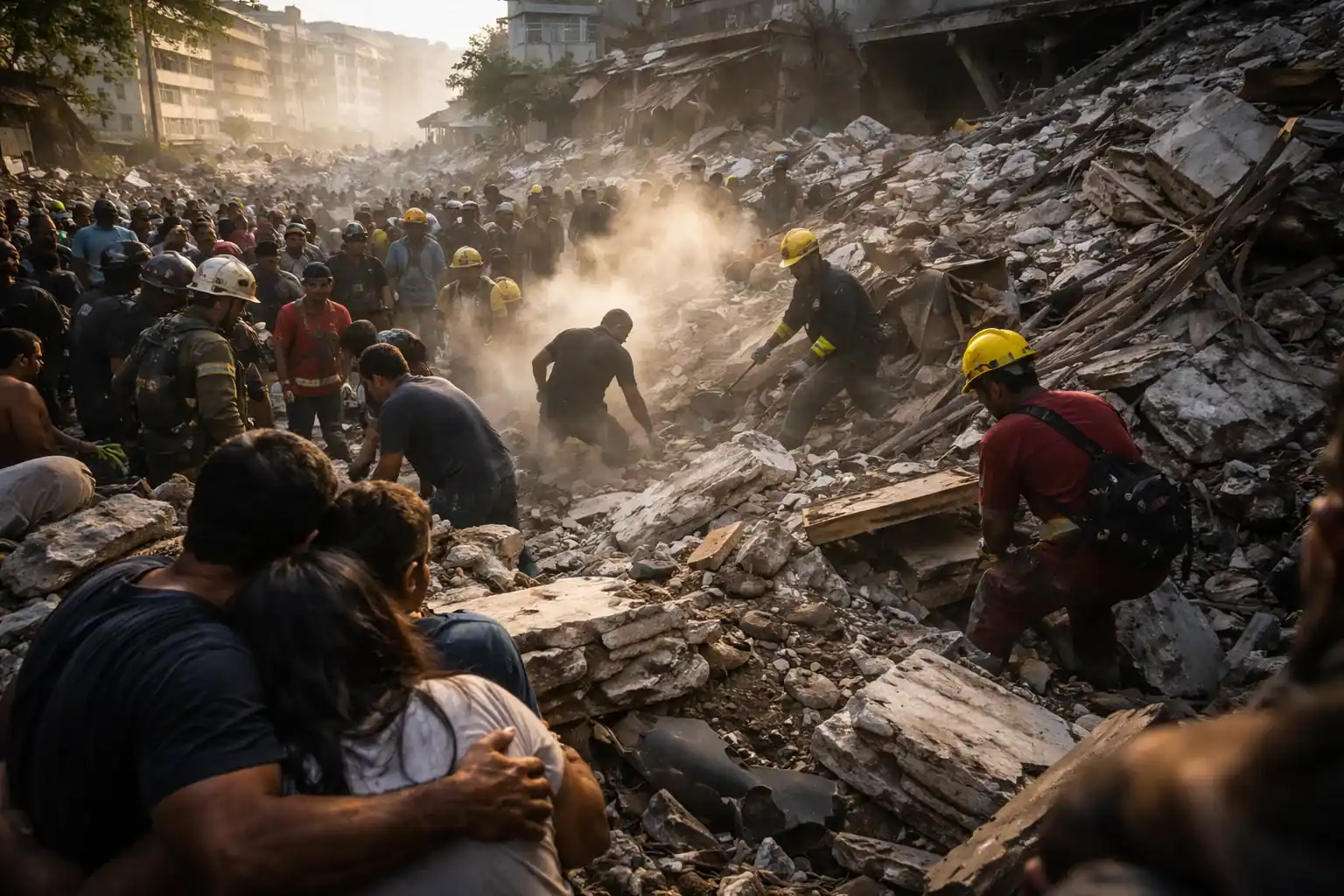
On Wednesday, Venezuela was struck by two consecutive earthquakes with magnitudes of 7.2 and 7.5, causing widespread devastation across the nation's coastal regions and the capital district. The stronger of the two quakes ranks as one of the most powerful seismic events recorded in the country over the last century. In the immediate aftermath, hundreds of buildings collapsed, particularly in the state of La Guaira, which borders Caracas. Currently, official records confirm at least 1,430 fatalities, but the United Nations estimates that approximately 50,000 people remain missing. The scale of the destruction is most visible in towns like Catia La Mar, where the infrastructure has been almost entirely leveled, leaving thousands of residents without shelter or access to basic services. This disaster has triggered a massive internal mobilization to locate those still trapped beneath the concrete and metal wire debris.
What's new in this update
The rescue operation is entering a critical phase as the 48-to-72-hour golden window for finding survivors alive begins to close. Families in La Guaira are desperately calling out into the rubble, hoping for any sign of life from loved ones. In one instance, the relatives of 31-year-old Carlos Eduardo reported hearing groans and muffled responses from beneath a collapsed structure, though communication has since fallen silent. International specialist teams from Mexico, Spain, the United States, and the United Kingdom have now touched down and joined local efforts. Despite this influx of expert help, the sheer volume of debris remains overwhelming. Mexican volunteers and soldiers have implemented periods of absolute silence at search sites, using drones and acoustic sensors to detect any faint sounds of life, while families like that of Jean Suárez wait anxiously nearby for any news of their missing relatives.
Key details
A significant hurdle for the rescue operation is the lack of heavy machinery and sophisticated excavation equipment in the most affected coastal zones. Residents have been forced to shift heavy rubble using only shovels and their bare hands, a process that is both dangerously slow and physically exhausting. Interim President Delcy Rodríguez has stated that the government is deploying a comprehensive rescue response, but local observers note that national resources are stretched thin. Traffic congestion and large crowds gathering around collapse sites have occasionally hindered the movement of emergency vehicles and specialized teams. Humanitarian agencies have emphasized that while the first three days are vital, the survival window can be extended if trapped individuals have access to air pockets, food, or water. However, the structural instability of the remaining buildings continues to pose a severe risk to both survivors and the rescuers attempting to reach them.
Background and context
Venezuela has a history of seismic activity, but the magnitude 7.5 earthquake is a generational event that surpasses recent memory in its intensity and destructive power. The state of La Guaira, being a coastal hub and a neighbor to the Caracas capital district, is a vital economic and residential corridor, making the high casualty count even more impactful for the nation's core functions. Jorge Rodríguez, president of the National Assembly, has publicly committed to transparency regarding the scale of the tragedy, asserting that the government will not hide the extent of the loss. This disaster occurs against a backdrop of existing economic challenges, which has complicated the initial mobilization of heavy equipment and medical supplies. The arrival of international aid underscores the severity of the crisis, as the global community reacts to what is quickly becoming one of the most significant humanitarian emergencies in South America this decade.
What to watch next
In the coming days, the primary focus will remain on the search for the estimated 50,000 missing persons. As more specialized equipment arrives from international partners, the pace of debris removal is expected to accelerate, which will likely lead to a sharp increase in the confirmed death toll. The Venezuelan government and international aid agencies will need to coordinate long-term shelter and medical care for the tens of thousands of displaced citizens whose homes were destroyed. Watch for updates regarding the restoration of power and water services in La Guaira and Catia La Mar, as these are essential for preventing secondary health crises. Additionally, the international community's continued involvement will be scrutinized, as the need for long-term reconstruction funds and humanitarian assistance will persist long after the initial search and rescue phase concludes.
Why it matters
This disaster represents one of the strongest seismic events in Venezuela’s modern history, testing the country's fragile infrastructure and capacity for large-scale humanitarian response. The scale of the missing persons list suggests the death toll could rise significantly in the coming days.
Read next
Follow this story through the topic hub, more world coverage, and the latest updates.
Weekly briefing
Get the week's key developments in one concise email.
Get a fast catch-up on the biggest stories, the context behind them, and the links worth your time.
Cadence
Weekly, for a quick catch-up
Coverage
AI, business, world, security, sports
Format
Clear takeaways and useful context
Request the briefing
Leave your email to open a prepared request and get on the list for the weekly briefing.
About the byline
World correspondent
Leila Haddad covers world affairs, diplomacy, and humanitarian crises, with a focus on how fast-moving international developments affect public policy, conflict response, and cross-border institutions.
Sources and methodology