US Mobilizes Against Flesh-Eating Screwworm Outbreak in Texas
Agriculture officials have established a 20km control zone and plan to release hundreds of millions of sterile flies to prevent the parasite from

World correspondent
Reports on international affairs, diplomacy, and humanitarian developments with an emphasis on official statements, multilateral institutions, and regional context.
Editorial responsibility: Lead reviewer for geopolitics, international institutions, and crisis coverage
Primary source: BBC World News. Full source links and update notes are below.
Fast summary
Start here
- A New World Screwworm infection was confirmed in a calf in La Pryor, Texas, marking the first US case since 1966.
- The USDA containment plan requires breeding up to 600 million sterile flies per week, though current capacity is only 100 million.
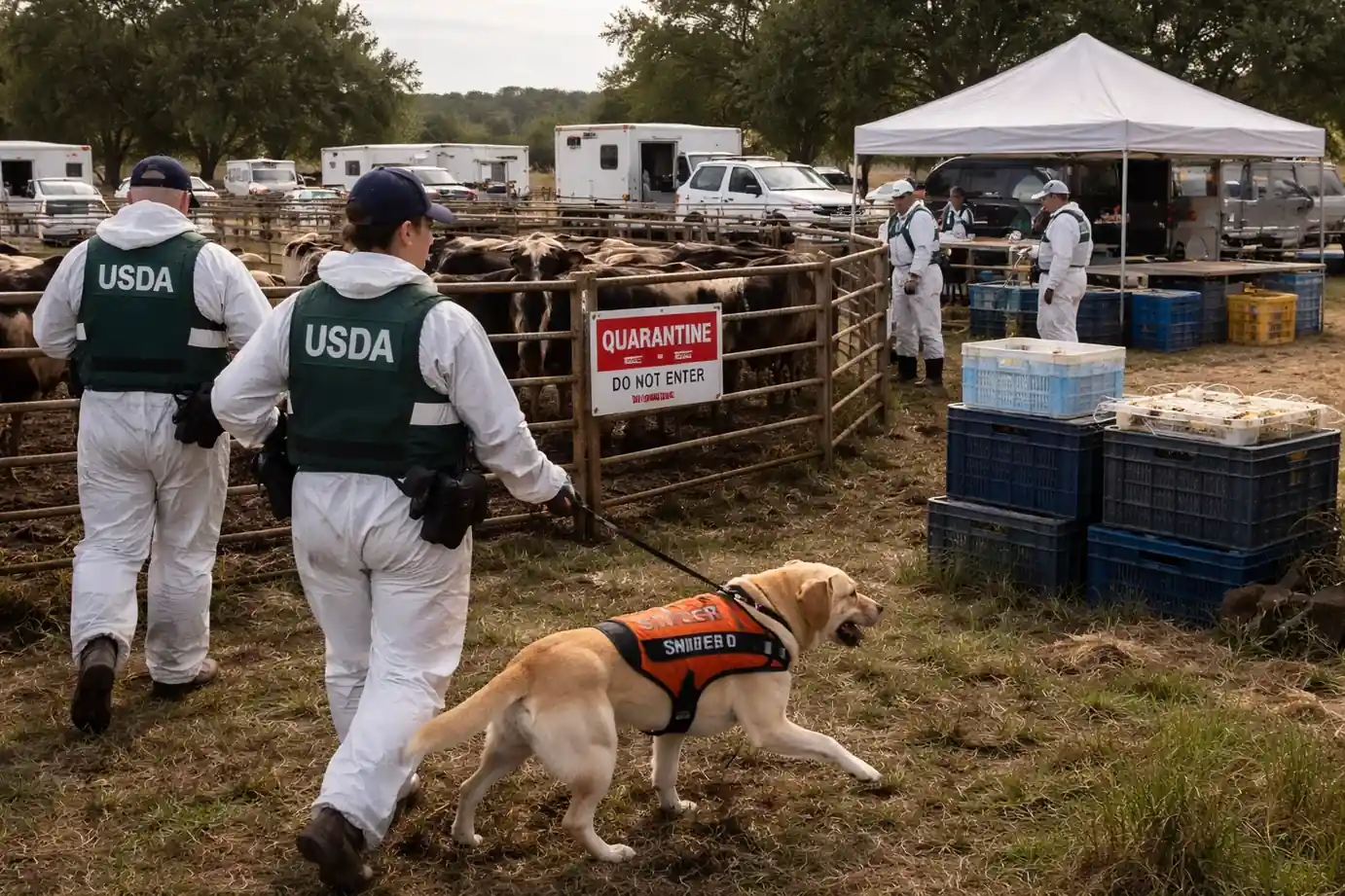
- A 20km-wide control zone with movement restrictions and sniffer dogs has been implemented near the Mexico border.
What happened
US agriculture and animal health officials have launched an emergency containment campaign after confirming New World Screwworm larvae in a calf in La Pryor, Texas. The case is the first detected in the United States since 1966 and has triggered immediate concern because the parasite can spread rapidly through livestock if not controlled early. Authorities say the infected calf was found roughly 30 miles from the Mexico border, placing the outbreak in a region where cattle movement and cross-border agricultural traffic are constant realities.
The response combines quarantine measures, insect surveillance, and one of the best-known pest-eradication tools in modern agriculture: mass releases of sterile male flies. Officials are also deploying trained sniffer dogs to help locate potential infestations, adding another layer to a containment effort that is being treated as both an animal-health emergency and a biosecurity threat.
What's new in this update
Agriculture Secretary Brooke Rollins said the federal response now includes weekly releases of sterile flies by both ground and air, with roughly four million distributed through each method. A 20-kilometer control zone has been established around the site where the parasite was found, and livestock movement rules have tightened to reduce the chance of the screwworm being transported to ranches farther north.
That response reflects how seriously officials are treating even a single confirmed case. Because screwworm larvae feed on living tissue rather than dead matter, a localized outbreak can quickly become a major threat to cattle, wildlife, pets, and, in rare circumstances, humans. Early action is therefore considered critical.
Key details
The central strategy is the Sterile Insect Technique, which involves breeding large numbers of male flies, sterilizing them with radiation, and releasing them into the wild. Female screwworm flies mate only once. If that single mating is with a sterile male, the eggs fail to hatch and the population gradually collapses. The method helped eliminate the pest from the United States decades ago and remains the foundation of current containment planning.
The challenge is scale. USDA officials have said they may need as many as 600 million sterile flies each week to fully suppress the threat, yet present production capacity in the United States and Mexico is closer to 100 million. Ranchers and veterinary experts are therefore watching whether the government can expand output quickly enough to keep the outbreak from becoming entrenched.
Background and context
The New World Screwworm was once one of the most damaging livestock pests in the Americas. It was pushed south over many years through coordinated eradication campaigns, eventually being contained beyond Panama's Darien Gap. But outbreaks farther south and gradual northward movement have remained a persistent risk, especially as climate conditions, transport links, and animal movement patterns change.
The parasite is dangerous because it lays eggs in open wounds or mucous membranes. Once the larvae hatch, they burrow into living flesh, worsening the wound and potentially killing untreated animals. That makes ranch surveillance especially important in hot-weather regions where injuries, branding marks, and insect exposure are common.
What to watch next
The next key test is whether the current Texas control zone is enough to prevent additional detections. Officials will be monitoring nearby ranches, transport routes, and wildlife populations, while industry groups will be pressing for more sterile-fly capacity and faster cross-border coordination with Mexican authorities.
If new cases appear outside the quarantine ring, the response could widen quickly and become more disruptive for cattle movement and local producers. If the campaign succeeds early, however, it may prevent a much larger agricultural and market shock.
Why this matters
The immediate public-health risk to people is relatively low, but the livestock risk is substantial. A wider screwworm outbreak could drive animal losses, raise treatment costs, disrupt cattle shipments, and put added pressure on beef markets. That is why officials are treating this not as an isolated veterinary issue, but as a serious test of agricultural preparedness.
Reader context
This story belongs to Northstar Herald's International Relations coverage, with related entities including USDA, Texas, Public Health, Livestock Industry. The report is based on BBC World News source material.
Related coverage
Why it matters
While the threat to humans is low, an uncontrolled screwworm outbreak could devastate the American cattle industry and significantly impact beef markets.
Read next
Follow this story through the topic hub, more world coverage, and the latest updates.
Weekly briefing
Get the week's key developments in one concise email.
Get a fast catch-up on the biggest stories, the context behind them, and the links worth your time.
Cadence
Weekly, for a quick catch-up
Coverage
AI, business, world, security, sports
Format
Clear takeaways and useful context
Request the briefing
Leave your email to open a prepared request and get on the list for the weekly briefing.
About the byline
World correspondent
Leila Haddad covers world affairs, diplomacy, and humanitarian crises, with a focus on how fast-moving international developments affect public policy, conflict response, and cross-border institutions.
Sources and methodology