Bangkok Bar Fire Death Toll Rises to 30 as Safety Probes Begin
Authorities probe locked exits and flammable decor after a deadly blaze at a Bangkok bar kills 30, highlighting gaps in Thai safety regulations.

World correspondent
Reports on international affairs, diplomacy, and humanitarian developments with an emphasis on official statements, multilateral institutions, and regional context.
Editorial responsibility: Lead reviewer for geopolitics, international institutions, and crisis coverage
Primary source: BBC World News. Full source links and update notes are below.
Fast summary
Start here
- The confirmed death toll from the Rong Beer Na Lat Phrao fire has reached 30, with 24 survivors still in critical condition.
- Fire safety experts found that emergency exits were locked or obstructed by furniture, trapping patrons inside the burning building.
- The venue used highly flammable decorative materials and lacked the fire-retardant protections required for official entertainment venues.
What happened
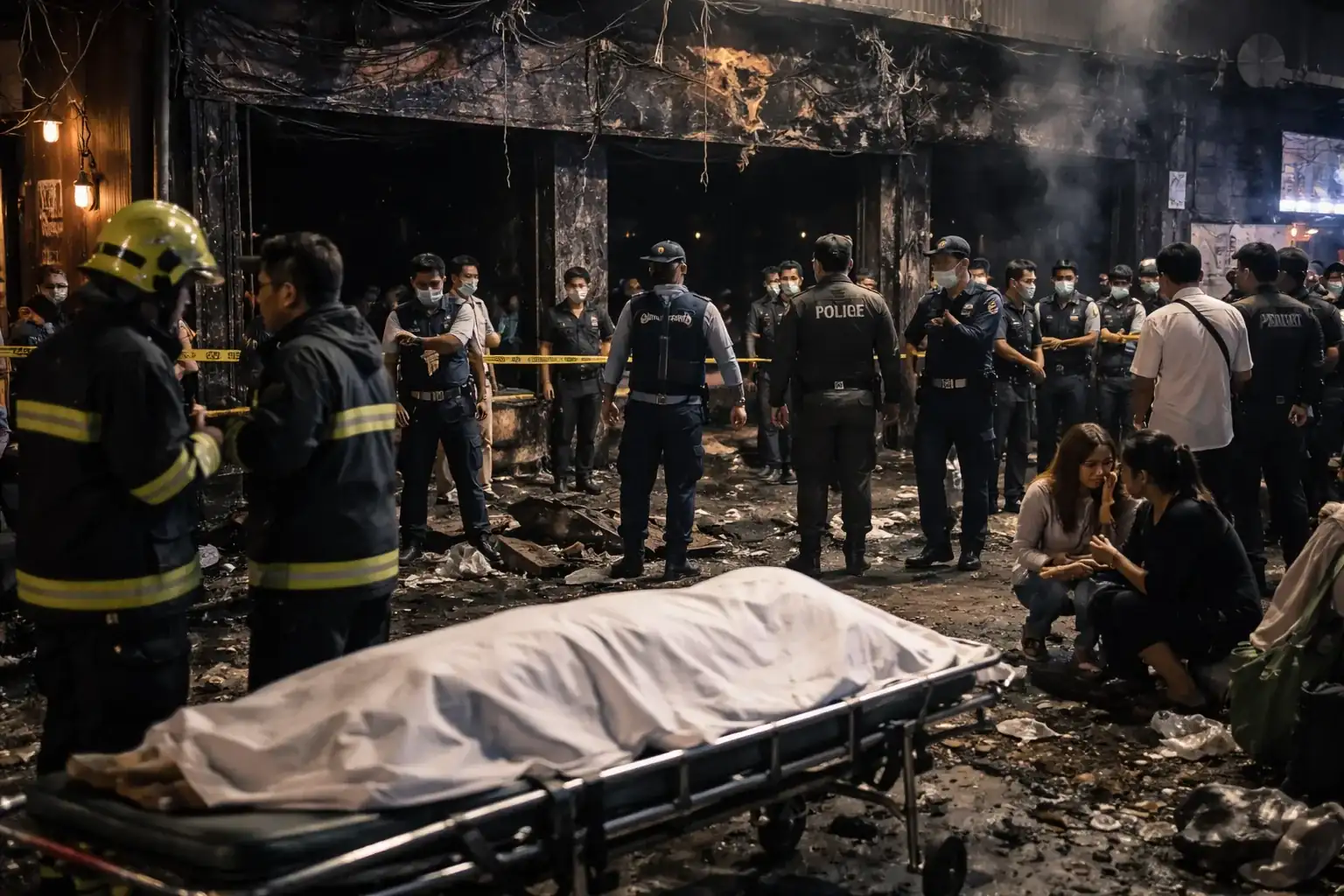
A catastrophic fire that tore through a popular Bangkok bar on Sunday night has now claimed the lives of 30 people. The incident occurred at Rong Beer Na Lat Phrao while the Thai indie band Thotsakan was performing for a crowded room. As of Tuesday morning, authorities have successfully identified 27 of the deceased victims, while the medical community continues to treat more than 70 individuals for various degrees of injury. Among the survivors, 24 remain in critical condition, battling severe burns and the effects of smoke inhalation. The blaze reportedly erupted near the stage area and spread with terrifying speed, plunging the venue into darkness as power lines were severed. First responders described a grim scene, discovering many of the victims clustered in the restrooms at the back of the building, where they had apparently sought safety after finding their primary escape routes blocked.
What's new in this update
Thai police have officially launched a negligence investigation into the management of the establishment, with Police General Kittiratt Phanphet citing a blatant disregard for patron safety. New evidence from site inspectors suggests that the tragedy was exacerbated by systemic failures in emergency preparedness. Busakorn Saensuk, a fire safety expert from the Engineering Institute of Thailand, conducted a post-fire inspection and confirmed that a critical emergency exit located near the restrooms was locked at the time of the fire. Furthermore, survivors have reported that the two main entrance doors were partially obstructed by furniture and other equipment, making a swift evacuation nearly impossible. The lack of illuminated emergency signage meant that patrons, disoriented by the thick smoke and sudden darkness, were unable to find the manual releases for the locked doors, leading to a fatal bottleneck at the rear of the bar.
Key details
Preliminary forensic investigations point to an electrical short circuit in an air conditioning unit as the likely cause of the initial spark. However, it was the interior composition of the bar that turned a localized fire into a lethal inferno. Professor Worsak Kanok Nukulchai, a specialist in structural engineering, explained that the stage was decorated with highly flammable plastic flowers, while the ceiling was lined with combustible foam used for soundproofing. When these materials ignited, they released a deadly combination of carbon monoxide and hydrogen cyanide, often referred to by experts as the 'toxic twins' of fire smoke. This chemical cocktail is so potent that many victims likely lost consciousness or died from inhalation before the flames ever reached them. The rapid ignition of the foam ceiling meant the entire interior was engulfed in a matter of seconds, leaving almost no time for a coordinated exit.
Background and context
The disaster has brought intense scrutiny to the regulatory classification of nightlife venues in Thailand. Bangkok authorities confirmed that Rong Beer Na Lat Phrao was officially registered as a 'restaurant with live music' rather than an 'entertainment venue.' This administrative distinction allowed the establishment to operate under less stringent fire safety codes, specifically exempting it from the requirement to use fire-retardant construction and decoration materials. This loophole is a known issue in urban planning, where businesses seek restaurant status to avoid the higher costs and stricter inspections associated with nightclub licenses. Compounding the tragedy is the revelation that the bar's owner has a prior history with fire-related incidents. In December 2019, another pub owned by the same individual in Thailand's Yasothon province was completely destroyed by a fire. While that event occurred during the day and caused no casualties, it highlights a recurring failure to implement basic safety standards.
What to watch next
Bangkok's Metropolitan Administration has announced an immediate review of all safety regulations governing the materials allowed in both restaurants and entertainment venues. This policy shift aims to close the loophole that allowed Rong Beer Na Lat Phrao to bypass fire-retardant mandates. In the legal sphere, the negligence probe is expected to lead to criminal charges against the owner and management as police finalize their report on the locked exits and lack of signage. The Thai music community continues to mourn, as the band Thotsakan confirmed the loss of two members in the fire. Moving forward, advocacy groups are calling for a nationwide audit of high-occupancy venues to ensure that emergency exits are never obstructed. Public pressure is mounting for the government to mandate visible, battery-backed emergency lighting and to hold inspectors accountable for missing clear violations during previous building safety checks.
Why it matters
This tragedy exposes critical failures in urban building safety enforcement and regulatory loopholes that allow high-occupancy venues to operate with minimal fire protection.
Read next
Follow this story through the topic hub, more world coverage, and the latest updates.
Weekly briefing
Get the week's key developments in one concise email.
Get a fast catch-up on the biggest stories, the context behind them, and the links worth your time.
Cadence
Weekly, for a quick catch-up
Coverage
AI, business, world, security, sports
Format
Clear takeaways and useful context
Request the briefing
Leave your email to open a prepared request and get on the list for the weekly briefing.
About the byline
World correspondent
Leila Haddad covers world affairs, diplomacy, and humanitarian crises, with a focus on how fast-moving international developments affect public policy, conflict response, and cross-border institutions.
Sources and methodology