US Mobilizes Against Flesh-Eating Screwworm Outbreak in Texas
Agriculture officials have established a 20km control zone and plan to release hundreds of millions of sterile flies to prevent the parasite from spreading.
Primary source: BBC World News. Full source links and update notes are below.
Fast summary
Start here
- A New World Screwworm infection was confirmed in a calf in La Pryor, Texas, marking the first US case since 1966.
- The USDA containment plan requires breeding up to 600 million sterile flies per week, though current capacity is only 100 million.
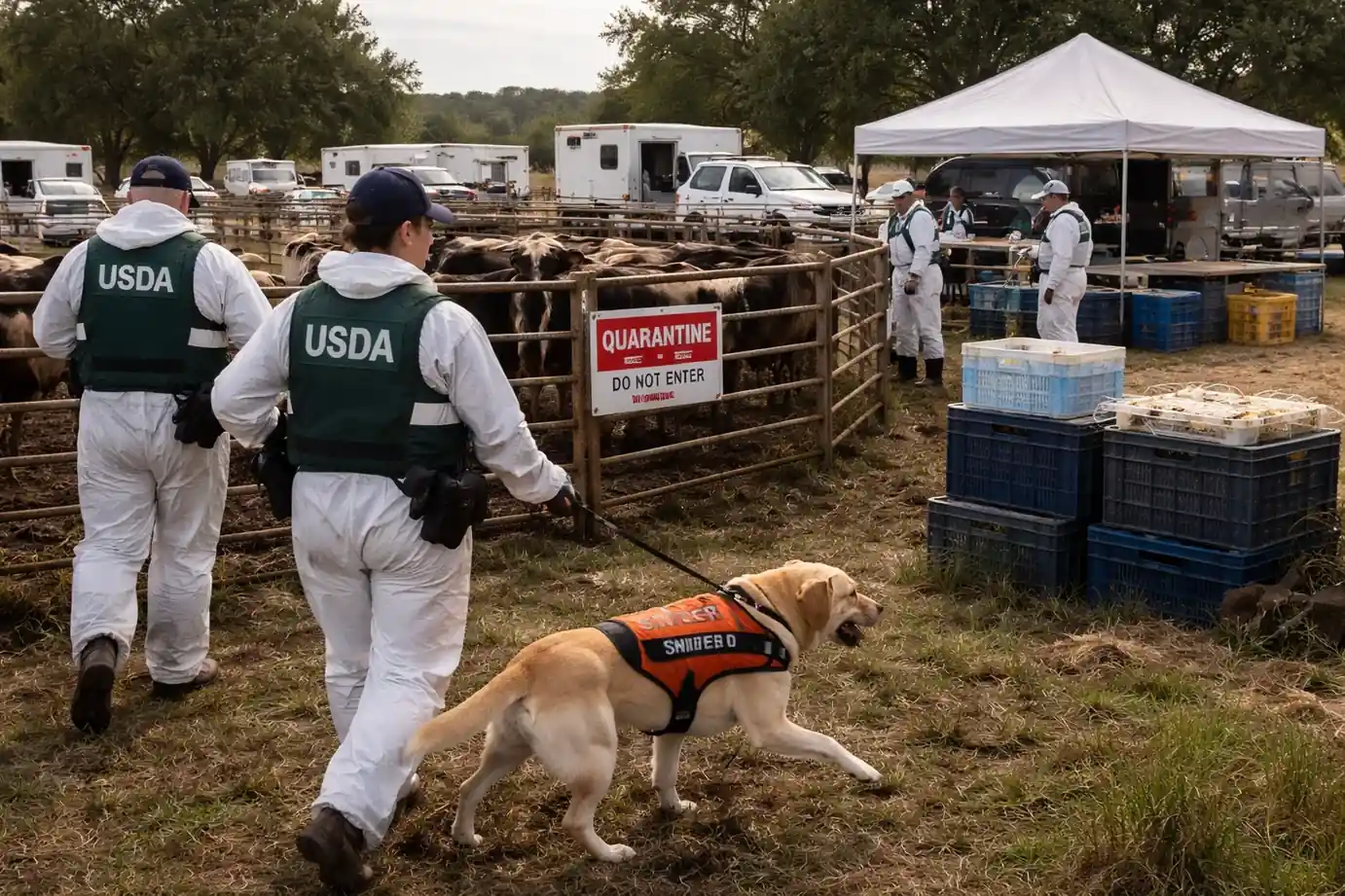
- A 20km-wide control zone with movement restrictions and sniffer dogs has been implemented near the Mexico border.
What happened
US agriculture and health officials have activated an emergency response plan following the discovery of New World Screwworm larvae in a three-week-old calf in La Pryor, Texas. The town is located approximately 30 miles from the Mexico border. This detection represents the first time the flesh-eating parasite has been found in the United States since 1966, sparking immediate concerns for the regional livestock industry.
What's new in this update
US Secretary of Agriculture Brooke Rollins announced that officials are now releasing four million sterile flies by ground and four million by air on a weekly basis. A 20km 'control zone' has been established around the infection site, where the Department of Agriculture is implementing quarantines, movement controls, and surveillance. Sniffer dogs are also being deployed to detect the presence of the insects in the area.
Key details
The containment effort relies on the Sterile Insect Technique, where flies are hatched in facilities, sterilized via radiation, and released to mate with wild females. Because females only mate once, the resulting eggs do not hatch, eventually collapsing the population. However, entomologists note a significant supply gap; while the USDA estimates a need for 600 million flies per week to halt the outbreak, current facilities in the US and Mexico only produce about 100 million.
Background and context
The New World Screwworm was largely eradicated in the US decades ago, with the population pushed south of Panama's Darien Gap by the 1970s. However, the parasite has recently trended northward, with Panama reporting a surge in cases in 2022. The larvae are particularly dangerous because they burrow into the living flesh of warm-blooded animals through open wounds, which can be fatal if the host is left untreated.
What to watch next
Cattle ranchers in Texas have expressed concern that the current scale of sterile fly releases may be insufficient to prevent the parasite from establishing a permanent presence. Observers are monitoring whether the USDA can successfully ramp up production at its joint facilities with Mexico and whether the localized quarantine in La Pryor will be enough to stop the spread through human-facilitated transport.
Why it matters
While the threat to humans is low, an uncontrolled screwworm outbreak could devastate the American cattle industry and significantly impact beef markets.
Read next
Follow this story through the topic hub, more world coverage, and the latest updates.
Weekly briefing
Get the week's key developments in one concise email.
Get a fast catch-up on the biggest stories, the context behind them, and the links worth your time.
Cadence
Weekly, for a quick catch-up
Coverage
AI, business, world, security, sports
Format
Clear takeaways and useful context
Request the briefing
Leave your email to open a prepared request and get on the list for the weekly briefing.
Author
See who assembled this story and follow more of their work.
Sources and methodology