Global Mangrove Forests Staging Significant Recovery
After decades of rapid decline, new satellite data reveals that mangrove forests have begun to expand globally as conservation efforts and natural regrowth take hold.
Primary source: BBC World News. Full source links and update notes are below.
Fast summary
Start here
- Since 2010, the world has seen a net increase in mangrove coverage as gains from restoration and natural expansion outpace human-driven losses.
- Public awareness sparked by the 2004 Indian Ocean tsunami and 2008 Cyclone Nargis led to stronger legal protections in high-density regions like Indonesia and Myanmar.
- Advanced Landsat satellite imaging allowed researchers to identify new growth and canopy changes that previous global assessments had missed.
What happened
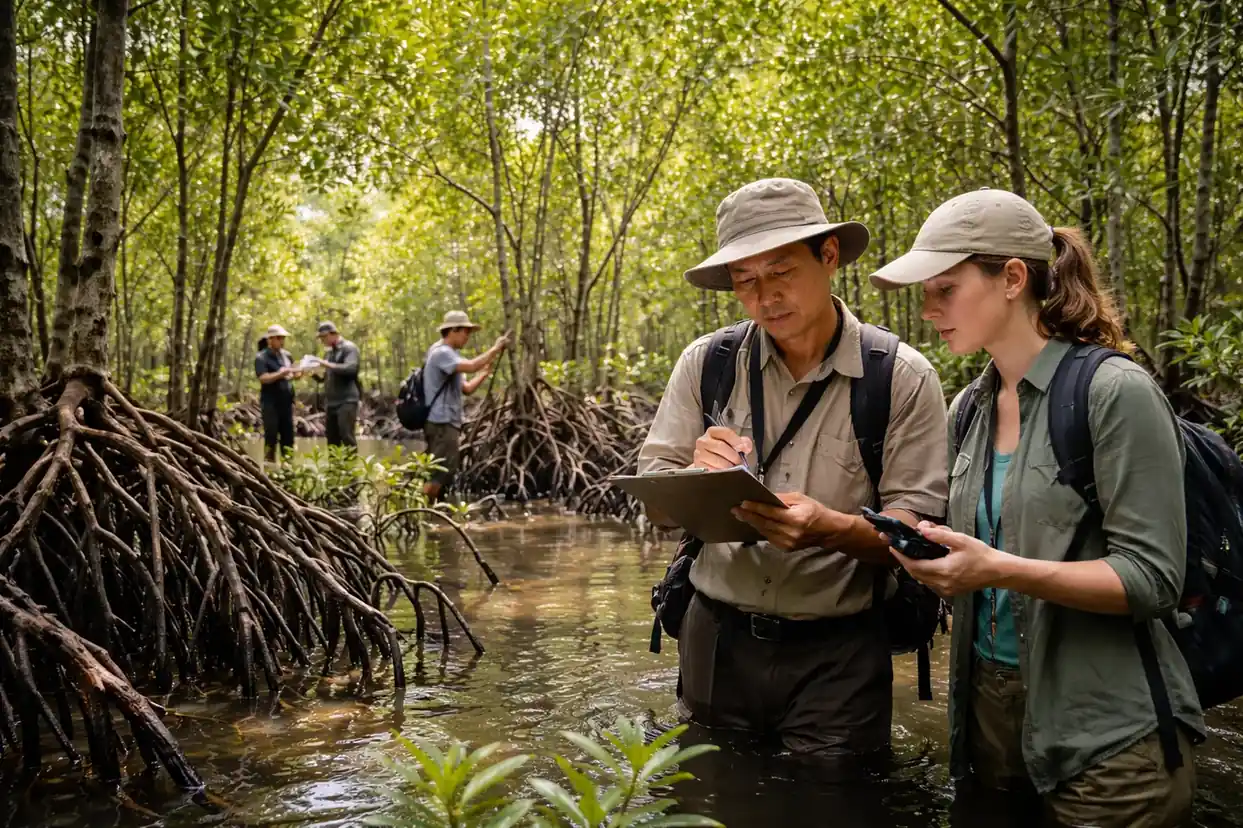
A study led by researchers at Tulane University found that the trend of rapid mangrove loss has reversed, with global levels stabilizing or growing since 2010. While over 12,000 square kilometers were cleared between 1980 and 2010, recent years have seen restoration efforts and natural regeneration significantly offset the impact of fish farming and urban expansion. The research indicates that once human interference ceases, these forests possess a remarkable capacity to recover on their own.
What's new in this update
The findings leverage high-resolution Landsat satellite imagery, which provides more granular data on canopy changes than previous methodologies. This technology revealed that many mangroves are regenerating naturally in areas where human activity has decreased. In countries like Indonesia and Myanmar—two of the most mangrove-dense nations—forest levels have stabilized or expanded following national logging bans and shifts in coastal management policy.
Key details
Mangroves provide essential ecosystem services, acting as nurseries for marine life and natural barriers against tsunamis. The study notes that total net losses since the 1980s have been reduced to approximately 849 square kilometers globally. However, researchers noted a potential trade-off: some expansion in regions like Brazil may be linked to nutrient-rich sediment runoff, such as nitrogen, caused by upstream mining and deforestation flushing minerals into the coastal ecosystem.
Background and context
For decades, mangrove forests were cleared at alarming rates to make room for agriculture, coastal housing, and aquaculture, particularly shrimp farming. A turning point in public perception occurred after the 2004 Indian Ocean tsunami, when it became evident that coastal communities with intact mangrove systems suffered significantly less damage. This realization led to a surge in conservation initiatives and stricter enforcement of coastal protections across Asia, Africa, and the Americas.
What to watch next
Scientists are monitoring whether this recovery trend can withstand the continued pressures of climate change and rising sea levels. While legal protections have slowed direct human-driven destruction, the long-term health of these ecosystems depends on maintaining the specific water quality and sediment balance that allow natural regeneration to persist in the face of warming global temperatures.
Why it matters
Mangroves are critical environmental shields that store five times more carbon than land-based forests and protect coastal communities from devastating storm surges.
Read next
Follow this story through the topic hub, more world coverage, and the latest updates.
Weekly briefing
Get the week's key developments in one concise email.
Get a fast catch-up on the biggest stories, the context behind them, and the links worth your time.
Cadence
Weekly, for a quick catch-up
Coverage
AI, business, world, security, sports
Format
Clear takeaways and useful context
Request the briefing
Leave your email to open a prepared request and get on the list for the weekly briefing.
Author
See who assembled this story and follow more of their work.
Sources and methodology