Hegseth Criticizes 'Free-Riding' Allies, Announces Review of US Troops in Europe
The six-month assessment, termed 'Nato 3.0,' will evaluate ally defense spending and cooperation as the U.S. scales back high-readiness commitments.
Primary source: BBC World News. Full source links and update notes are below.
Fast summary
Start here
- A six-month review will determine the future of U.S. force posture in Europe, with results varying by individual country performance.
- U.S. dues to Nato will become contingent on member states meeting a new 5% GDP defense spending target.
- The U.S. is already reducing commitments to the Nato Force Model, specifically regarding air and naval capabilities.
What happened
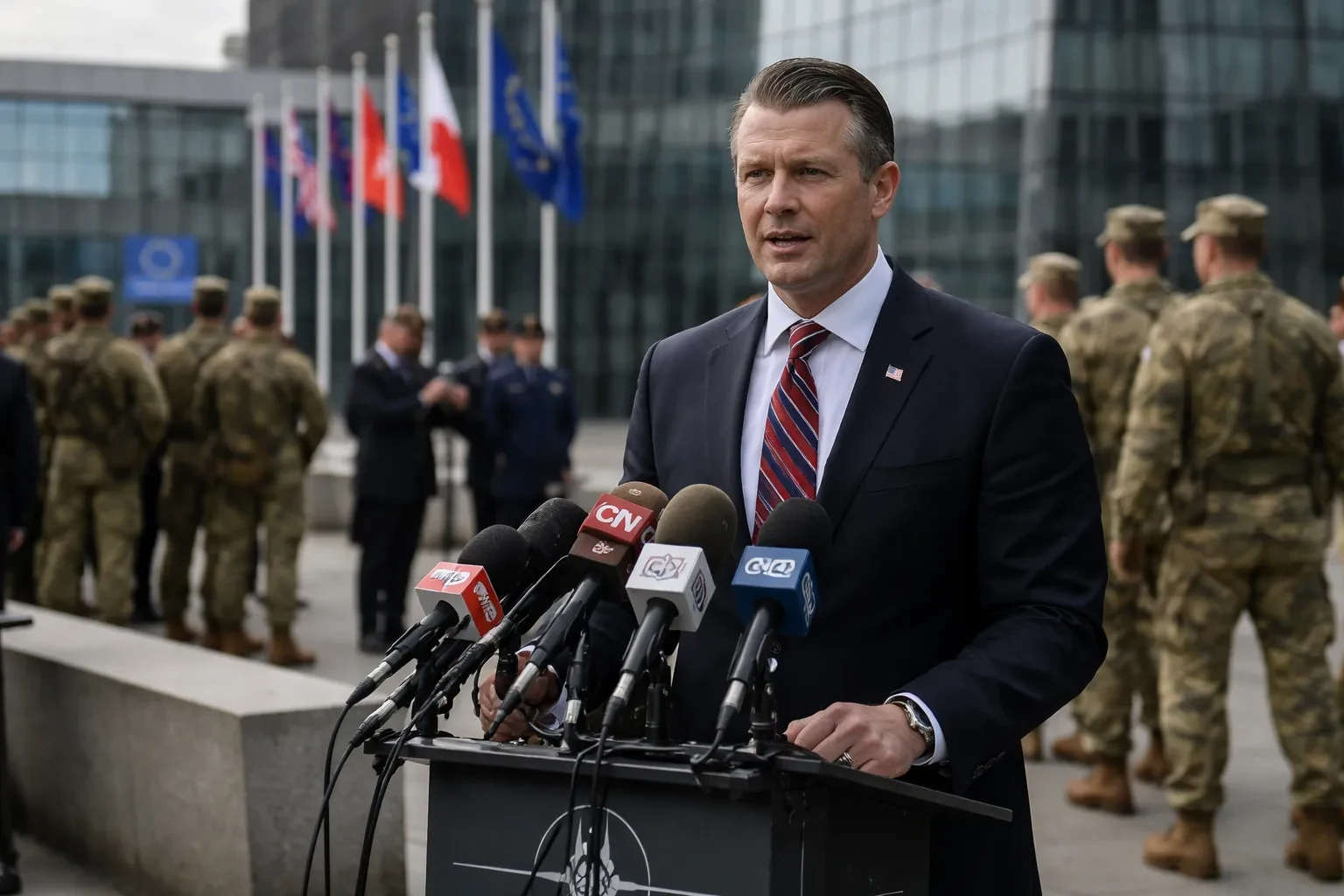
U.S. Defense Secretary Pete Hegseth announced a six-month review of the American military presence in Europe during a meeting of Nato defense ministers in Brussels. Hegseth characterized the review, which he called 'Nato 3.0,' as a measure to ensure European nations lead on continental security. He warned that the results of the review would vary by country, stating that while some allies would 'pass with flying colors,' others would 'fail' based on their contributions and cooperation.
What's new in this update
The U.S. is making its annual dues to Nato contingent on allies meeting specific defense spending targets. Hegseth specifically targeted 'free-riding' nations among Nato's largest and wealthiest economies. Furthermore, the U.S. has begun scaling back its commitments to the Nato Force Model (NFM), a high-readiness framework. Nato Secretary-General Mark Rutte confirmed these changes are taking effect immediately and noted that European allies are already attempting to 'backfill' the resources the U.S. is withdrawing.
Key details
The U.S. is pushing for a defense spending target of 5% of national GDP, divided into 3.5% for core defense and 1.5% for related infrastructure. Hegseth also expressed sharp criticism for member states that imposed limits on assistance to U.S. forces during the recent conflict with Iran. While the specific countries facing troop reductions were not named in the review announcement, a U.S. official noted that no outcomes have been predetermined.
Background and context
The announcement follows recent volatility in U.S. troop deployments across the continent. In May, the U.S. announced the withdrawal of 5,000 troops from Germany following a dispute between President Trump and Chancellor Friedrich Merz. Similar uncertainty has affected Poland, where a withdrawal plan for 4,000 troops was recently reversed in favor of a 5,000-troop deployment. Meanwhile, Spain recently faced trade threats after refusing the use of air bases for operations against Iran.
What to watch next
The focus shifts to how individual European nations will respond to the 5% spending demand and the impending six-month deadline. Poland’s Defense Minister Władysław Kosiniak-Kamysz indicated that Warsaw is pursuing a permanent U.S. base, a decision currently pending further negotiation. In the UK, Defense Secretary Dan Jarvis attended the summit without a formal investment plan, following the resignation of his predecessor who warned that current plans fall short of national needs.
Why it matters
This review signals a potential shift in the transatlantic security architecture, pressuring European nations to take primary responsibility for their own defense while the U.S. reduces its regional footprint.
Read next
Follow this story through the topic hub, more world coverage, and the latest updates.
Weekly briefing
Get the week's key developments in one concise email.
Get a fast catch-up on the biggest stories, the context behind them, and the links worth your time.
Cadence
Weekly, for a quick catch-up
Coverage
AI, business, world, security, sports
Format
Clear takeaways and useful context
Request the briefing
Leave your email to open a prepared request and get on the list for the weekly briefing.
Author
See who assembled this story and follow more of their work.
Sources and methodology