Uganda's Leading Independent Media Outlets Shuttered by Military
General Muhoozi Kainerugaba, the army chief and son of President Yoweri Museveni, has placed major newsrooms under siege, claiming he does not believe in a

World correspondent
Reports on international affairs, diplomacy, and humanitarian developments with an emphasis on official statements, multilateral institutions, and regional context.
Editorial responsibility: Lead reviewer for geopolitics, international institutions, and crisis coverage
Primary source: BBC World News. Full source links and update notes are below.
Fast summary
Start here
- Military forces have surrounded the headquarters of the Daily Monitor in Kampala, forcing major TV and radio outlets off the air.
- General Muhoozi Kainerugaba explicitly stated on social media that he intends to control the press through revolutionary cadres.
- The crackdown targets the Nation Media Group, one of East Africa's most prominent and influential independent media organizations.
What happened
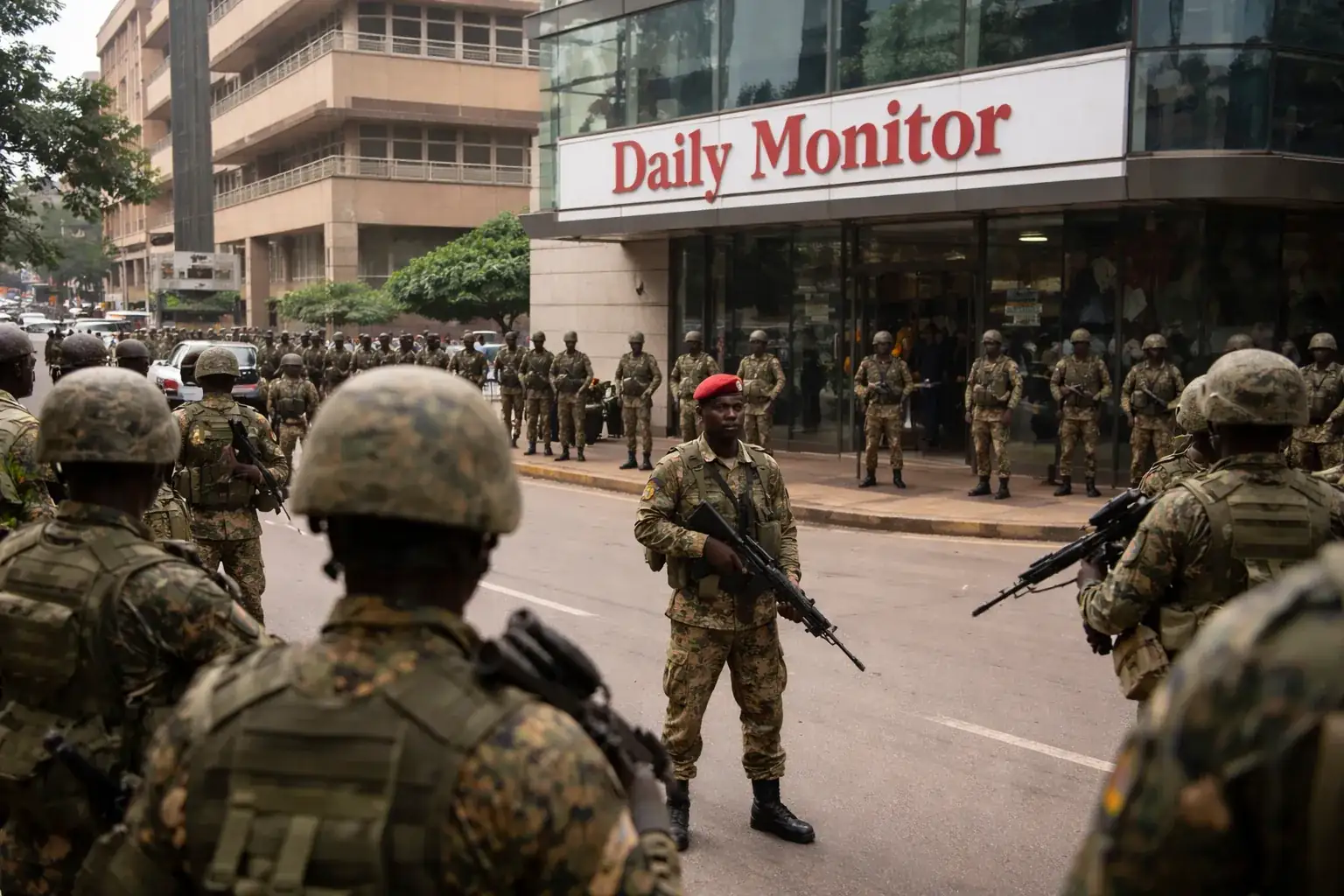
In a sudden and aggressive escalation against independent journalism, Ugandan military forces have established what local journalists are calling a 'military siege' around the country's most prominent media houses. General Muhoozi Kainerugaba, the Chief of Defence Forces and son of President Yoweri Museveni, ordered the immediate closure of several influential outlets. Among the primary targets is the Daily Monitor newspaper, whose headquarters in Kampala was surrounded by armed soldiers in the early hours of Sunday. Simultaneously, major television broadcasters including NTV Uganda and Spark TV were forcibly removed from the airwaves. Viewers across the country reported seeing blank screens or error messages where news programming once aired. This coordinated operation marks one of the most severe direct attacks on the Ugandan press in over a decade, effectively silencing the most significant independent voices in the nation's capital.
What's new in this update
The most striking development in this latest crackdown is the transparency with which the army chief has dismissed the concept of media independence. In a series of posts on the social media platform X, General Kainerugaba stated bluntly, 'I DO NOT believe in a free press!' He further asserted that the media must henceforth be 'guided by cadres of the revolution,' suggesting that the state intends to replace independent editorial oversight with ideological control. Kainerugaba claimed that his father, President Museveni, had granted him the specific authority to shut down any media house at his discretion. He warned that the affected outlets, particularly NTV and the Daily Monitor, would not be permitted to resume operations without his personal authorization. These statements represent a departure from previous government efforts to use legal or regulatory pretexts for media suppression, moving instead toward direct military decree.
Key details
The affected outlets are part of the Nation Media Group, a regional powerhouse in East African journalism that has long been a thorn in the side of the Museveni administration. Staff members at the Daily Monitor reported that they were prohibited from entering or leaving the compound during the military's initial surge, effectively trapping those inside and locking out the remaining workforce. This action is not an isolated incident but follows a history of hostility toward the publication. President Museveni has previously labeled the Daily Monitor an 'enemy' and an 'evil newspaper' due to its investigative reporting on government corruption and human rights abuses. The current shutdown occurs against a backdrop of increasing political tension, following a disputed January election where security forces were accused by international observers, including the United Nations, of creating an environment of widespread repression and intimidation.
Background and context
Uganda has been ruled by President Yoweri Museveni since 1986, when he took power as a rebel leader. Now 81 years old, Museveni recently secured a record seventh term in office, though opposition leaders and human rights organizations have consistently questioned the legitimacy of the electoral process. Central to the current political climate is the rising profile of General Kainerugaba. There is widespread speculation that the General is being groomed to succeed his father, a transition often referred to by critics as the 'Muhoozi Project.' In 2013, the Daily Monitor was raided by police after publishing a letter concerning this alleged succession plan. Furthermore, NTV was previously forced off the air in 2007 after the government accused it of negative news coverage. The military's current intervention suggests that the administration is no longer willing to tolerate dissent that might complicate the transition of power or challenge the family's 40-year legacy.
What to watch next
The immediate future of independent media in Uganda remains highly uncertain as the military maintains its presence at media headquarters. Observers are watching for reactions from international diplomatic bodies and human rights organizations, which have previously condemned the Museveni regime for its treatment of political opponents like Bobi Wine. The specific 'rules' mentioned by General Kainerugaba have yet to be formally outlined, but they likely involve strict censorship and the appointment of state-approved monitors within newsrooms. The international community will also be monitoring whether this crackdown extends to digital media and individual journalists' social media accounts, as the government continues to tighten its control over the flow of information ahead of what many expect to be a volatile period of political maneuvering for the presidency.
Why it matters
This military-led suppression of independent journalism signals a sharp decline in democratic norms in Uganda and likely points to a tightening grip on power as the 81-year-old president prepares for a potential dynastic succession.
Read next
Follow this story through the topic hub, more world coverage, and the latest updates.
Weekly briefing
Get the week's key developments in one concise email.
Get a fast catch-up on the biggest stories, the context behind them, and the links worth your time.
Cadence
Weekly, for a quick catch-up
Coverage
AI, business, world, security, sports
Format
Clear takeaways and useful context
Request the briefing
Leave your email to open a prepared request and get on the list for the weekly briefing.
About the byline
World correspondent
Leila Haddad covers world affairs, diplomacy, and humanitarian crises, with a focus on how fast-moving international developments affect public policy, conflict response, and cross-border institutions.
Sources and methodology