Taiwan Labels China's Fruit Import Pledges a 'Raise, Trap, Kill'
Taipei warns that Beijing's move to increase purchases of atemoya custard apples is a tactic to create economic reliance before imposing sudden market

World correspondent
Reports on international affairs, diplomacy, and humanitarian developments with an emphasis on official statements, multilateral institutions, and regional context.
Editorial responsibility: Lead reviewer for geopolitics, international institutions, and crisis coverage
Primary source: BBC World News. Full source links and update notes are below.
Fast summary
Start here
- Taiwan's agriculture ministry warned farmers that China uses large-scale purchases to build dependency before unilaterally cutting off market access.
- The warning follows a forum in Xiamen where Chinese companies pledged to expand imports of Taiwanese fruit, fish, and tea.
- Taiwanese officials who attended the Chinese forum despite an official ban may face investigation by the Mainland Affairs Council.
What happened
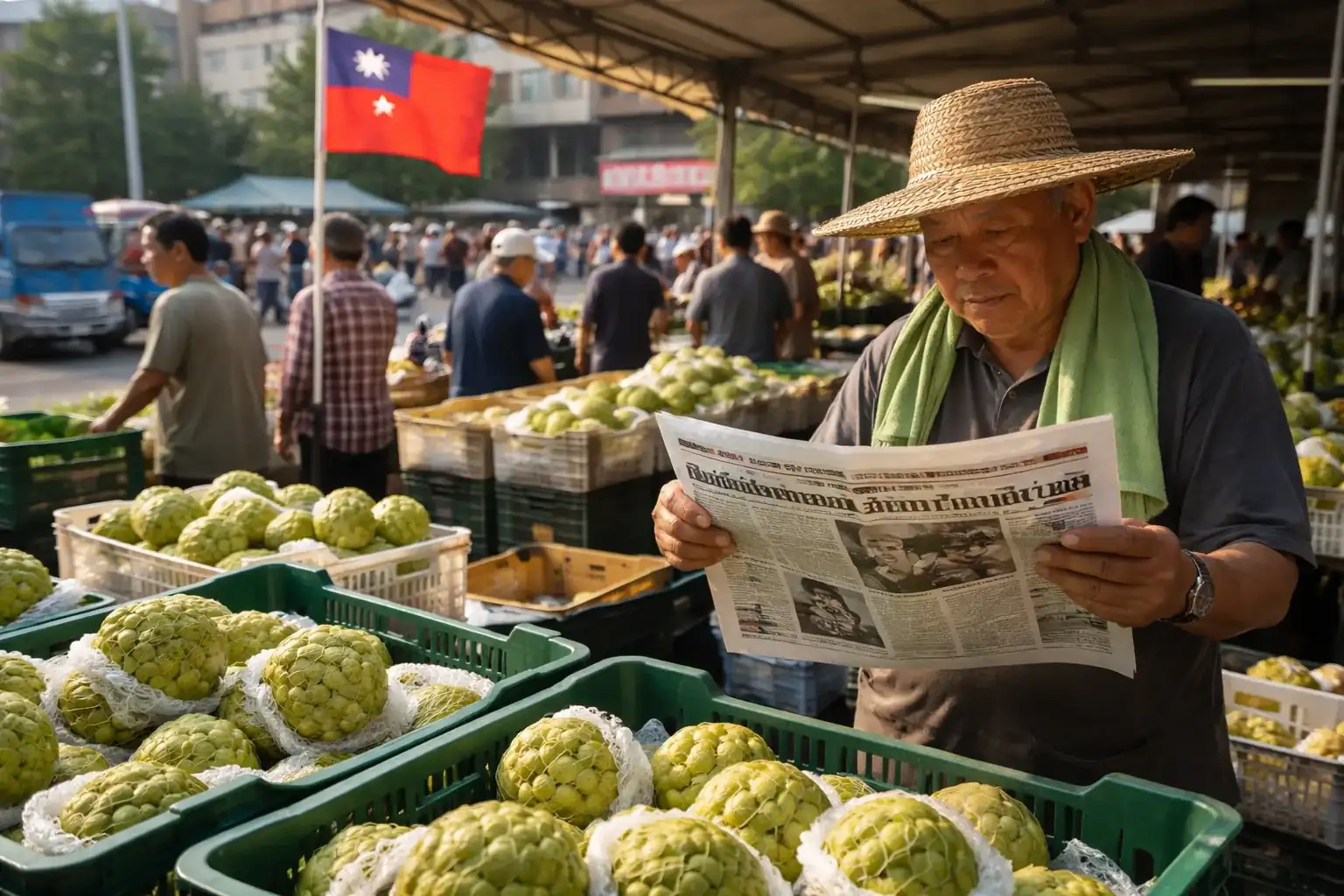
Taiwan has warned farmers not to trust new Chinese pledges to increase imports of Taiwanese fruit, arguing that such offers can be part of a broader strategy of economic dependence followed by sudden restriction. The immediate trigger is a new round of promises tied to atemoya custard apples and other agricultural goods, but Taipei's response makes clear that it sees the issue as political as much as commercial.
That makes the Taiwan fruit imports dispute about more than produce volumes. It is another chapter in the wider contest over how Beijing uses trade access, selective pressure, and economic incentives to shape behavior inside Taiwan.
Why Taipei is sounding the alarm
Taiwanese officials framed the Chinese approach with unusually blunt language, describing a pattern that can be summarized as attract, entangle, then punish. In practical terms, the fear is that farmers expand production around mainland demand, invest in logistics and market relationships, and then become vulnerable when China abruptly cites pests, customs problems, or regulatory changes to suspend access.
This warning is not theoretical. Taiwan has already experienced sudden disruptions affecting products such as pineapples and atemoya. That history gives the current government a stronger basis to argue that growers should treat new Chinese buying promises less as opportunity and more as strategic risk.
Why atemoya has become politically sensitive
Atemoya is not just another export crop. It is closely associated with Taitung County and carries economic and symbolic value for local agriculture. Because it is a specialty fruit, producers can be especially exposed if one major external market becomes dominant. That vulnerability makes atemoya an effective target for coercive trade pressure.
When China signals that it will buy more, the appeal is obvious. Demand support can stabilize prices and encourage expansion. But from Taipei's point of view, that same dependence can become a lever. If Beijing later tightens access, the resulting pain falls directly on farming communities that may have few equivalent alternatives in the short term.
The trade issue overlaps with domestic politics
The controversy widened after Taiwanese figures attended a forum in Xiamen despite central government restrictions on participation. That has turned an agricultural trade dispute into a domestic political fight over who gets to engage with China and on what terms. Opposition-linked actors may argue they are pursuing practical opportunities for farmers. The government argues that such forums can legitimize a coercive framework and undercut a national diversification strategy.
This matters because agricultural livelihoods can become politically potent very quickly. If farmers believe Taipei is blocking income, the government takes domestic heat. If officials allow deeper dependence on the mainland and China later cuts access again, the same government gets blamed for naivete.
Why diversification is the key policy response
Taiwan's answer appears to be diversification rather than denial that China is a huge market. Officials want farmers and processors to reduce reliance on fresh-fruit exports to the mainland by developing frozen products, puree, processed goods, and alternative destination markets. That approach is slower and sometimes less lucrative in the short run, but it is meant to make the sector harder to manipulate.
The strategy fits a broader Taiwanese view of economic security: resilience matters as much as raw export volume. In an environment where trade can be weaponized, a slightly less profitable but more diversified industry may be considered safer than one heavily dependent on a politically hostile buyer.
What to watch next
The next questions are whether China follows through with larger purchases, whether Taiwanese authorities investigate attendees at the Xiamen forum, and whether farmers accept the government's case that caution now is worth the lost upside. Watch also for how quickly Taitung producers can expand processing and alternative export channels, because that will determine whether the diversification message becomes a viable economic model or just a defensive slogan.
Why this matters
Taiwan's warning matters because it shows how ordinary trade flows can become instruments of geopolitical pressure. For Taipei, fruit imports are not a narrow farm issue. They are part of the larger struggle over coercion, dependence, and how to protect local industries from being turned into leverage in cross-strait politics.
Why it matters
The dispute highlights how Beijing uses agricultural trade as a tool of economic statecraft and coercion to exert political pressure on Taiwan's domestic industries.
Read next
Follow this story through the topic hub, more world coverage, and the latest updates.
Weekly briefing
Get the week's key developments in one concise email.
Get a fast catch-up on the biggest stories, the context behind them, and the links worth your time.
Cadence
Weekly, for a quick catch-up
Coverage
AI, business, world, security, sports
Format
Clear takeaways and useful context
Request the briefing
Leave your email to open a prepared request and get on the list for the weekly briefing.
About the byline
World correspondent
Leila Haddad covers world affairs, diplomacy, and humanitarian crises, with a focus on how fast-moving international developments affect public policy, conflict response, and cross-border institutions.
Sources and methodology