Ryanair Passenger Nearly Sucked Out of Window During Mid-Air
A passenger on a Ryanair flight was saved by his seatbelt after a cabin window dislodged, forcing an emergency return to Thessaloniki, Greece.

World correspondent
Reports on international affairs, diplomacy, and humanitarian developments with an emphasis on official statements, multilateral institutions, and regional context.
Editorial responsibility: Lead reviewer for geopolitics, international institutions, and crisis coverage
Primary source: BBC World News. Full source links and update notes are below.
Fast summary
Start here
- A Serbian passenger in his 60s was partially pulled through a broken window shortly after takeoff from Thessaloniki.
- Fellow passengers managed to pull the man back into the cabin after he was seen hanging out as far as his shoulders.
- The Irish Aviation Authority and Greek officials have launched an investigation into the 18-year-old aircraft operated by Malta Air.
What happened
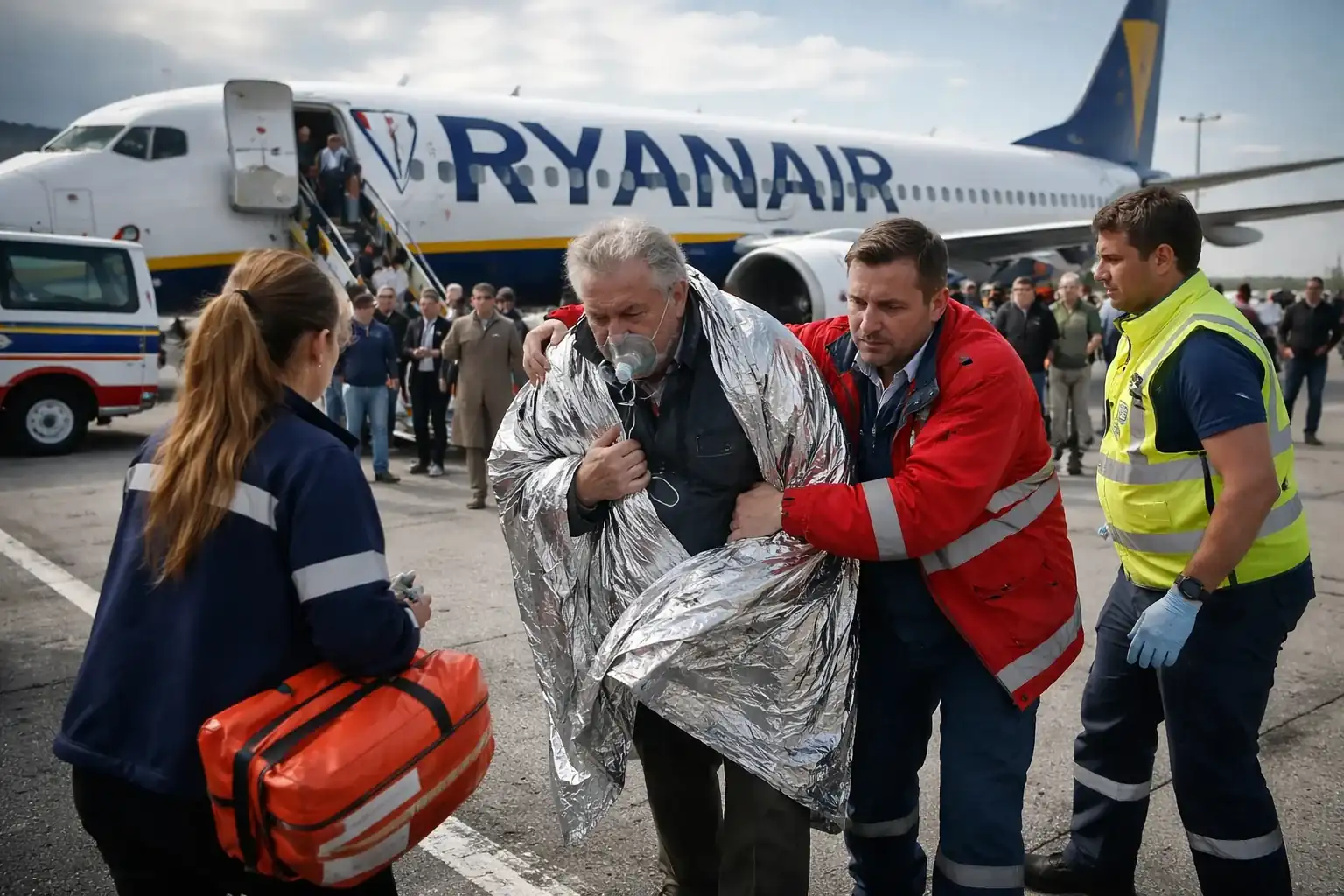
Shortly after departing from Thessaloniki, Greece, a Ryanair flight bound for Memmingen, Germany, experienced a terrifying mid-air emergency. A cabin window became dislodged, causing a sudden decompression that reportedly nearly sucked a passenger out of the aircraft. Witnesses described a scene of chaos as the individual, identified as a Serbian citizen in his 60s, was pulled toward the opening. According to those on board, the man was left hanging head-first out of the window as far as his shoulders for several minutes while the plane was at altitude. Other passengers reacted quickly, grabbing the man and pulling him back into the safety of the cabin. The aircraft, operated by Ryanair subsidiary Malta Air, was forced to make an immediate emergency return to the Greek airport to seek medical aid.
What's new in this update
In the aftermath of the incident, Ryanair confirmed that flight FR7016 returned to Thessaloniki shortly after take-off when the window dislodged inflight. The airline stated that the aircraft landed normally and that all passengers were eventually transferred to the terminal. One passenger, presumably the man involved in the window incident, requested and received medical assistance on the ground. The Irish Aviation Authority (IAA) has since announced that it is aware of the situation and will be collaborating with the Greek aviation safety investigation authority and the Maltese Civil Aviation Directorate. This multi-national investigation aims to determine exactly how a window could fail so catastrophically on a commercial flight and whether maintenance oversights or external factors contributed to the structural failure.
Key details
Passengers aboard the Boeing 737 described hearing a loud bang followed immediately by the deployment of oxygen masks and a sharp drop in cabin pressure. One passenger, Christina, told local media that she initially feared an emergency door had been opened due to the intensity of the noise and the rush of air. She noted a strong smell following the decompression and observed that the victim’s head and shoulders were already outside the fuselage. Crucially, the passenger’s seatbelt remained fastened, which likely prevented him from being fully ejected from the plane before others could intervene and secure him. Some passengers speculated that debris from one of the jet’s engines might have struck the window, causing it to shatter, though Ryanair has not yet commented on the specific cause of the breakage.
Background and context
The aircraft involved in the incident is reported to be an 18-year-old plane operated by Malta Air, a subsidiary of the Irish budget carrier. While commercial aircraft are designed to last for decades with proper maintenance, the age of the fleet often comes under scrutiny following structural failures. This event draws harrowing parallels to a 2018 incident involving a Southwest Airlines flight in the United States. In that case, an engine failure sent debris through a cabin window, leading to a partial ejection and the subsequent death of a passenger. While fatalities were avoided in this Ryanair flight, the similarity of the partial ejection scenario underscores the extreme danger posed by window failures at high altitudes where the pressure differential between the cabin and the outside atmosphere is greatest.
What to watch next
The focus now shifts to the technical investigation led by Greek and Maltese authorities. Investigators will likely examine the window frame, the glass integrity, and the maintenance logs of the 18-year-old Boeing 737. A key question remains whether external debris, such as engine fragments, initiated the failure or if it was a result of structural fatigue. Ryanair will face pressure to explain its inspection protocols for older aircraft within the Malta Air fleet. Furthermore, the findings could prompt wider safety bulletins for operators of similar Boeing 737 models if a systemic issue is identified. Passengers on the flight, many of whom were left shaken by the experience, are awaiting more transparent communication regarding the mechanical health of the replacement aircraft and the budget carrier's fleet at large.
Why it matters
This incident highlights critical concerns regarding aging aircraft maintenance and the effectiveness of safety protocols during sudden mid-air decompressions.
Read next
Follow this story through the topic hub, more world coverage, and the latest updates.
Weekly briefing
Get the week's key developments in one concise email.
Get a fast catch-up on the biggest stories, the context behind them, and the links worth your time.
Cadence
Weekly, for a quick catch-up
Coverage
AI, business, world, security, sports
Format
Clear takeaways and useful context
Request the briefing
Leave your email to open a prepared request and get on the list for the weekly briefing.
About the byline
World correspondent
Leila Haddad covers world affairs, diplomacy, and humanitarian crises, with a focus on how fast-moving international developments affect public policy, conflict response, and cross-border institutions.
Sources and methodology