Massive Typhoon Bavi Nears Taiwan After Deadly Philippine Landslides
Landslides kill 15 in Mindanao as East Asian nations brace for Typhoon Bavi, one of the largest and most destructive storms to hit the region in decades.

World correspondent
Reports on international affairs, diplomacy, and humanitarian developments with an emphasis on official statements, multilateral institutions, and regional context.
Editorial responsibility: Lead reviewer for geopolitics, international institutions, and crisis coverage
Primary source: BBC World News. Full source links and update notes are below.
Fast summary
Start here
- At least 15 people died in Mindanao, Philippines, due to rain-triggered landslides buried families overnight.
- Typhoon Bavi spans 1,000km, roughly the width of France, and is the largest storm to threaten Taiwan since 1987.
- Major airlines including JAL and ANA have cancelled hundreds of flights, disrupting travel for over 40,000 passengers.
What happened
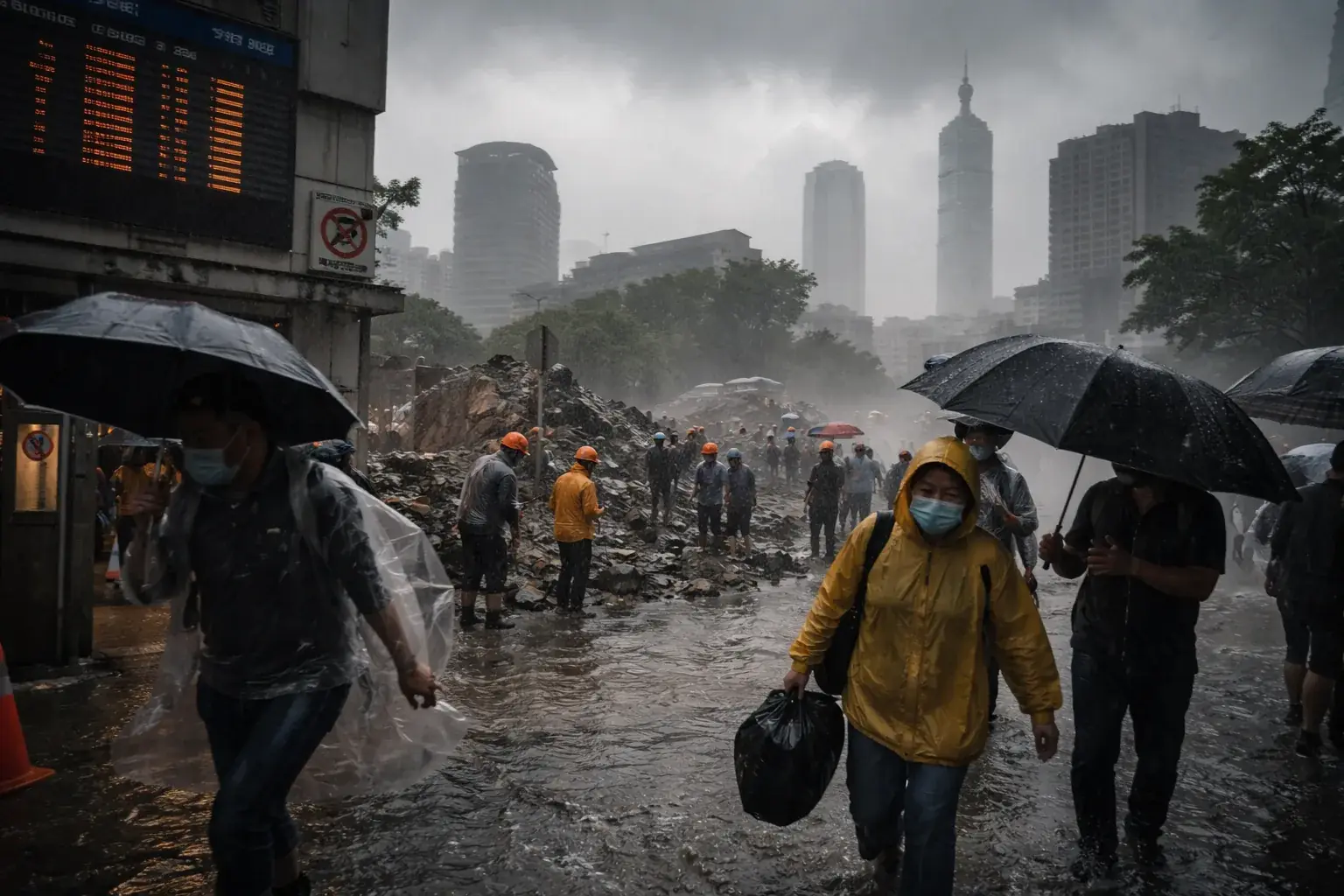
At least 15 people have been confirmed dead on the Philippine island of Mindanao after heavy rainfall triggered devastating landslides. These landslides, occurring as Typhoon Bavi gains strength in the Pacific, buried several families overnight in their homes. Rescue teams continue to comb through the debris in search of missing residents, though local officials warn that moderate to heavy rains are expected to persist throughout the weekend, complicating recovery efforts. While the storm itself is sweeping toward Taiwan, its outer bands have already delivered a lethal impact to the southern Philippines. The sheer scale of Bavi is staggering; it currently spans approximately 1,000 kilometers at its widest point. To put this in perspective for international observers, the storm's diameter is roughly equivalent to the width of France, making it one of the most physically expansive weather systems to threaten East Asia in recent history.
What's new in this update
As the massive weather system moves across the Pacific, regional authorities have significantly escalated their alert levels. In Taiwan, the Central Weather Administration has identified Bavi as the largest storm by size to threaten the island since 1987. In response, the Ministry of National Defense has placed approximately 29,000 soldiers on standby to assist with potential relief and evacuation efforts. The aviation sector is already experiencing major disruptions, with Japan Airlines and All Nippon Airways together cancelling over 260 flights, affecting approximately 40,000 passengers across Friday, Saturday, and Sunday. Regional carriers like Thai Airways and Malaysia Airlines have also grounded flights bound for Taipei. Meanwhile, in Japan’s remote Sakishima Islands, residents have begun the process of taping up windows and installing windproof netting as the storm’s trajectory brings it dangerously close to the archipelago.
Key details
Meteorologists and environmental experts are particularly concerned about the abundant energy Typhoon Bavi is carrying. Ma Jun, the director of China’s Institute of Public and Environmental Affairs, noted that the storm’s massive rainbands could stretch as far as the northern provinces of Jiangsu and Anhui, eventually reaching the Bohai Sea region. This is of particular concern because northern Chinese provinces generally have less experience in managing the impact of super-typhoons compared to their southern counterparts. In Taiwan, officials are bracing for as much as one meter (39 inches) of rainfall in the north and east. On the ground, the immediate impact on local economies is visible. Supermarket shelves in Taipei and other major cities have been stripped of essentials as residents stock up on food and water. Farmers have also been forced to conduct emergency harvests, working through the night to save crops before the wind and rain arrive.
Background and context
The arrival of Typhoon Bavi comes at a precarious time for East Asia, which is still struggling to recover from the aftermath of Typhoon Maysak. That earlier storm, which struck just days ago, left a trail of destruction in southern China and parts of Southeast Asia. At least 39 people were killed by Maysak, and more than 130,000 residents were forced to evacuate their homes, primarily in the Guangxi region. The economic toll from Maysak was severe, resulting in the loss of vast swathes of livestock and massive agricultural damage. It even triggered two rare tornadoes in the central Hubei province, an unusual meteorological occurrence for the area. The consecutive nature of these storms—Maysak followed so closely by the even larger Bavi—leaves infrastructure weakened and disaster response teams stretched thin as they transition from one recovery effort into a new emergency preparation phase.
What to watch next
The primary focus for the next 24 to 48 hours is Bavi’s expected landfall in south-eastern China’s Fujian province on Saturday. Current forecasts suggest the storm could potentially make landfall twice within Chinese territory, which would dramatically increase the risk of flash flooding and structural damage. In the Philippines, the death toll may rise as rescuers reach more remote areas of Mindanao that were previously cut off by the landslides. Authorities will also be monitoring the storm’s path as it potentially shifts northward toward the Korean Peninsula or the northern provinces of China. International travelers should expect continued flight cancellations through at least Monday as airlines wait for the all-clear from regional meteorologists. Finally, the long-term impact on regional food prices will be scrutinized, as the destruction of crops in Taiwan and China could lead to significant market volatility in the coming weeks.
Why it matters
The storm's massive size and energy pose a severe threat to regional infrastructure and agriculture in areas already recovering from Typhoon Maysak.
Read next
Follow this story through the topic hub, more world coverage, and the latest updates.
Weekly briefing
Get the week's key developments in one concise email.
Get a fast catch-up on the biggest stories, the context behind them, and the links worth your time.
Cadence
Weekly, for a quick catch-up
Coverage
AI, business, world, security, sports
Format
Clear takeaways and useful context
Request the briefing
Leave your email to open a prepared request and get on the list for the weekly briefing.
About the byline
World correspondent
Leila Haddad covers world affairs, diplomacy, and humanitarian crises, with a focus on how fast-moving international developments affect public policy, conflict response, and cross-border institutions.
Sources and methodology