First Sanctioned Russian Tanker Enters English Channel Since Recent
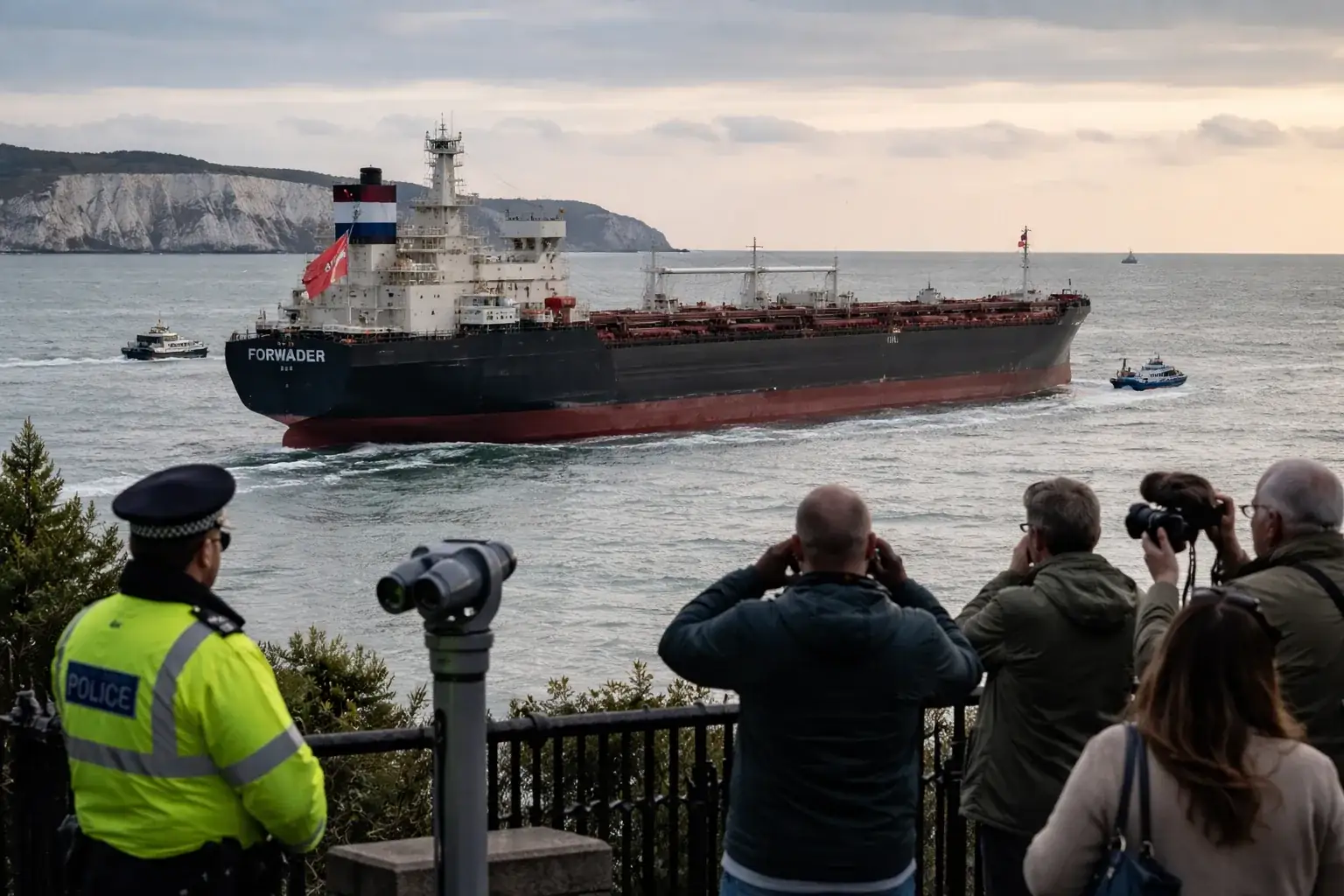
The Russian-flagged Forwarder entered the waterway Wednesday evening, testing UK maritime enforcement days after Royal Marines seized an unflagged vessel

World correspondent
Reports on international affairs, diplomacy, and humanitarian developments with an emphasis on official statements, multilateral institutions, and regional context.
Editorial responsibility: Lead reviewer for geopolitics, international institutions, and crisis coverage
Primary source: BBC World News. Full source links and update notes are below.
Fast summary
Start here
- The tanker Forwarder entered the English Channel on Wednesday, broadcasting its destination as China.
- It is the first sanctioned shadow fleet vessel to use the route since the UK's high-profile boarding of the Smyrtos.
- Maritime analysts suggest the UK is less likely to board the Forwarder because it flies a Russian flag, unlike the stateless Smyrtos.
What happened
The Russian-flagged tanker Forwarder has entered the English Channel, becoming the first sanctioned vessel of its kind to use the route since British forces boarded the Smyrtos days earlier. That makes the transit more than another shipping movement. It is an early test of how far the United Kingdom is actually prepared to go in enforcing its tougher posture toward Russia's so-called shadow fleet.
The shadow fleet refers to the aging, often opaque network of tankers used to move sanctioned Russian oil through renaming, reflagging, layered ownership structures, and legal gray zones. The Forwarder's passage through one of the world's busiest waterways therefore carries both practical and symbolic significance.
Why this transit matters after the Smyrtos seizure
The UK's boarding of the Smyrtos drew attention because it showed a willingness to act directly when a vessel appeared to be operating outside normal legal protections. But the Forwarder presents a different problem. Unlike the Smyrtos, it is reported to be sailing under a Russian flag, which changes the legal and diplomatic calculus.
That distinction is critical. Boarding a stateless or improperly flagged ship can be defended under one set of maritime arguments. Confronting a vessel openly tied to the Russian state is far more sensitive, especially if Moscow chooses to frame any intervention as a deliberate escalation rather than sanctions enforcement.
The legal and strategic gray area
This is where sanctions policy often runs into its limits. Western governments can restrict financing, insurance, and port access, but stopping physical transit at sea is harder unless there is a clear basis under international law. The UK's newer policy posture may sound forceful, but each case depends on the flag status of the vessel, the exact waters involved, and the risks of confrontation.
That helps explain why analysts believe British or French forces are less likely to board the Forwarder than they were to board the Smyrtos. Enforcement is not only a question of intent. It is also a question of whether the legal footing is strong enough to survive diplomatic blowback.
Why Russia's shadow fleet remains hard to stop
The Russian shadow fleet has become one of the most important tools in Moscow's effort to keep oil exports moving despite sanctions linked to the war in Ukraine. The vessels involved are often old, lightly scrutinized, and connected through opaque ownership arrangements. They allow Russian crude and petroleum products to keep reaching buyers even when formal trade channels are constrained.
That makes each transit part of a larger strategic contest:
- Western states want sanctions to impose real economic cost.
- Russia wants to prove that alternative shipping networks can absorb that pressure.
- Maritime authorities must balance enforcement with safety and escalation risks.
- Energy markets watch closely because disruptions can affect supply expectations.
The result is a cat-and-mouse pattern in which each interception or visible transit becomes a signal to the other side.
What the English Channel adds to the story
The English Channel is not a marginal route. It is one of the most sensitive and monitored maritime corridors in the world. A sanctioned tanker moving through it invites more political attention than a less visible voyage elsewhere because it forces governments to decide whether their rhetoric about sanctions is matched by operational will.
Reports that Royal Navy assets were nearby reinforce that point. Even without an interdiction, the presence of naval monitoring turns the voyage into a test case for deterrence, surveillance, and response thresholds.
What to watch next
The immediate question is whether the Forwarder completes its transit without incident. The broader question is what precedent that sets. If Russian-flagged sanctioned vessels can use the Channel while stateless vessels are singled out, Moscow may conclude that the practical limits of Western enforcement are narrower than recent headlines suggested.
Why this matters
The Forwarder English Channel transit highlights the gap between sanctions policy and maritime reality. It shows that seizing one vessel is easier than building a sustainable enforcement model against a large, adaptive shipping network tied to a nuclear-armed state. For the UK and its allies, this is not only a shipping story. It is a credibility test.
Why it matters
This transit tests the limits of the UK's new policy on boarding sanctioned vessels and highlights the ongoing friction between Western sanctions and Russia's energy export strategies.
Read next
Follow this story through the topic hub, more world coverage, and the latest updates.
Weekly briefing
Get the week's key developments in one concise email.
Get a fast catch-up on the biggest stories, the context behind them, and the links worth your time.
Cadence
Weekly, for a quick catch-up
Coverage
AI, business, world, security, sports
Format
Clear takeaways and useful context
Request the briefing
Leave your email to open a prepared request and get on the list for the weekly briefing.
About the byline
World correspondent
Leila Haddad covers world affairs, diplomacy, and humanitarian crises, with a focus on how fast-moving international developments affect public policy, conflict response, and cross-border institutions.
Sources and methodology