Rescuers Search Kyiv Rubble After Massive Russian Air Assault Kills
Russian forces launched over 700 missiles and drones overnight, striking a residential block in Kyiv and several other regions following the end of a brief

World correspondent
Reports on international affairs, diplomacy, and humanitarian developments with an emphasis on official statements, multilateral institutions, and regional context.
Editorial responsibility: Lead reviewer for geopolitics, international institutions, and crisis coverage
Primary source: BBC World News. Full source links and update notes are below.
Fast summary
Start here
- At least two people were killed and 40 injured in Kyiv when a nine-storey apartment block was partially destroyed.
- The attack involved one of the largest barrages of the war, with over 670 drones and 56 missiles launched nationwide.
- Ukrainian officials called on the U.S. and China to exert pressure on Moscow during their ongoing high-level summit.
What happened
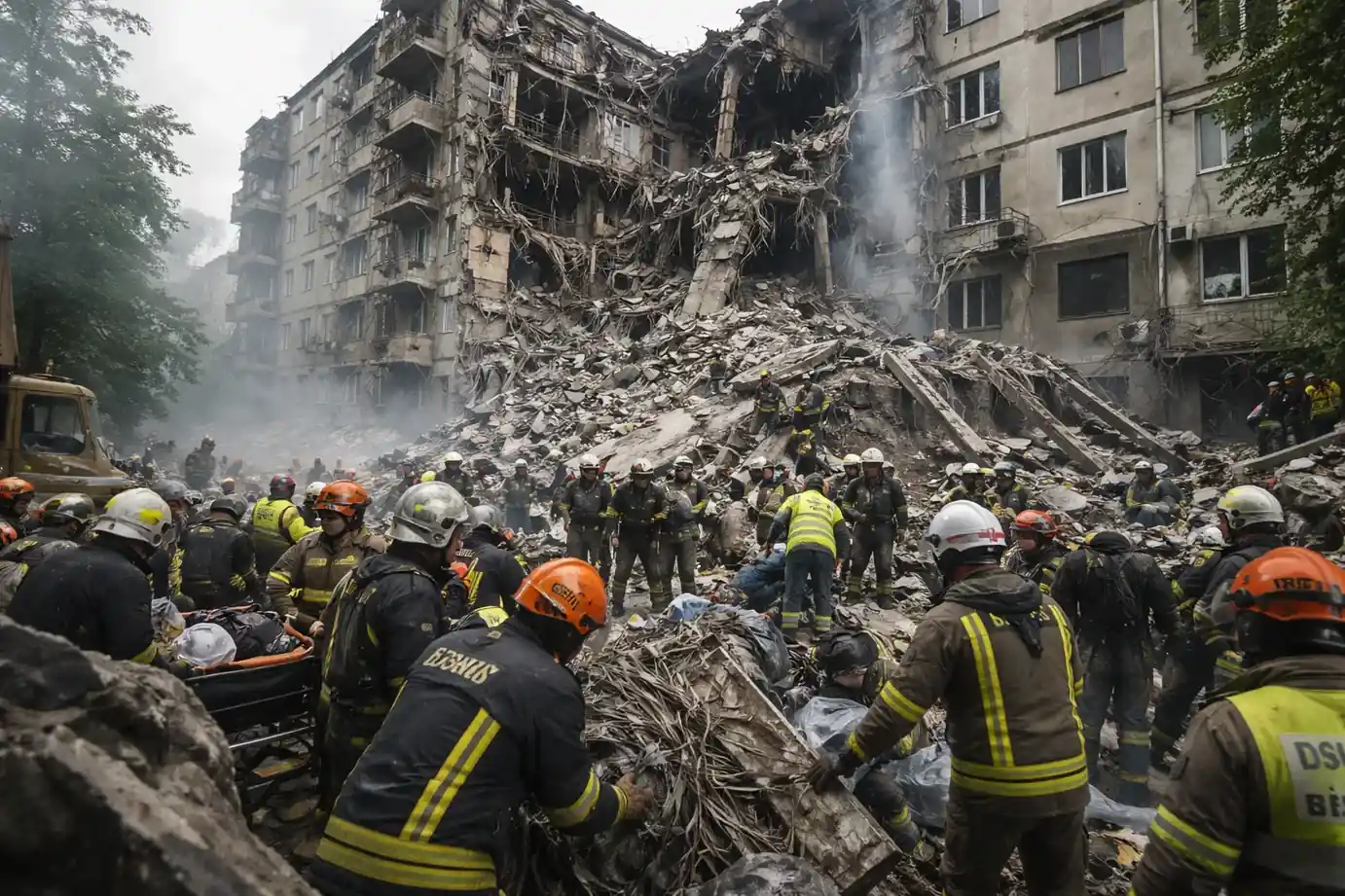
Emergency crews in Kyiv are searching through broken concrete, twisted metal, and shattered apartments after one of the largest Russian missile and drone assaults of the war struck the Ukrainian capital and several other regions overnight. Ukrainian officials said at least two people were killed in Kyiv and dozens more were injured when a nine-storey residential building was heavily damaged. The attack also disrupted city services, including parts of the water supply, and left rescue teams racing against time to determine whether more people were trapped in the rubble.
The scale of the barrage made the strike stand out even by the grim standards of the Russia-Ukraine war. President Volodymyr Zelensky said Russia launched more than 670 drones and 56 missiles in a single wave, turning the assault into one of the most intense long-range attacks seen since the full-scale invasion began in 2022. For residents of Kyiv, the immediate reality was not strategic theory but the familiar sound of sirens, air-defense fire, collapsing masonry, and emergency crews digging through destroyed homes before dawn.
Why this strike matters
Large Russian attacks are no longer rare, but this assault signals a renewed effort to exhaust Ukraine's air defense network through sheer volume. By combining drones with different types of missiles, Russia can force Ukrainian defenses to spread out resources, make fast prioritization decisions, and absorb more pressure over a longer period of time. Even where many incoming threats are intercepted, debris and breakthrough strikes can still inflict severe damage on apartment blocks, infrastructure, and public utilities.
That is why a night like this matters beyond casualty figures. The goal of mass aerial warfare is not only destruction. It is also attrition. Every major barrage consumes interceptor missiles, strains radar and response systems, and wears down civilians who must repeatedly shelter or wake to scenes of devastation in their own neighborhoods.
What happened in Kyiv and beyond
Kyiv was one of the main targets, but not the only one. Officials said regions including Kharkiv, Sumy, Odesa, and Kremenchuk were also hit. The broad geographic spread suggests a coordinated national-level attack rather than a narrowly focused strike package. That matters because it complicates the distribution of defensive resources and emergency support across the country.
In the capital, Mayor Vitaliy Klychko said 18 apartments in the damaged building were destroyed. Rescue operations continued as crews searched for survivors and assessed how unstable the structure remained. Such operations are especially dangerous after missile impacts because secondary collapses, gas leaks, fires, and weakened stairwells can all threaten both survivors and first responders.
Diplomacy and pressure on major powers
Ukraine's leadership used the attack to sharpen its message to foreign partners. Officials called on the United States and China to use their influence on Moscow, arguing that global diplomacy cannot remain detached while Russian strikes continue at this scale. Foreign Minister Andriy Sybiha noted that the timing overlapped with high-level discussions involving U.S. President Donald Trump and Chinese President Xi Jinping, giving Kyiv a reason to press both powers publicly.
The appeal reflects a recurring Ukrainian position: that battlefield defense and diplomatic pressure must work together. Ukraine needs more air defense support in the short term, but it also wants major powers to recognize that repeated attacks on cities cannot be treated as background noise in a prolonged war.
The ceasefire context
This surge in attacks followed the end of a short ceasefire period that had temporarily reduced large-scale aerial bombardment, even as violations on the front lines were reported. Since the pause ended, Russian strikes have intensified again, reinforcing the pattern seen throughout the war: brief diplomatic openings often collapse into renewed escalation rather than durable restraint.
For civilians, that cycle carries a harsh lesson. Periods of relative quiet may offer relief, but they do not necessarily indicate a strategic shift. Instead, they can be followed by even larger attacks that seek to reassert pressure quickly and dramatically.
What to watch next
The next major question is whether Russia sustains this tempo of drone and missile attacks in the days ahead. Ukraine will likely continue pressing allies for more interceptors, radar support, and air-defense systems capable of dealing with high-volume barrages. Any sign of shortages will be closely watched because repeated large attacks are designed in part to expose exactly those weaknesses.
For now, the image that defines this latest strike is not the missile count alone. It is rescuers digging into a damaged Kyiv apartment block, trying to find survivors in a war where residential buildings remain part of the battlefield whether the people inside them ever chose to be there or not.
Why it matters
The escalation signals a significant intensification of Russian aerial warfare following the failure of a short-lived ceasefire, placing renewed pressure on global diplomacy.
Read next
Follow this story through the topic hub, more world coverage, and the latest updates.
Weekly briefing
Get the week's key developments in one concise email.
Get a fast catch-up on the biggest stories, the context behind them, and the links worth your time.
Cadence
Weekly, for a quick catch-up
Coverage
AI, business, world, security, sports
Format
Clear takeaways and useful context
Request the briefing
Leave your email to open a prepared request and get on the list for the weekly briefing.
About the byline
World correspondent
Leila Haddad covers world affairs, diplomacy, and humanitarian crises, with a focus on how fast-moving international developments affect public policy, conflict response, and cross-border institutions.
Sources and methodology