'If We Sleep, They Bite': Gaza Camps Face Growing Pest Infestation
Accumulating waste and collapsed sewage infrastructure have turned displacement sites into breeding grounds for rodents and weasels that are now attacking

World correspondent
Reports on international affairs, diplomacy, and humanitarian developments with an emphasis on official statements, multilateral institutions, and regional context.
Editorial responsibility: Lead reviewer for geopolitics, international institutions, and crisis coverage
Primary source: BBC World News. Full source links and update notes are below.
Fast summary
Start here
- UN surveys indicate rodents or pests are visible in 80% of displacement sites, affecting approximately 1.45 million people.
- Children and the elderly have suffered severe bites, including cases of tetanus, fever, and physical injuries resulting from nocturnal attacks.
- Humanitarian agencies are calling for an urgent, large-scale campaign to remove rubble and waste to prevent widespread disease outbreaks.
What happened
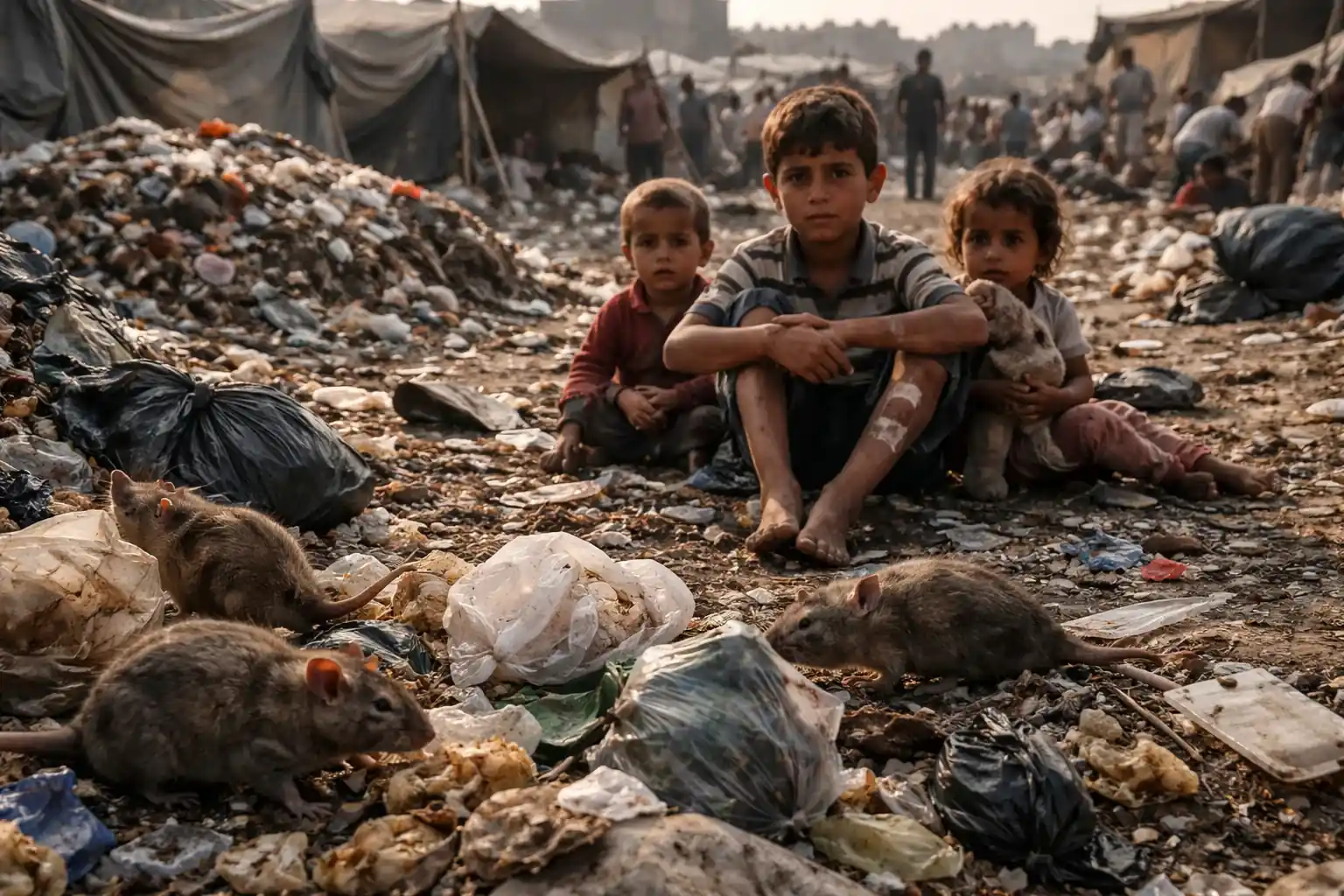
Displaced families in Gaza are facing a worsening pest infestation as rats and urban weasels spread through crowded camps built amid rubble, garbage, and broken sewage systems. Residents say the animals are entering tents at night, biting children, contaminating food, and forcing parents to stay awake to protect their families. What might sound like a secondary hardship is becoming a serious public health emergency in places where basic sanitation has already collapsed.
The infestation is not happening in isolation. It is emerging inside a broader humanitarian crisis defined by displacement, hunger, damaged medical services, and severe overcrowding. In such conditions, pests are not merely a nuisance. They become disease vectors, amplify fear, and create a new daily threat for families who are already living without adequate shelter, safe water, or reliable healthcare.
Why the problem is growing
UN-linked assessments indicate that rodents or other pests are now visible in around 80% of displacement sites, affecting roughly 1.45 million people. That figure helps explain why aid workers are increasingly framing the issue as a population-level health concern rather than an isolated sanitation complaint.
The environmental conditions are ideal for infestation. Piles of uncollected waste have built up near tents and temporary shelters. Wastewater treatment systems have been damaged or disabled. Raw sewage and standing water create breeding grounds, while warmer temperatures accelerate the growth of pest populations. In overcrowded camps, there is little distance between refuse, sleeping areas, and places where families try to store food.
Who is most at risk
Children, the elderly, and people with chronic illnesses are especially vulnerable. Reports from the camps describe severe bites, infections, fevers, and cases that required emergency treatment such as tetanus shots. For people who are already malnourished or immunocompromised, even injuries that would normally be manageable can become dangerous.
The infestation also affects mental health and sleep, which are often overlooked in crisis reporting. Families describe nights spent listening for movement, checking on children, and trying to guard limited food supplies from animals. In camps where trauma and exhaustion are already widespread, constant nighttime fear becomes another layer of harm.
Why sanitation and public health are now inseparable
The World Health Organization has warned that rodents pose risks well beyond bite injuries. Their droppings and urine can contribute to respiratory illness, skin infections, gastrointestinal disease, and contamination of already scarce food and water. In displacement settings, these risks multiply because healthcare access is limited and prevention systems such as waste removal, drainage, and pest control are either damaged or absent.
This is why the issue cannot be solved with small-scale spraying or improvised local fixes alone. Humanitarian workers say the underlying drivers are structural: rubble that cannot be cleared, garbage that cannot be collected, sewage that cannot be managed, and a shortage of heavy equipment needed to restore even minimal sanitation systems.
The political and logistical constraints
Aid agencies say meaningful improvement depends on access. Heavy machinery, spare parts, sanitation supplies, and more durable shelter materials are all needed to stabilize living conditions. But the conflict, movement restrictions, and the destruction of infrastructure have severely limited what can enter and where it can be used. Even where officials say coordination is underway, the scale of the damage has outpaced the available response.
At the same time, ceasefire talks and humanitarian access negotiations remain entangled with the broader war. That means families in the camps are living with the consequences of delays that are not only logistical but political. Without larger changes in access and security, public health measures remain partial and reactive.
What aid agencies want now
UNICEF, WHO, and other relief organizations are pushing for a broader sanitation and rubble-removal campaign that would reduce breeding sites and lower disease risk before conditions deteriorate further. That includes restoring some wastewater handling capacity, improving drainage, moving waste out of camp areas, and bringing in equipment for more effective pest control.
Their message is straightforward: if these environmental conditions remain in place, the infestation will keep worsening and may contribute to broader outbreaks of disease. In a population already weakened by displacement and shortages, that could have serious consequences very quickly.
What comes next
The next phase of this crisis depends less on identifying the problem than on whether humanitarian agencies can get the access and equipment needed to act at scale. Until then, families in Gaza's displacement camps are left managing a public health emergency with almost no protective buffer.
The image at the center of this story is stark. Children are not just growing up in tents beside rubble. They are sleeping in places where parents fear what may crawl in after dark. That is what a sanitation collapse looks like when it turns into a human survival issue.
Why it matters
The infestation introduces a significant biological threat to a population already vulnerable to malnutrition and lack of medical care, complicating the existing humanitarian emergency.
Read next
Follow this story through the topic hub, more world coverage, and the latest updates.
Weekly briefing
Get the week's key developments in one concise email.
Get a fast catch-up on the biggest stories, the context behind them, and the links worth your time.
Cadence
Weekly, for a quick catch-up
Coverage
AI, business, world, security, sports
Format
Clear takeaways and useful context
Request the briefing
Leave your email to open a prepared request and get on the list for the weekly briefing.
About the byline
World correspondent
Leila Haddad covers world affairs, diplomacy, and humanitarian crises, with a focus on how fast-moving international developments affect public policy, conflict response, and cross-border institutions.
Sources and methodology