Putin Justifies Ukraine War and Attacks NATO in Scaled-Back Victory
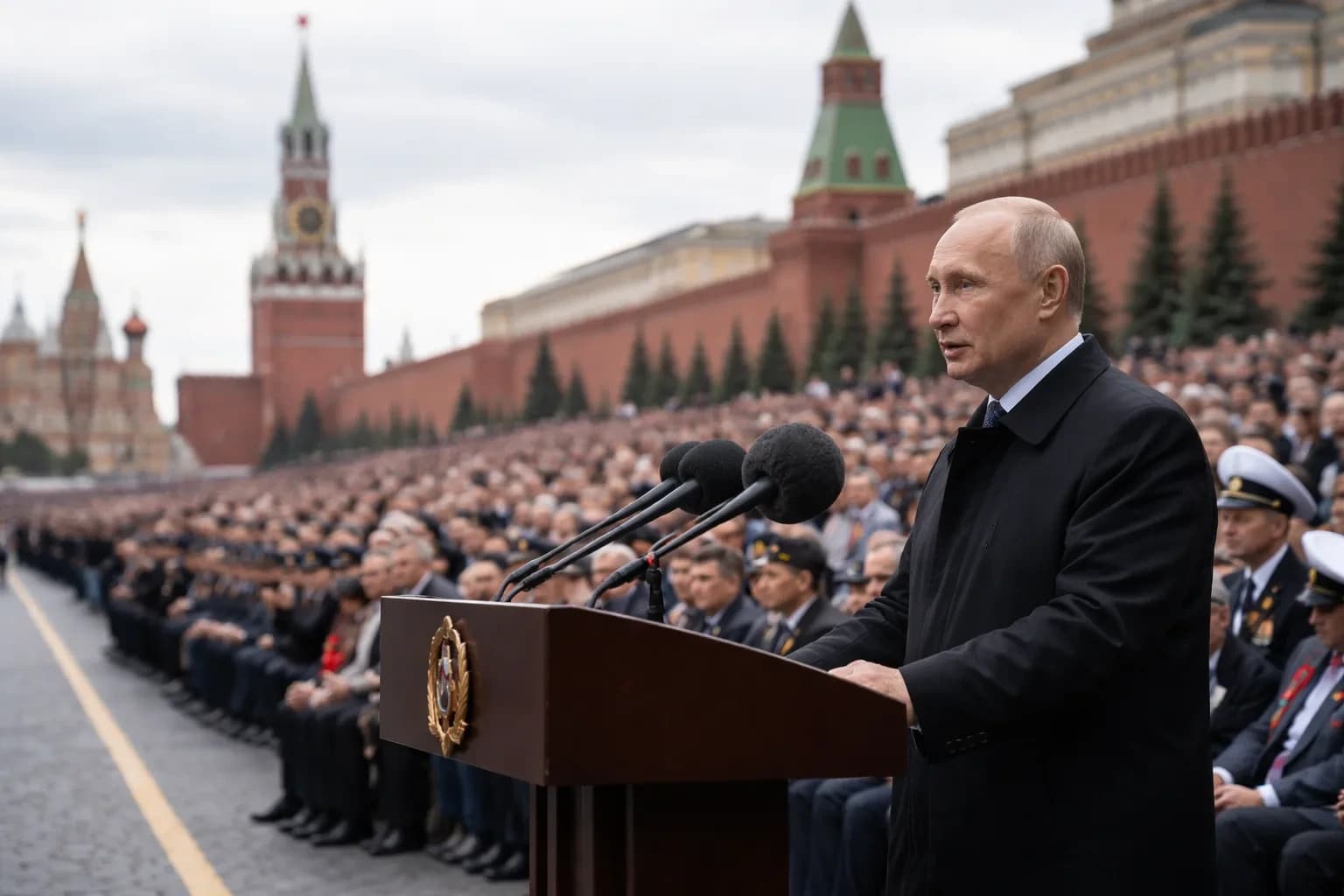
Addressing troops in Red Square, the Russian president framed the invasion as a 'just' war while modern military hardware was noticeably absent from the

World correspondent
Reports on international affairs, diplomacy, and humanitarian developments with an emphasis on official statements, multilateral institutions, and regional context.
Editorial responsibility: Lead reviewer for geopolitics, international institutions, and crisis coverage
Primary source: BBC World News. Full source links and update notes are below.
Fast summary
Start here
- Vladimir Putin used his annual speech to characterize the war in Ukraine as a necessary defense against an aggressive NATO bloc.
- For the first time in nearly two decades, no military hardware was featured in the Moscow parade, with officials stating equipment is needed at the front.
- International attendance was significantly lower than in previous years, though the leaders of Belarus, Laos, and Malaysia were present.
What happened
Vladimir Putin used Russia's Victory Day parade in Red Square to defend the war in Ukraine and again portray NATO as the underlying threat driving Moscow's actions. In his speech, the Russian president framed the invasion as a justified act of defense against an aggressive Western bloc, tying present-day war aims to the memory politics of the Soviet victory over Nazi Germany. The ceremony, however, carried a contradiction that was difficult to miss: the rhetoric projected strength, but the parade itself appeared more constrained than in past years.
For the first time in nearly two decades, the Victory Day event proceeded without the usual display of modern military hardware. No prominent tanks, missile systems, or heavy combat vehicles rolled through Red Square. Russian officials explained that the equipment was needed at the front, but that explanation itself underscored the degree to which the war in Ukraine is consuming resources that would once have been used for national spectacle.
Why Victory Day matters politically
Victory Day is not just a holiday in Russia. It is one of the Kremlin's most powerful civic and political stages. The event combines military ritual, national memory, and state messaging in a way few other ceremonies can. Putin has long used it to reinforce historical continuity, national sacrifice, and the legitimacy of the Russian state.
That is why the framing of the Ukraine war during the parade is so significant. By linking the current conflict to anti-fascist memory and NATO hostility, the Kremlin tries to place contemporary policy inside a sacred historical narrative. The effect is to make dissent harder and compromise less imaginable. A war presented as necessary civilizational defense is not easily traded away at the negotiating table.
What the missing hardware suggests
The absence of military hardware matters precisely because Victory Day traditionally serves as a showcase of national power. If tanks and missile systems are being withheld because they are more urgently needed on the battlefield, it points to a practical wartime economy in which display has been subordinated to operational necessity. It may also reflect concerns about security, optics, or the availability of equipment that can be presented without inviting awkward questions.
At minimum, the scaled-back format shows that the war is shaping domestic symbolism in visible ways. A state that once relied on parades to project overwhelming military confidence is now signaling, intentionally or not, that the demands of the battlefield take priority over pageantry.
Security and diplomatic limits
Security concerns also hovered over the event. Reports of possible Ukrainian drone threats led to tightened measures in Moscow, and some cities reportedly curtailed or canceled public celebrations because of the operational situation. That matters because it shows how the war's reach is no longer confined to occupied territory or the front line. Even Russia's most important ceremonial day is now planned under the shadow of potential disruption.
International attendance further reflected Russia's narrower diplomatic space. A handful of foreign leaders were present, including figures from Belarus, Laos, and Malaysia, but the guest list was noticeably smaller than at more prominent anniversary events that once attracted a broader range of partners. Moscow can still assemble symbolic support, but not at the level that would suggest broad global alignment.
Why NATO remains central to Putin's messaging
Putin's criticism of NATO serves several purposes at once. It externalizes blame, explaining the war as a reaction to Western encirclement rather than a Russian choice. It also offers a unifying narrative for domestic audiences by presenting Russia as a besieged power resisting outside pressure. In the context of Victory Day, that story is especially potent because it ties current anxieties to deeply rooted memories of invasion and sacrifice.
Yet the reliance on NATO as the central explanatory frame also reveals the Kremlin's need to maintain ideological coherence as the war grinds on. The longer the conflict lasts, the more the state must keep justifying why the costs remain necessary.
What comes next
The next question is whether the scaled-back parade proves to be a temporary wartime adjustment or part of a longer pattern in how Russia presents military power at home. Observers will also watch whether any ceasefire language around the commemorative period leads to durable de-escalation, or whether it serves mainly as a short pause within a much larger war cycle.
For now, the most revealing detail may be the contrast at the heart of the event. Putin spoke in the language of strength, destiny, and historical mission. But the missing hardware, reduced attendance, and tightened security hinted at a state under strain, trying to preserve the image of control while the war continues to shape what Russia can actually display.
Why it matters
The removal of military hardware from Russia's most significant national holiday highlights the ongoing logistical and security pressures caused by the prolonged conflict in Ukraine.
Read next
Follow this story through the topic hub, more world coverage, and the latest updates.
Weekly briefing
Get the week's key developments in one concise email.
Get a fast catch-up on the biggest stories, the context behind them, and the links worth your time.
Cadence
Weekly, for a quick catch-up
Coverage
AI, business, world, security, sports
Format
Clear takeaways and useful context
Request the briefing
Leave your email to open a prepared request and get on the list for the weekly briefing.
About the byline
World correspondent
Leila Haddad covers world affairs, diplomacy, and humanitarian crises, with a focus on how fast-moving international developments affect public policy, conflict response, and cross-border institutions.
Sources and methodology