Uneasy Calm Returns to Strait of Hormuz as Iran Maintains Control of
A fragile ceasefire has allowed local fishermen to return to the waters of Bandar Abbas, yet the Iranian Revolutionary Guard Corps continues to hold

World correspondent
Reports on international affairs, diplomacy, and humanitarian developments with an emphasis on official statements, multilateral institutions, and regional context.
Editorial responsibility: Lead reviewer for geopolitics, international institutions, and crisis coverage
Primary source: BBC World News. Full source links and update notes are below.
Fast summary
Start here
- International journalists have been granted first access to the Iranian side of the Strait of Hormuz since the conflict erupted in February 2026.
- Despite a partial reopening of the waterway under a fragile ceasefire, the IRGC continues to hold the seized ships MSC Francesca and Epaminondas.
- The city of Bandar Abbas remains a critical strategic hub for Iran's military doctrine of asymmetric warfare and global energy shipments.
What happened
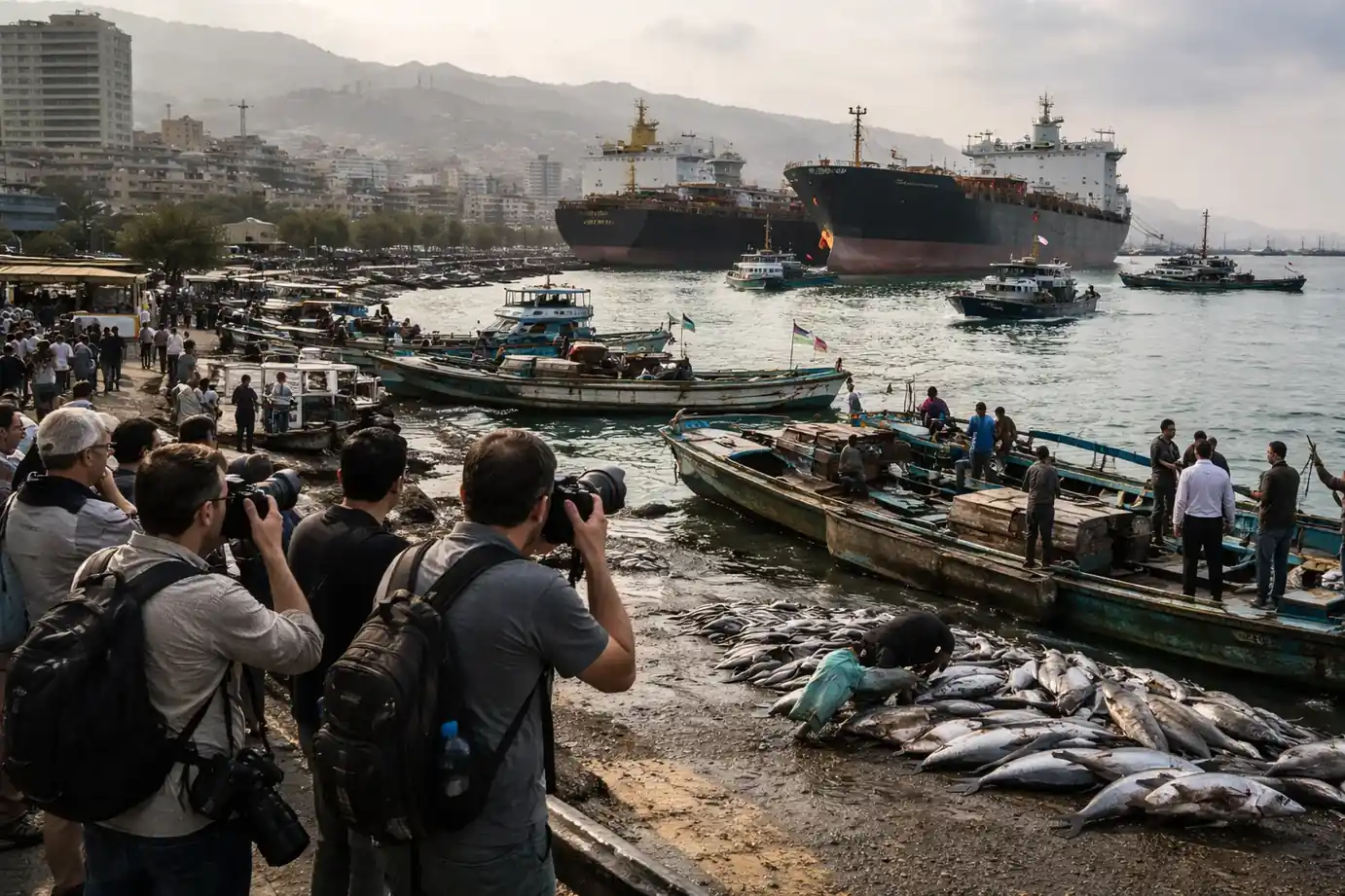
In the sweltering heat of Bandar Abbas, a semblance of normalcy has returned to the docks where Iranian fishermen unload their daily catch. For the first time since the outbreak of hostilities between the United States, Israel, and Iran, international observers have been permitted to witness the conditions on the Iranian side of the Strait of Hormuz. The scene at the port is a study in contrasts: local fishermen proudly display baby sharks and large fish destined for local markets, while just beyond the horizon, the machinery of global conflict remains visible. This port city serves as a primary logistical hub for the Iranian regime, and the resumption of fishing activity marks a significant, albeit precarious, shift in the local atmosphere following months of intense naval standoffs where these waters were too dangerous to navigate.
What's new in this update
A crucial development in this recent observation is the identification of seized international vessels that remain in Iranian custody despite the current ceasefire agreement. During a transit through the strait, the MSC Francesca and the Epaminondas—flagged to Panama and Liberia, respectively—were spotted still held by the Islamic Revolutionary Guards Corps (IRGC). These ships were intercepted in April during the peak of the maritime conflict, with Tehran claiming they had violated navigation protocols. Furthermore, dozens of other cargo ships were observed anchored offshore, effectively idling as they await explicit permission from Iranian authorities to navigate the narrow waterway. This indicates that while the strait is no longer a site of active combat, it is far from being fully reopened to free international commerce, as Tehran maintains a strict permit system.
Key details
The strategic significance of Bandar Abbas and the surrounding waters cannot be overstated, as approximately 20 percent of the world’s oil and gas shipments pass through this specific maritime corridor in peacetime. The region is home to both the regular Iranian Navy and the specialized naval wing of the IRGC, which utilizes the geography of the strait to practice 'asymmetric warfare.' This doctrine allows a less technologically advanced force to leverage narrow passages and coastal terrain to disrupt the operations of more powerful adversaries. Near the coast of Bandar Abbas lies Hormuz Island, where a 16th-century Portuguese fortress stands as a silent witness to centuries of conflict over this vital passage. The weathered red walls of the fortress serve as a reminder that the struggle for control over the entrance to the Persian Gulf is a historical constant rather than a modern anomaly.
Background and context
The current crisis was precipitated on February 28, 2026, when a series of coordinated attacks launched by the United States and Israel led to a fierce Iranian response. Tehran utilized its control over the Strait of Hormuz as primary leverage, with the IRGC firing on commercial vessels and rendering the waterway impassable for months. This naval blockade caused immediate shocks to the global economy, sending oil prices soaring and increasing the cost of energy and consumer goods worldwide. In retaliation, the United States implemented its own blockade, targeting vessels attempting to utilize Iranian ports in the Gulf. This escalation turned the Strait of Hormuz into a literal battlefield, forcing most local fishermen to abandon their livelihoods as the waters became a focal point of the US-Israeli war with Iran.
What to watch next
Looking ahead, the stability of the region hinges on a fragile ceasefire agreement between the United States and Iran that currently remains in effect but is largely untested. However, the situation is clouded by continued political pressure and the threat of further escalation from Washington. Former U.S. President Donald Trump has signaled a potential for renewed conflict, suggesting that failure to fully reopen the strait could lead to more severe military consequences for the Iranian state. Analysts remain concerned that as long as the IRGC maintains its restrictive permission-based transit system and continues to hold seized tankers like the MSC Francesca, the risk of a miscalculation or a sudden return to hostilities remains high. The international community will be closely monitoring whether the current uneasy calm can be transitioned into a permanent diplomatic resolution.
Why it matters
The Strait of Hormuz is a global energy chokepoint through which 20 percent of the world's oil and gas passes; ongoing instability there threatens global economic security.
Read next
Follow this story through the topic hub, more world coverage, and the latest updates.
Weekly briefing
Get the week's key developments in one concise email.
Get a fast catch-up on the biggest stories, the context behind them, and the links worth your time.
Cadence
Weekly, for a quick catch-up
Coverage
AI, business, world, security, sports
Format
Clear takeaways and useful context
Request the briefing
Leave your email to open a prepared request and get on the list for the weekly briefing.
About the byline
World correspondent
Leila Haddad covers world affairs, diplomacy, and humanitarian crises, with a focus on how fast-moving international developments affect public policy, conflict response, and cross-border institutions.
Sources and methodology