Israeli Soldiers Kill Two in Southern Lebanon as Fragile Ceasefire
The fatal shooting in Nabatieh al-Fawqa marks the first reported deaths since a weekend lull in fighting between Israel and Hezbollah.

World correspondent
Reports on international affairs, diplomacy, and humanitarian developments with an emphasis on official statements, multilateral institutions, and regional context.
Editorial responsibility: Lead reviewer for geopolitics, international institutions, and crisis coverage
Primary source: BBC World News. Full source links and update notes are below.
Fast summary
Start here
- Two Lebanese men were killed by Israeli fire while reportedly clearing a road in Nabatieh al-Fawqa.
- The Israeli military stated it targeted four Hezbollah terrorists who had crossed into an Israeli-declared security zone.
- Hezbollah condemned the incident as a blatant violation of the ceasefire agreement that began on Sunday.
What happened
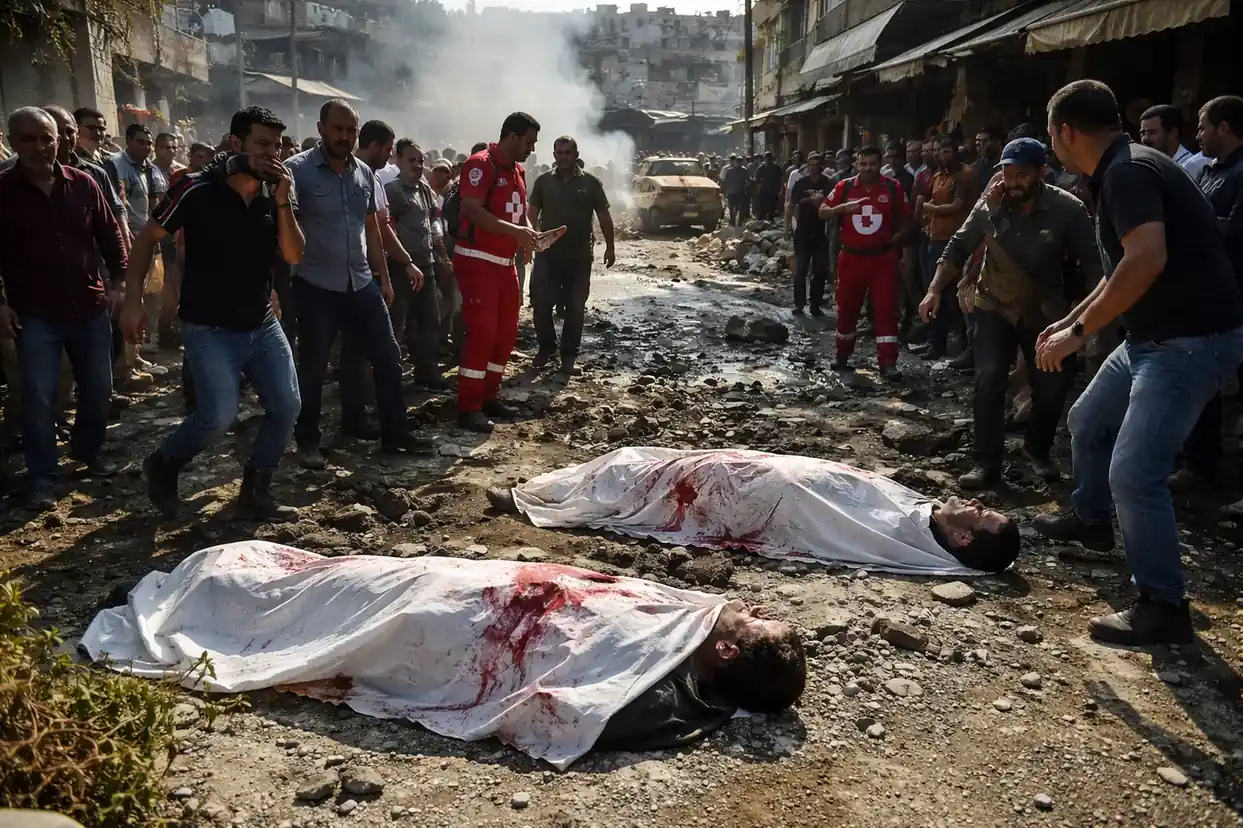
Two men were killed in southern Lebanon after Israeli troops opened fire in what has become the first reported fatal breach of a fragile new ceasefire between Israel and Hezbollah. The incident in Nabatieh al-Fawqa immediately raises the question that hangs over every new truce in the region: whether the ceasefire is a real stabilizing mechanism or simply a pause waiting to collapse.
Because the lull in fighting had only just begun, the shooting carries outsized significance. Early fatalities after a ceasefire are rarely treated as isolated events. They are read as indicators of whether local commanders, armed groups, and political leaders are actually operating under the same rules.
Why this is such an important test of the ceasefire
The first fatal breach of the ceasefire matters because ceasefires survive on perception as much as on text. Once civilians, aid workers, or local operatives begin dying again, trust disappears quickly, and each side becomes more likely to justify fresh force as a defensive necessity.
That is why the competing narratives are so important here. Lebanese sources describe the dead men as involved in road clearing and recovery work. The IDF says it was targeting armed Hezbollah-linked figures inside a declared security zone. Those are not small differences in emphasis. They are fundamentally different descriptions of the event itself.
Why the location matters
The area around Nabatieh al-Fawqa and the Ali al-Taher ridge is strategically sensitive because it has seen heavy fighting and carries both tactical and symbolic weight. High ground, access routes, and reconstruction activity all become politically charged during ceasefires because movement on the ground can be read either as civilian recovery or as hostile repositioning.
That ambiguity makes southern Lebanon especially vulnerable to renewed escalation. In conflict zones, the line between humanitarian movement, local defense presence, and suspected militant activity is often exactly where ceasefires break down.
Why Hezbollah's response matters
Hezbollah has condemned the killings as a clear violation of the truce, and its next choices will matter enormously. If the group responds militarily, even in a limited way, the ceasefire could unravel almost immediately. If it holds fire and pushes the issue through political or mediated channels, it may signal that both sides still see some value in preserving the agreement despite the breach.
That calculation is never purely military. Hezbollah also has to weigh public anger, internal legitimacy, and its relationship with Lebanese communities that may see any failure to respond as weakness.
The diplomatic timing is bad
The incident comes at a particularly delicate moment because Lebanese and Israeli officials are engaged in talks tied to broader de-escalation efforts. A fatal breach during active diplomacy weakens moderates and strengthens those arguing that the other side cannot be trusted. Even if negotiators continue talking, the political space around them narrows.
That is why this is not just a field incident. It is a diplomatic stress test. When a ceasefire is this new, each breach becomes evidence for one side's narrative about whether peace is possible at all.
What to watch next
The immediate questions are whether more shootings occur, whether international mediators push for a joint clarification mechanism, and whether Hezbollah retaliates directly or absorbs the incident for the sake of the broader truce. Watch too for whether the Israeli military expands its public evidence for the claim that the group targeted was armed and hostile.
Why this matters
The Israeli troops kill two in south Lebanon episode matters because the first deaths after a ceasefire often determine whether the agreement can survive real conditions on the ground. If this breach leads to retaliation, the truce may already be in danger. If it is contained politically, the ceasefire may still have a chance.
Why it matters
This incident represents the first lethal breakdown of the ceasefire and threatens the stability of ongoing peace talks between Lebanese and Israeli officials in Washington.
Read next
Follow this story through the topic hub, more world coverage, and the latest updates.
Weekly briefing
Get the week's key developments in one concise email.
Get a fast catch-up on the biggest stories, the context behind them, and the links worth your time.
Cadence
Weekly, for a quick catch-up
Coverage
AI, business, world, security, sports
Format
Clear takeaways and useful context
Request the briefing
Leave your email to open a prepared request and get on the list for the weekly briefing.
About the byline
World correspondent
Leila Haddad covers world affairs, diplomacy, and humanitarian crises, with a focus on how fast-moving international developments affect public policy, conflict response, and cross-border institutions.
Sources and methodology