Australian IS-Linked Families Repatriated from Syria Face Police
Thirteen individuals arrived in Melbourne and Sydney on Thursday as the government warns that returnees will face the full force of the law.

World correspondent
Reports on international affairs, diplomacy, and humanitarian developments with an emphasis on official statements, multilateral institutions, and regional context.
Editorial responsibility: Lead reviewer for geopolitics, international institutions, and crisis coverage
Primary source: BBC World News. Full source links and update notes are below.
Fast summary
Start here
- Thirteen women and children from the al-Roj detention camp in Syria landed in Melbourne and Sydney on Thursday afternoon.
- One woman, Janai Safar, was taken into police custody immediately upon arrival in Sydney to face potential terrorism charges.
- Federal authorities are investigating the group for crimes including entering declared areas and crimes against humanity such as slave trading.
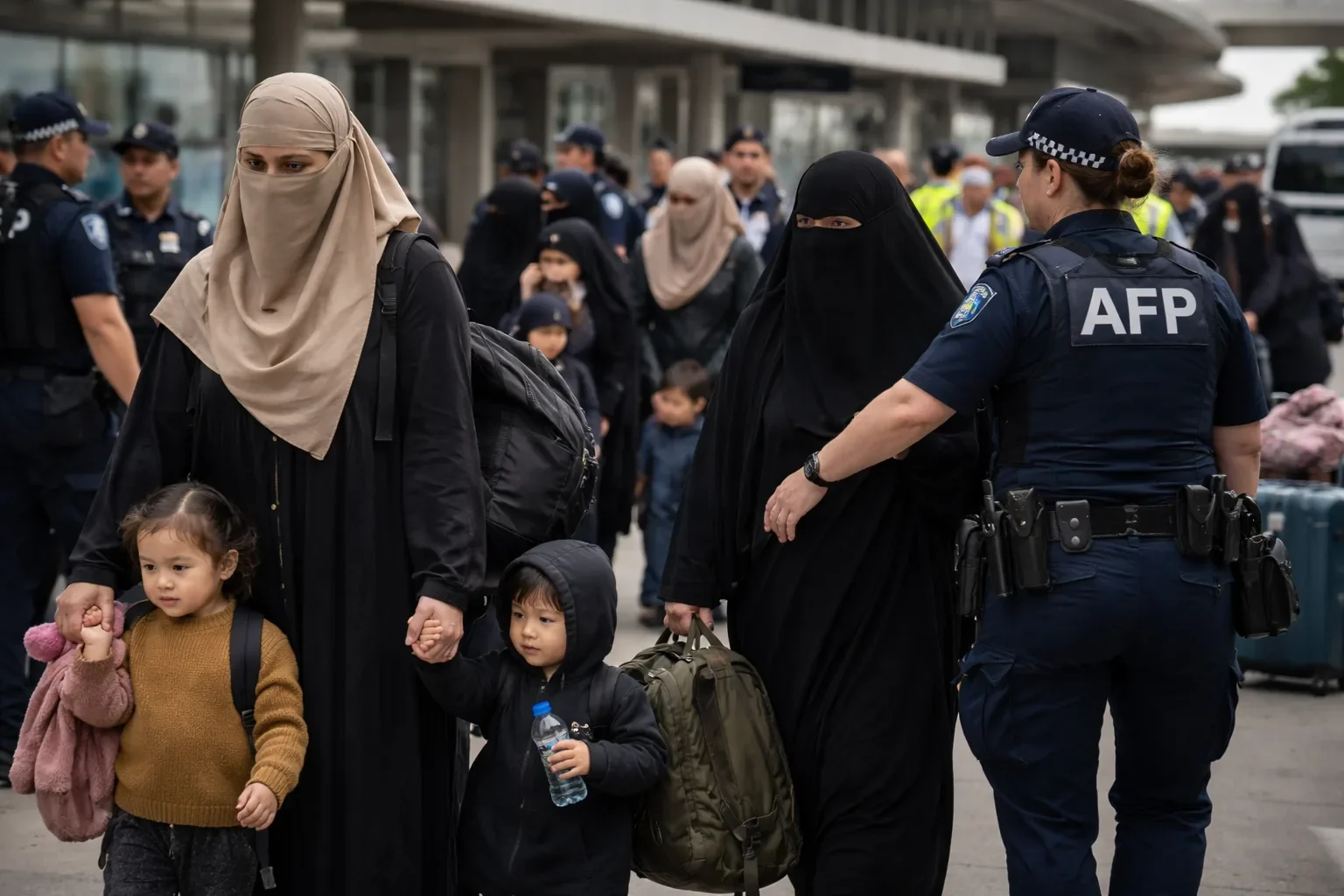
What happened
Thirteen Australian women and children linked to the Islamic State have returned to Australia from detention camps in Syria, bringing to a head a long-running debate over repatriation, accountability, and national security. The group arrived in Melbourne and Sydney after years in or around al-Roj camp, one of the detention sites that has come to symbolize the unresolved aftermath of the Islamic State's territorial collapse. Australian authorities moved quickly to take at least one woman into custody and made clear that any adult returnees suspected of crimes would face investigation or prosecution.
This repatriation matters because it forces Australia to confront a question many governments have tried to postpone: what should be done with citizens who traveled to Islamic State territory, lived under the caliphate, or were linked to its networks once the battlefield phase ended? Bringing them home resolves one problem but activates several others.
Why repatriation is so politically difficult
Repatriation from Syrian camps has always sat at the intersection of security risk and human rights pressure. On one side, governments fear bringing back people who may have supported, enabled, or joined a terrorist organization. On the other, leaving women and children in unstable camps indefinitely creates legal, moral, and strategic problems of its own, especially when those camps are under-resourced and vulnerable to further radicalization.
Australia's decision to accept these returnees therefore reflects more than administrative coordination. It reflects a judgment that monitoring, prosecution, and reintegration at home are ultimately preferable to indefinite abandonment in Syria.
The significance of al-Roj camp
Al-Roj camp has become shorthand for the unresolved social wreckage left behind by the Islamic State. Families with varying levels of responsibility, coercion, indoctrination, and victimization have been held in conditions that are both politically toxic and difficult to sustain. Children in these camps often grow up stateless in practice, traumatized, and isolated from any normal civic environment.
That is why the return of women and children from al-Roj is not simply a security story. It is also a child welfare, deradicalization, and rule-of-law story.
Immediate legal and policing consequences
The arrest of Janai Safar upon arrival underlines the government's effort to show that repatriation is not amnesty. Australian police and intelligence services have signaled that adult returnees may face charges related not only to travel into declared conflict zones, but potentially to more serious alleged conduct, including crimes against humanity. Those possibilities will shape public perception of the whole operation.
The state therefore has two parallel tasks. It must reassure the public that security screening and law enforcement are robust, while also managing the practical reality that children and some family members may need support services rather than immediate punishment.
Children, rehabilitation, and public trust
The children returning from Syria are arguably the most difficult and important part of the story. Many were taken there by parents or born into conflict they did not choose. Their reintegration will require schooling, psychological support, social supervision, and in some cases participation in programs designed to counter violent extremism. Public trust in the broader repatriation effort may depend on whether authorities can show that these children are being protected without minimizing the risks surrounding the adults around them.
This is where repatriation policy often becomes most complex: it is possible for children to be victims of extremism even when their parents are suspects in extremism-related crimes.
What comes next
The next stage will unfold in courts, police investigations, intelligence assessments, and state-run support programs. More details may emerge about the adults' past conduct in Syria, and those details could shape future Australian policy toward any remaining citizens in the region. Authorities will also be judged on whether long-term monitoring and rehabilitation systems are strong enough to manage this cohort responsibly.
For now, the return of IS-linked women and children to Australia from Syrian camps ends one chapter of delay but opens another of legal and political consequence. The country now has to prove that repatriation can serve both justice and security while dealing honestly with the human damage left by the Islamic State project.
Why it matters
The repatriation resolves a long-standing political and security dilemma for Australia regarding citizens who traveled to Islamic State-controlled territories.
Read next
Follow this story through the topic hub, more world coverage, and the latest updates.
Weekly briefing
Get the week's key developments in one concise email.
Get a fast catch-up on the biggest stories, the context behind them, and the links worth your time.
Cadence
Weekly, for a quick catch-up
Coverage
AI, business, world, security, sports
Format
Clear takeaways and useful context
Request the briefing
Leave your email to open a prepared request and get on the list for the weekly briefing.
About the byline
World correspondent
Leila Haddad covers world affairs, diplomacy, and humanitarian crises, with a focus on how fast-moving international developments affect public policy, conflict response, and cross-border institutions.
Sources and methodology