Huge Crowds in Mashhad for Burial of Iran's Late Supreme Leader
Ayatollah Ali Khamenei was laid to rest at the Imam Reza shrine as Iran concludes six days of mourning amid escalating military tensions with the US.

World correspondent
Reports on international affairs, diplomacy, and humanitarian developments with an emphasis on official statements, multilateral institutions, and regional context.
Editorial responsibility: Lead reviewer for geopolitics, international institutions, and crisis coverage
Primary source: BBC World News. Full source links and update notes are below.
Fast summary
Start here
- Khamenei was buried at the gold-domed Imam Reza shrine in Mashhad after six days of public mourning ceremonies across Iran and Iraq.
- The funeral occurred amid allegations from the Revolutionary Guards that the US bombed railway lines to disrupt the final procession.
- Successor Mojtaba Khamenei remained absent from public view, fueling speculation about his health following the strike that killed his father.
What happened
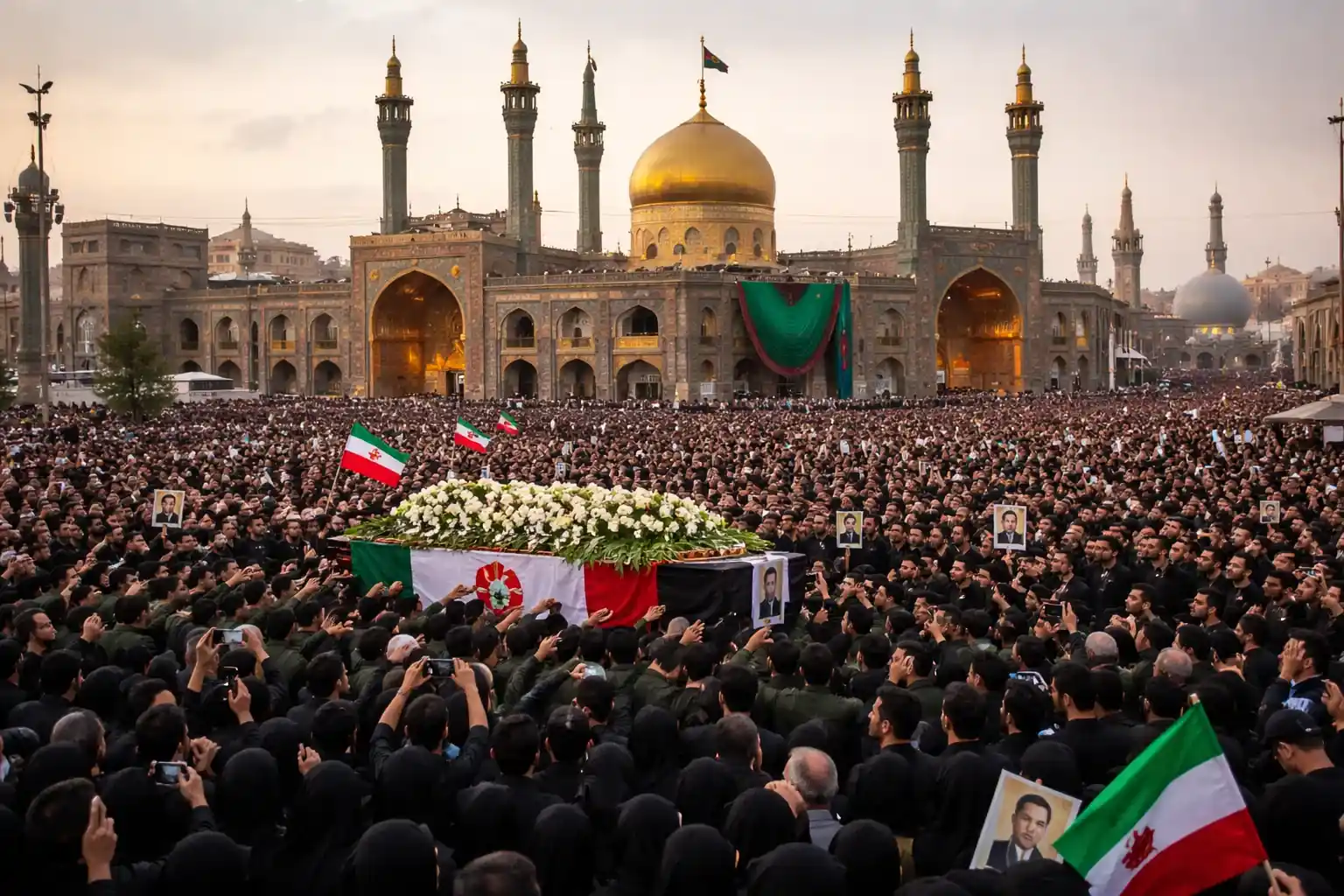
Thousands of mourners converged on the holy city of Mashhad to witness the final interment of Ayatollah Ali Khamenei, Iran's supreme leader for nearly four decades. The burial at the shrine of Imam Reza, the holiest Shia Muslim site in Iran, serves as the conclusion to nearly a week of choreographed public mourning that spanned five cities across Iran and neighboring Iraq. State media reported that the coffin arrived by plane from Iraq, where processions were held in the religious centers of Najaf and Karbala. The scale of the crowds in Mashhad, Iran's second-largest city and the late leader’s birthplace, reflects the gravity of the political vacuum left by his sudden death. Black-clad citizens lined the main boulevards, waving national flags and banners of vengeance, signaling a nation still in the throes of both grief and active warfare following the Feb. 28 strike on Tehran.
What's new in this update
This final stage of the mourning period was marked by renewed military friction between Tehran and Washington. Shortly before the burial, Iran's Revolutionary Guards issued a formal accusation against the United States, claiming that American forces bombed two critical bridges on the railway line connecting Tehran to Mashhad. The Iranian military establishment characterized these strikes as a deliberate attempt to overshadow the funeral and disrupt the logistics of the state-mandated ceremonies. This development comes at a precarious moment for regional stability, as it follows a recent exchange of direct strikes between the two nations. These hostilities threaten to dismantle a preliminary agreement intended to halt the broader conflict that initially claimed the life of the supreme leader four months ago. The presence of red banners among the crowds in Mashhad underscored the demand for retaliation against Western leaders.
Key details
The logistics of the burial were heavily secured, with a lorry transporting the coffin slowly through the dense throngs toward the 9th-century mausoleum complex. Khamenei was laid to rest alongside several members of his family, including his granddaughter, son-in-law, and daughter, who also perished in the strike on his residence. Notably absent from the proceedings was his son and successor, Mojtaba Khamenei. Although officially appointed to lead the Islamic Republic, the 56-year-old Mojtaba has not made a public appearance since the February attack. Reports suggest he was seriously wounded in the same strike that killed his father, and his continued absence from the high-profile funerals in Tehran, Qom, and now Mashhad has raised significant questions regarding his capacity to govern during this period of existential threat to the regime. The state-run IRNA news agency emphasized the religious significance of the Imam Reza shrine as the final resting place.
Background and context
Ayatollah Ali Khamenei assumed power in 1989 following the death of the Islamic Republic's founder, Ruhollah Khomeini. Over his 37-year tenure, he consolidated absolute control over Iran’s political, judicial, and military apparatus. His leadership was defined by a hard-line stance against Western influence and the suppression of internal dissent, most recently evidenced by the violent crackdown on mass protests in January that resulted in thousands of deaths. The current conflict, which began with a joint U.S.-Israeli strike on the supreme leader's residence, has shifted Iran into a state of total mobilization. The leadership in Tehran has utilized the funeral ceremonies as a tool for political theater, aiming to project a unified front and domestic strength despite the heavy losses sustained during the recent months of war. The burial in Mashhad, where Khamenei was born and educated, brings his legacy full circle within the clerical establishment.
What to watch next
The immediate concern for regional observers is whether the burial of Khamenei will serve as a catalyst for a new phase of Iranian military action or if the regime will pivot toward the preliminary peace deal. The rhetoric from mourners in Mashhad, who openly called for the deaths of U.S. President Donald Trump and Israeli Prime Minister Benjamin Netanyahu, suggests that the domestic pressure for vengeance remains high. Simultaneously, the health and political visibility of Mojtaba Khamenei will be a critical indicator of the regime's internal stability. If the new supreme leader remains incapacitated or hidden, a power struggle within the Revolutionary Guards or the clerical elite could emerge. Furthermore, the status of the Tehran-Mashhad railway line and any potential retaliatory strikes for the bridge bombings will determine if the current exchange of fire between the U.S. and Iran escalates into a wider, more destructive regional conflagration.
Why it matters
The burial of Iran's longest-serving supreme leader marks a volatile transition of power during an active conflict with Israel and the United States.
Read next
Follow this story through the topic hub, more world coverage, and the latest updates.
Weekly briefing
Get the week's key developments in one concise email.
Get a fast catch-up on the biggest stories, the context behind them, and the links worth your time.
Cadence
Weekly, for a quick catch-up
Coverage
AI, business, world, security, sports
Format
Clear takeaways and useful context
Request the briefing
Leave your email to open a prepared request and get on the list for the weekly briefing.
About the byline
World correspondent
Leila Haddad covers world affairs, diplomacy, and humanitarian crises, with a focus on how fast-moving international developments affect public policy, conflict response, and cross-border institutions.
Sources and methodology