Scientists Identify Largest Dinosaur Ever Found in Southeast Asia
The discovery of Nagatitan chaiyaphumensis sheds light on how massive sauropods thrived during a period of rising global temperatures.

World correspondent
Reports on international affairs, diplomacy, and humanitarian developments with an emphasis on official statements, multilateral institutions, and regional context.
Editorial responsibility: Lead reviewer for geopolitics, international institutions, and crisis coverage
Primary source: BBC World News. Full source links and update notes are below.
Fast summary
Start here
- Nagatitan chaiyaphumensis weighed approximately 27 tonnes and reached 27 meters in length.
- The species lived between 100 and 120 million years ago in what is now Thailand's Chaiyaphum province.
- The discovery provides evidence of how gigantic herbivores adapted to extreme climatic conditions and rising CO2 levels.
What happened
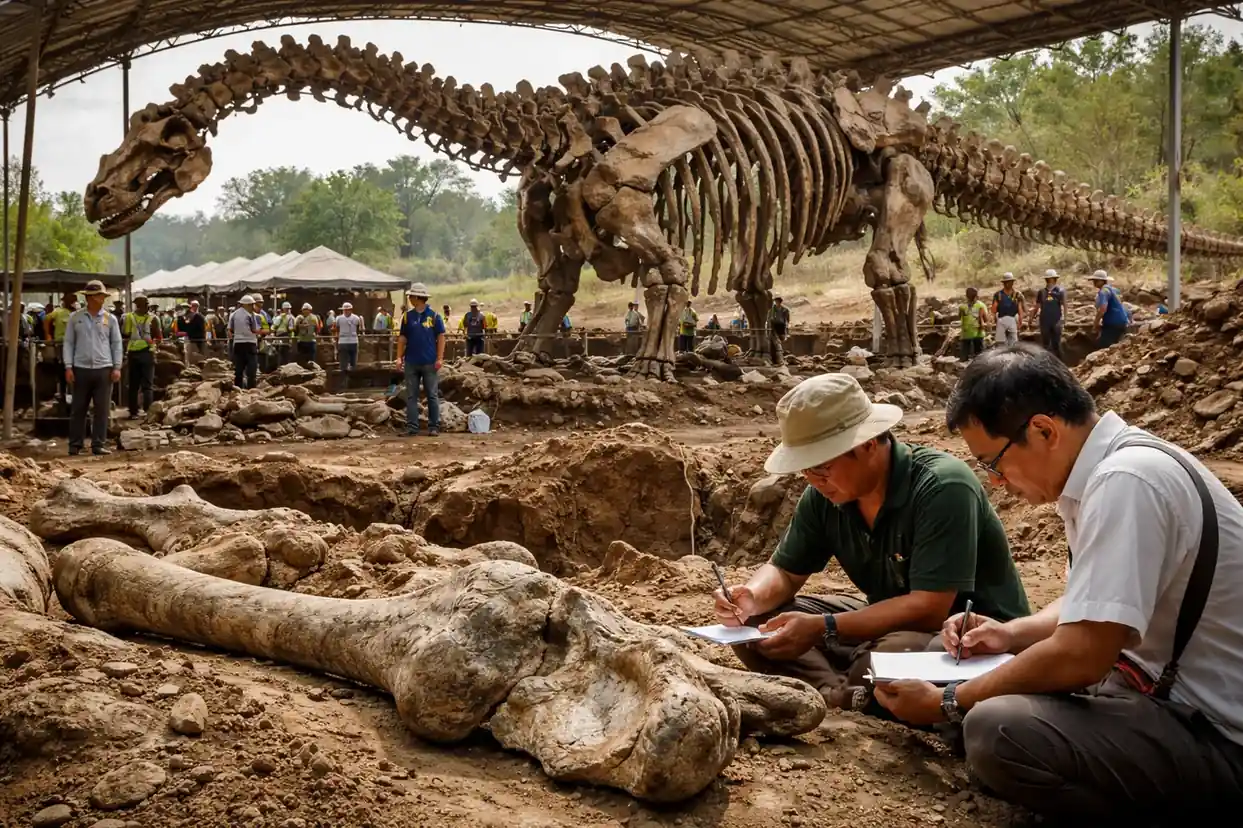
Scientists have identified a new giant dinosaur species in Thailand, Nagatitan chaiyaphumensis, now described as the largest dinosaur ever found in Southeast Asia. The discovery is based on fossils recovered in Chaiyaphum province and places Thailand more firmly on the global paleontological map. The animal is estimated to have weighed around 27 tonnes and stretched roughly 27 meters in length, making it a truly massive sauropod and one of the most significant dinosaur discoveries in the region.
This matters not only because of the dinosaur's size, but because the find changes how scientists think about Southeast Asia's role in dinosaur evolution and about how giant herbivores survived in climates warmer than today's. Nagatitan is important as both a local and global scientific discovery.
Why Nagatitan is such a significant find
The identification of Nagatitan chaiyaphumensis is significant because size alone makes it extraordinary. But paleontology values more than spectacle. What matters is what a new species reveals about geography, ecology, and evolutionary relationships. In this case, Nagatitan suggests that large sauropods were thriving in parts of Southeast Asia during a period when the environment was already hot, carbon dioxide levels were high, and ecological conditions were changing.
That gives the discovery scientific value beyond public fascination with giant dinosaurs. It offers evidence about how life adapted to ancient climate systems.
Why Thailand matters in dinosaur research
Thailand has become increasingly important to paleontology over the past several decades, with multiple dinosaur species already identified there. The discovery of Nagatitan strengthens that reputation. It shows that Southeast Asia is not a peripheral zone in dinosaur science, but a region capable of producing fossils that reshape broader debates about dinosaur diversity and distribution.
That matters for two reasons. First, it encourages more research and investment in local fossil study. Second, it challenges the tendency of global dinosaur narratives to center overwhelmingly on North America, China, or South America.
Sauropods, climate, and gigantism
Sauropods were among the largest land animals ever to live, and one of the long-running scientific questions about them is how such enormous bodies functioned under ancient climate conditions. Large animals face difficulties dissipating heat, which is why Nagatitan's presence during a warm Cretaceous environment is scientifically interesting. It suggests either that these animals had effective ecological strategies for coping with heat, or that the local conditions were more favorable to gigantism than broad climate summaries might imply.
That is one reason the discovery is tied to discussions about climate and deep-time biology. The fossil is not just a skeleton. It is evidence in a larger argument about environmental adaptation.
The meaning of the name
The name Nagatitan chaiyaphumensis carries cultural as well as scientific significance. "Naga" invokes the serpent beings of Southeast Asian mythology, while "titan" signals size and grandeur. "Chaiyaphumensis" anchors the species to the province where it was found. Naming in paleontology matters because it ties the global scientific record to local geography and cultural context, ensuring that discoveries are not detached from the places that produced them.
That local anchoring may also help build public interest in science and heritage within Thailand itself.
What comes next
Researchers will now continue studying where Nagatitan fits among other sauropods and what its anatomy reveals about movement, feeding, and environmental adaptation. There will also be interest in whether related fossils remain hidden in nearby formations and whether Chaiyaphum can yield additional finds from the same ecosystem.
For now, the discovery of Nagatitan chaiyaphumensis establishes Thailand as the site of the largest dinosaur ever found in Southeast Asia and adds a major piece to the story of giant herbivores in a hot ancient world. It is a discovery that combines scale, regional significance, and climate-era scientific value, which is why it is much more than a simple dinosaur headline.
Why it matters
This discovery establishes Thailand as a critical site for understanding dinosaur evolution and how large-bodied species survived during historical periods of high global heat.
Read next
Follow this story through the topic hub, more world coverage, and the latest updates.
Weekly briefing
Get the week's key developments in one concise email.
Get a fast catch-up on the biggest stories, the context behind them, and the links worth your time.
Cadence
Weekly, for a quick catch-up
Coverage
AI, business, world, security, sports
Format
Clear takeaways and useful context
Request the briefing
Leave your email to open a prepared request and get on the list for the weekly briefing.
About the byline
World correspondent
Leila Haddad covers world affairs, diplomacy, and humanitarian crises, with a focus on how fast-moving international developments affect public policy, conflict response, and cross-border institutions.
Sources and methodology