Climate-Induced Extreme Weather Events Threaten Survival of World's
A new comprehensive study finds that four days of heavy rain and landslides in Sumatra killed at least 58 Tapanuli orangutans, representing 7% of the total

World correspondent
Reports on international affairs, diplomacy, and humanitarian developments with an emphasis on official statements, multilateral institutions, and regional context.
Editorial responsibility: Lead reviewer for geopolitics, international institutions, and crisis coverage
Primary source: BBC World News. Full source links and update notes are below.
Fast summary
Start here
- A study published Wednesday confirms that approximately 7% of the world's rarest orangutan population was lost during Cyclone Senyar.
- Experts warn the species cannot survive population losses exceeding 1% per year, making the 7% loss a catastrophic blow to their survival.
- The Indonesian government has suspended major industrial developments in the Batang Toru forest to assess ongoing ecological risks.
What happened
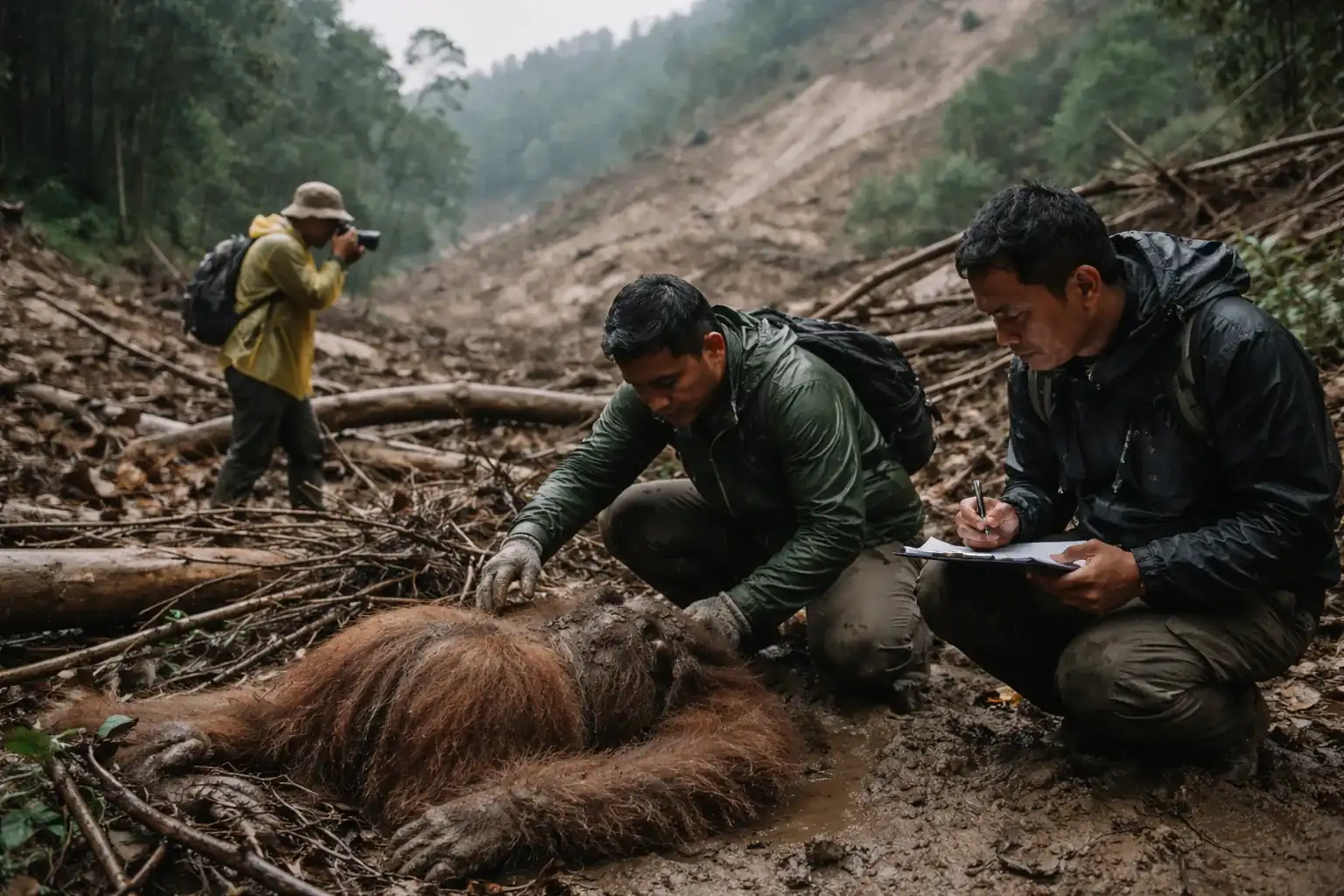
A new study has found that extreme rainfall and landslides in Sumatra killed at least 58 Tapanuli orangutans, wiping out roughly 7% of the world's rarest great ape in a matter of days. For a species already living on the edge of viability, that is not merely a conservation setback. It is a population-level shock.
The event was linked to intense weather associated with Cyclone Senyar, which caused widespread devastation across the region. Human casualties dominated the immediate disaster coverage, but the new research shows that the storm was also catastrophic for one of the planet's most endangered primates.
Why the 7% figure is so alarming
With many wildlife stories, percentage losses can sound abstract. In the case of the Tapanuli orangutan, they are brutally concrete. The global population is thought to number fewer than 800 individuals, confined largely to the Batang Toru forest in North Sumatra. That means every death matters, and a loss of 58 animals in one event is ecologically severe.
Conservation experts have warned that the species may not be able to withstand annual losses much above 1%. A sudden 7% decline therefore represents damage far beyond what a fragile population can comfortably absorb. It reduces breeding capacity, fragments already thin social and territorial structures, and increases the risk that future shocks could push the species past a recovery threshold.
Why climate-linked disasters are now a direct extinction threat
The study matters because it reframes the risk. Habitat destruction, mining, road building, and hydropower development have long been seen as the main threats to the Tapanuli orangutan. They still are. But this event shows that climate-intensified disasters can interact with those pressures in ways that accelerate decline much faster than gradual habitat loss alone.
When a species is concentrated in a single restricted range, extreme weather is not just another stress factor. It becomes a systemic vulnerability. Landslides, flood surges, and forest destabilization can wipe out clusters of animals at once, especially when fragmented habitat leaves them with fewer escape routes and fewer resilient refuges.
Why Batang Toru is so important
The Batang Toru forest is the only place on Earth where the Tapanuli orangutan survives. That geographic confinement makes every policy decision in the area consequential. Industrial activity that weakens slopes, fragments canopy routes, or increases ecological stress does not just pressure the species indirectly. It can make storm-driven mortality more likely and recovery more difficult.
Indonesia's temporary suspension of major development projects in the area therefore matters. It suggests the government recognizes that conservation planning can no longer treat climate risk as a secondary issue. The stability of the habitat itself is now part of species survival.
A conservation warning beyond one species
The Sumatra orangutan landslide findings also speak to a wider pattern in biodiversity protection. Conservation strategies have often been built around chronic threats: poaching, land clearing, agricultural expansion, and infrastructure encroachment. Those remain central, but acute climate events are now becoming extinction accelerants in their own right.
For narrow-range species, one storm can erase years of slow recovery. That changes the math for policymakers and researchers. Protecting habitat is still essential, but it is no longer enough to assume that preserved habitat alone guarantees resilience.
What to watch next
Researchers will now look for more precise data on the distribution of losses, reproductive impacts, and whether surviving orangutans are shifting their movement patterns after the storm. Conservation groups will also watch whether Indonesia's temporary pause on development becomes a stronger long-term protection framework.
Why this matters
The Tapanuli orangutan population story matters because it shows how extinction can accelerate in a climate-disrupted world. A species discovered only recently as distinct is now losing meaningful portions of its total population in single weather events. That is not just a warning for Sumatra. It is a warning for conservation everywhere.
Why it matters
The loss of nearly 10% of a localized population in a single event highlights how climate-induced disasters can push critically endangered species toward rapid extinction.
Read next
Follow this story through the topic hub, more world coverage, and the latest updates.
Weekly briefing
Get the week's key developments in one concise email.
Get a fast catch-up on the biggest stories, the context behind them, and the links worth your time.
Cadence
Weekly, for a quick catch-up
Coverage
AI, business, world, security, sports
Format
Clear takeaways and useful context
Request the briefing
Leave your email to open a prepared request and get on the list for the weekly briefing.
About the byline
World correspondent
Leila Haddad covers world affairs, diplomacy, and humanitarian crises, with a focus on how fast-moving international developments affect public policy, conflict response, and cross-border institutions.
Sources and methodology