Trump and Xi Jinping Hold Two-Hour Meeting During Beijing State
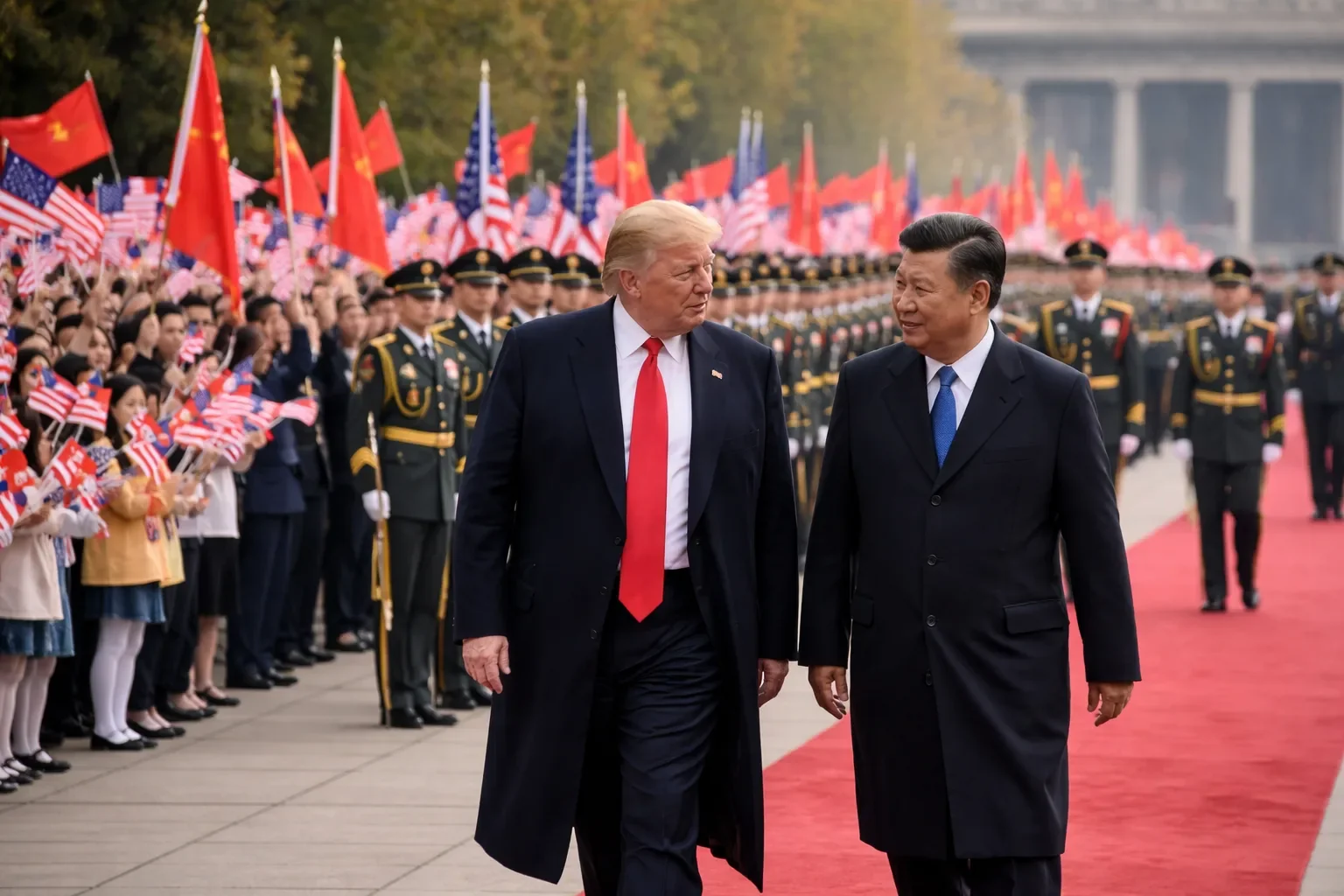
The U.S. President received a ceremonial welcome including a troop parade before engaging in high-level talks with China's leader.

World correspondent
Reports on international affairs, diplomacy, and humanitarian developments with an emphasis on official statements, multilateral institutions, and regional context.
Editorial responsibility: Lead reviewer for geopolitics, international institutions, and crisis coverage
Primary source: BBC World News. Full source links and update notes are below.
Fast summary
Start here
- Donald Trump was greeted by a troop parade and cheering children upon his arrival in Beijing.
- A two-hour private meeting was held between President Trump and Chinese leader Xi Jinping.
- The diplomatic itinerary included a cultural tour of the Temple of Heaven.
What happened
Donald Trump began his state visit to China with a ceremonially dense first day in Beijing that combined diplomatic theater with a two-hour meeting alongside Chinese leader Xi Jinping. The welcome included military pageantry, choreographed symbolism, and cultural elements designed to underline the importance Beijing attached to the visit. But beneath the spectacle, day one was really about reopening or stabilizing the highest channel of direct political contact between the United States and China.
That makes a Donald Trump China state visit recap more than a schedule summary. The public optics matter because both governments understand that major bilateral meetings are performed as much for domestic and international audiences as for the negotiators in the room.
Why the ceremonial welcome matters
State visits are never only about policy. The scale of the welcome signals political intent. A troop parade, cheering schoolchildren, and carefully managed visual settings communicate that the host country wants the encounter to be read as important, respectful, and strategically valuable. In Beijing, that symbolism carries additional meaning because protocol often doubles as diplomatic language.
That matters for Trump and Xi because their relationship has always been interpreted through both personal style and geopolitical tension. A visibly warm or highly formal day-one reception can shape outside expectations before any detailed readout from the talks is even released.
Why the Trump-Xi meeting was the real center of the day
The two-hour Trump Xi Jinping meeting is the part of day one that matters most substantively. Even without immediate public breakthroughs, a session of that length suggests a broad agenda and a desire to handle sensitive issues at the top level rather than through lower-intensity bureaucratic messaging alone. The key themes are likely to have included trade, regional security, strategic competition, and the broader effort to keep China-US relations from becoming even more adversarial.
That is important because the two countries now manage one of the most consequential and fragile relationships in the world. Even symbolic stability has value when the underlying disputes remain large.
Why Beijing is such a consequential setting
Holding the early phase of the visit in Beijing reinforces the degree to which this is a state-managed political moment rather than a transactional side meeting. Every movement inside the capital carries institutional meaning. The Temple of Heaven visit, for example, is not just tourism. It is part of the host's effort to situate diplomatic engagement within a deeper civilizational and cultural narrative.
This matters because China often uses such settings to signal continuity, legitimacy, and grandeur. The message is not only that America is welcome. It is that it is being hosted on terms shaped by Chinese state confidence and historical self-presentation.
What day one can and cannot tell us
It is important not to overread the first day of a state visit. Ceremonial harmony does not automatically translate into policy convergence. US-China relations are too complex, and the structural tensions are too deep, for atmospherics alone to serve as proof of progress. But day one can reveal tone, seriousness, and whether both sides are trying to create space for managed competition rather than open deterioration.
That is why the state visit recap still matters. The choreography is not empty, even if it is not decisive. It helps define the framework within which harder negotiations continue.
What to watch next
The most important next steps are official statements, whether trade or security language becomes more concrete, and whether the visit produces even limited joint framing on the biggest disputed issues. Watch especially for how each side characterizes the talks afterward. Differences in wording often reveal how much real alignment exists beneath the ceremony.
Why this matters
Day one of Donald Trump's state visit to China matters because it set the tone for one of the world's most consequential bilateral relationships. The ceremonial welcome showed political intent, while the Trump-Xi meeting created the first real measure of whether both governments are seeking tactical stability, symbolic optics, or something more durable in the next phase of China-US diplomacy.
Reader context
This story belongs to Northstar Herald's International Relations coverage, with related entities including Donald Trump, Xi Jinping, China-US relations, Beijing. The report is based on BBC World News source material.
Related coverage
Why it matters
This meeting is a pivotal moment for China-US relations as both nations address complex trade and security issues on the global stage.
Read next
Follow this story through the topic hub, more world coverage, and the latest updates.
Weekly briefing
Get the week's key developments in one concise email.
Get a fast catch-up on the biggest stories, the context behind them, and the links worth your time.
Cadence
Weekly, for a quick catch-up
Coverage
AI, business, world, security, sports
Format
Clear takeaways and useful context
Request the briefing
Leave your email to open a prepared request and get on the list for the weekly briefing.
About the byline
World correspondent
Leila Haddad covers world affairs, diplomacy, and humanitarian crises, with a focus on how fast-moving international developments affect public policy, conflict response, and cross-border institutions.
Sources and methodology