Dead Humpback Whale Towed Ashore in Denmark for Autopsy
After a weeks-long saga in the Baltic Sea, the whale nicknamed 'Timmy' has been moved to a Danish beach for a post-mortem examination.
Primary source: BBC World News. Full source links, newsroom standards, and correction details are below.
Fast summary
Start here
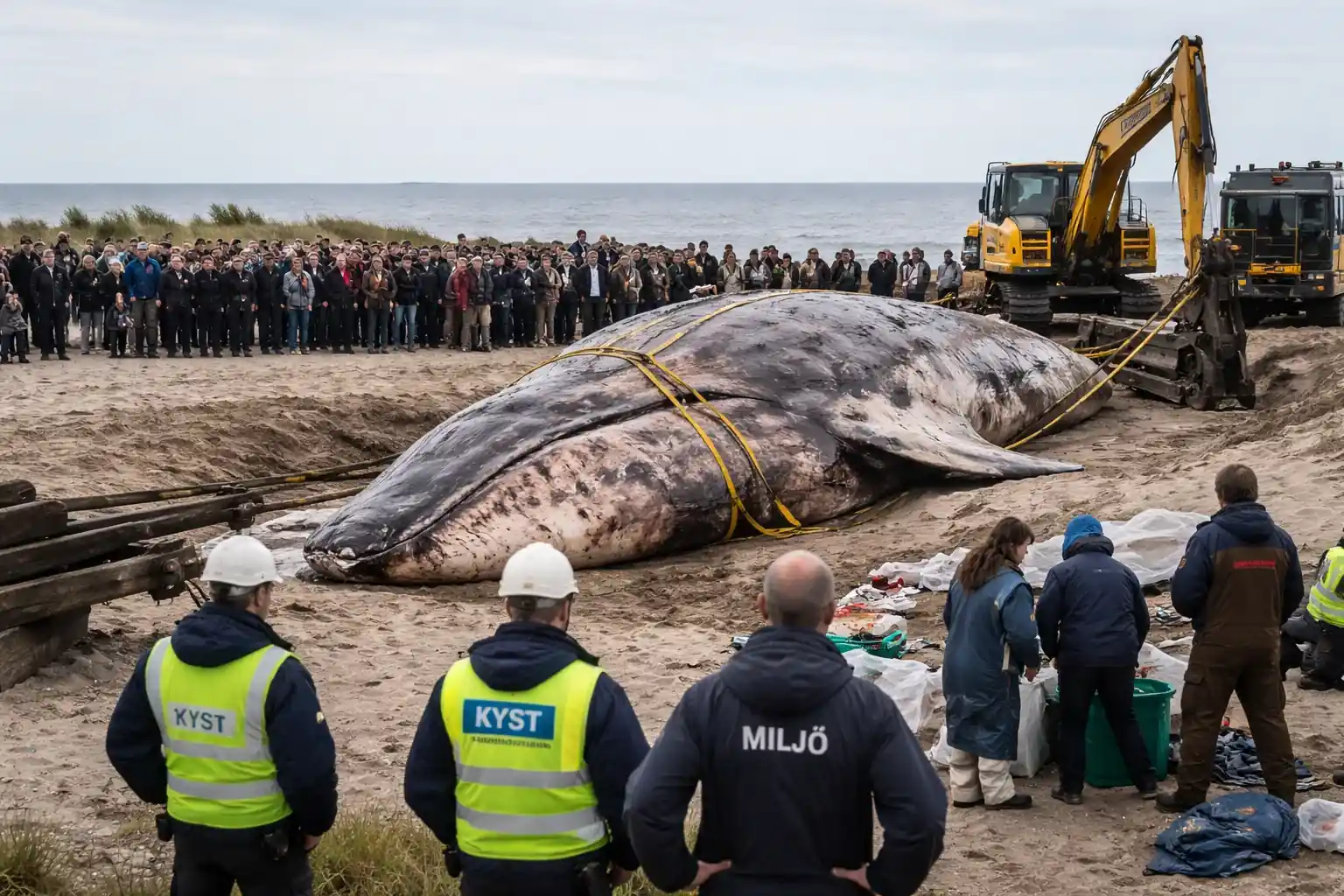
- Industrial winches were used Saturday to pull the whale carcass onto a beach on the Danish island of Anholt.
- Danish environment officials scheduled a post-mortem examination for Thursday to be followed by the dismantling of the body.
- Authorities expressed concern about the carcass exploding due to a build-up of decomposition gases while sitting on a popular beach.
What happened
The carcass of a humpback whale, which had become a subject of intense public interest across Germany and Denmark, was successfully towed onto the shoreline of Anholt. Timelapsed footage showed the mammal being pulled slowly onto the beach by an industrial winch on Saturday. This development follows the animal's death shortly after a failed private mission to relocate it to the North Sea.
What's new in this update
Denmark's environment agency has confirmed that a team of veterinarians and researchers will travel to the island on Thursday to conduct a post-mortem examination. Following the sampling, the whale—which has grown in size due to internal gas buildup—will be cut into pieces and transported elsewhere to be destroyed. The urgency of the disposal is driven by the carcass's location on a popular public beach.
Key details
The whale, estimated to be between 12 and 15 meters in length, was found dead off Anholt's shoreline earlier in May. Morten Abildstrøm, a Danish Environmental Agency official, noted that previous attempts to move the body to the mainland port of Grenaa were thwarted by poor weather conditions. There is currently an active concern regarding the risk of the carcass exploding as decomposition progresses.
Background and context
The whale, nicknamed 'Timmy' and 'Hope,' first gained international attention when it became stranded in Lübeck Bay in March. Despite efforts by German environmental workers to free it from sandbanks, it swam further into the Baltic Sea, eventually getting stuck near the island of Poel. A last-ditch private rescue effort using inflatable cushions and a floating platform attempted to move the weakened animal back to the North Sea, but the whale was already severely ailing due to skin damage caused by the Baltic's low salt content.
What to watch next
The results of the post-mortem on Thursday may provide further insight into the whale's health prior to its death. Once the samples are taken, the logistical challenge of dismantling and removing the 15-meter carcass from the island of Anholt will begin, marking the final chapter of the mammal's journey.
Why this matters
The whale's death concludes a high-profile cross-border rescue effort that highlighted the ecological challenges faced by marine mammals in the low-salinity waters of the Baltic Sea.
Reader context
This story belongs to Northstar Herald's International Relations coverage, with related entities including Denmark, Germany, Wildlife, Humpback Whale. The report is based on BBC World News source material.
Related coverage
Why it matters
The whale's death concludes a high-profile cross-border rescue effort that highlighted the ecological challenges faced by marine mammals in the low-salinity waters of the Baltic Sea.
Read next
Follow this story through the topic hub, more world coverage, and the latest updates.
Weekly briefing
Get the week's key developments in one concise email.
Get a fast catch-up on the biggest stories, the context behind them, and the links worth your time.
Cadence
Weekly, for a quick catch-up
Coverage
AI, business, world, security, sports
Format
Clear takeaways and useful context
Request the briefing
Leave your email to open a prepared request and get on the list for the weekly briefing.
Author

The world desk follows geopolitics, humanitarian crises, diplomacy, and major international developments with an emphasis on fast updates and public-interest context.
Sources and methodology