Danish Mission to Tow Dead Humpback Whale Hits Sandbank
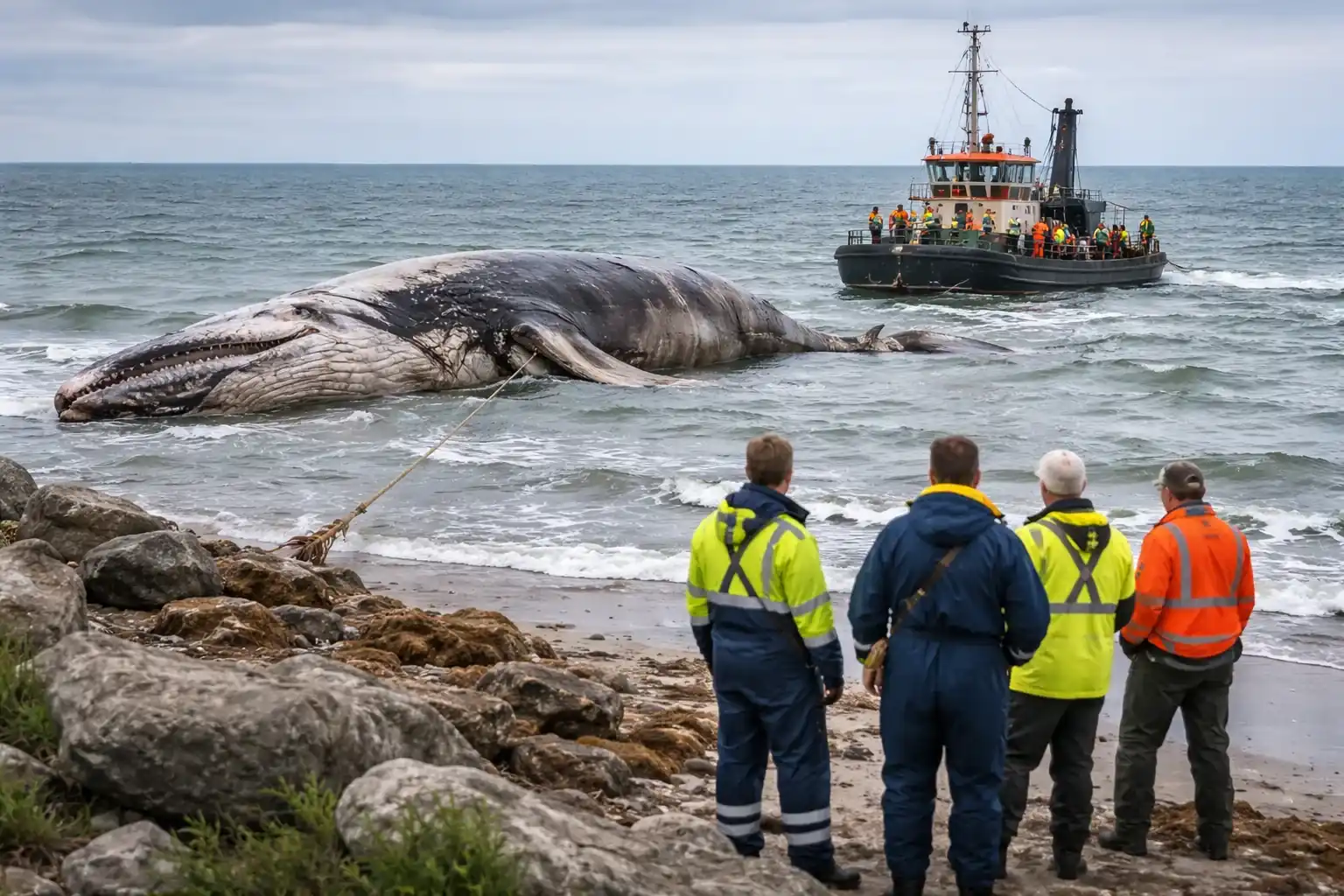
An operation to transport a decomposing humpback whale from Anholt island to the Danish mainland has been suspended after the carcass became stuck on a sandbank.
Primary source: BBC World News. Full source links, newsroom standards, and correction details are below.
Fast summary
Start here
- Danish environmental officials attempted to tow a dead humpback whale 57km from Anholt island to the port of Grenaa for research.
- The mission was paused on Thursday after the carcass became stranded on a sandbank, with further attempts delayed by a public holiday.
- The whale, identified via a GPS tracker, was the same animal involved in a failed private rescue mission in German waters earlier this year.
What happened
Danish environmental authorities launched an emergency operation to remove the carcass of a humpback whale from the shores of Anholt island. The whale was discovered last weekend, two weeks after it was released into the sea during a failed rescue attempt in Germany. Officials decided to move the mammal to the mainland port of Grenaa to mitigate disruption and potential health risks to the island's residents.
What's new in this update
The relocation effort hit a significant obstacle early Thursday when the whale became stranded on a sandbank some distance from the shore. Despite multiple attempts to tow the animal into deeper water for transport by a larger vessel, the Danish Environmental Protection Agency confirmed the operation has been temporarily paused while the response team evaluates alternative logistical options.
Key details
The carcass has become a point of concern for islanders as decomposition has caused a significant build-up of gas, leading to a visible increase in size and fears of a possible explosion. Authorities have warned the public to keep their distance due to the risk of infection. A GPS tracker found on the mammal confirmed it is the same whale previously nicknamed 'Timmy' or 'Hope' by the German public.
Background and context
The whale first gained international attention in March when it became entangled in netting in Germany's Lübeck Bay. Private entrepreneurs later attempted to save the animal by transporting it via barge toward the North Sea in late April, despite warnings from experts that the whale was too weak to survive. It was eventually released roughly 70km from the northern tip of Denmark.
What to watch next
A second attempt to move the whale is unlikely to proceed before the conclusion of Denmark's long public holiday weekend. Once the carcass is successfully moved to Grenaa, marine researchers plan to perform a post-mortem examination and collect scientific samples to better understand why the mammal's health declined following its release.
Why this matters
The whale's death concludes a high-profile international effort to save the animal, while its current state poses environmental hazards and potential safety risks due to decomposition.
Reader context
This story belongs to Northstar Herald's International Relations coverage, with related entities including Denmark, Germany, Humpback Whale, Anholt Island. The report is based on BBC World News source material.
Related coverage
Why it matters
The whale's death concludes a high-profile international effort to save the animal, while its current state poses environmental hazards and potential safety risks due to decomposition.
Read next
Follow this story through the topic hub, more world coverage, and the latest updates.
Weekly briefing
Get the week's key developments in one concise email.
Get a fast catch-up on the biggest stories, the context behind them, and the links worth your time.
Cadence
Weekly, for a quick catch-up
Coverage
AI, business, world, security, sports
Format
Clear takeaways and useful context
Request the briefing
Leave your email to open a prepared request and get on the list for the weekly briefing.
Author

The world desk follows geopolitics, humanitarian crises, diplomacy, and major international developments with an emphasis on fast updates and public-interest context.
Sources and methodology