Knicks Extend Playful 10-Day Contract Offer to Actor Timothée
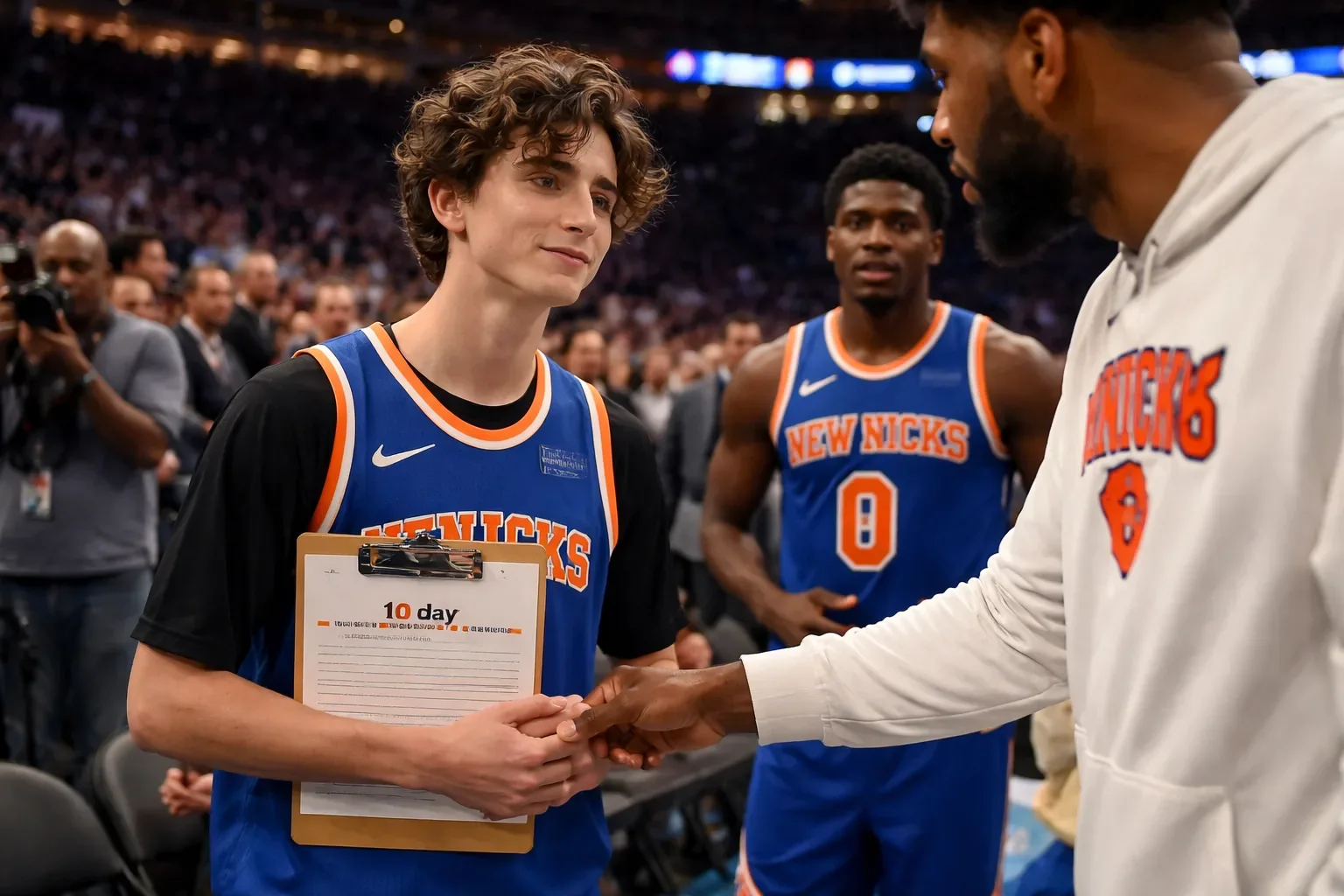
The New York Knicks organization shared a lighthearted mock contract offer to actor and frequent courtside guest Timothée Chalamet.

Sports reporter
Reports on leagues, tournaments, and athlete developments with an emphasis on verified event details, official announcements, and commercial context.
Editorial responsibility: Lead reviewer for match reporting, tournament context, and league governance coverage
Primary source: ESPN Top Headlines. Full source links and update notes are below.
Fast summary
Start here
- The New York Knicks jokingly offered actor Timothée Chalamet a 10-day NBA contract on social media.
- The gesture followed public banter involving Knicks center Karl-Anthony Towns and Timberwolves guard Anthony Edwards.
- Chalamet is a lifelong Knicks fan and a frequent presence at Madison Square Garden games.
What happened
The New York Knicks jokingly offered actor Timothée Chalamet a 10-day contract, turning a small piece of NBA banter into a social media moment that blended basketball, celebrity culture, and team branding. The mock offer was never meant as anything more than a joke, but it landed because Chalamet is not just any celebrity fan. He is one of the Knicks' most visible and most recognizable supporters, a familiar courtside presence at Madison Square Garden and a genuine part of the team's public image.
What's new in this update
The joke grew out of a playful chain involving Karl-Anthony Towns and Anthony Edwards, which gave the Knicks' social team an easy opening to join the conversation. Rather than simply reposting the exchange, the organization leaned into the NBA language of short-term roster moves and presented Chalamet as if he were ready to sign a 10-day deal. That framing worked because it borrowed a very real piece of league culture and turned it into a fan-service punchline.
This kind of post matters more than it may seem. Teams increasingly treat social media as part of the entertainment product, not just a channel for announcements. A light joke involving Chalamet, Towns, and Edwards can generate attention well beyond regular Knicks coverage and keep the franchise visible to casual audiences who may not even be following the actual basketball storyline closely.
Key details
In NBA terms, a 10-day contract is a real roster mechanism used to address injuries, test fringe talent, or add short-term depth. The Knicks used that recognizable concept to make the joke instantly legible to basketball fans. Chalamet, of course, is not joining the roster, but the device worked because it played on a familiar part of league life rather than inventing an unrelated celebrity gag.
Chalamet's Knicks connection also gives the joke authenticity. He is a New Yorker, a longtime fan, and someone whose presence at Madison Square Garden has become part of the broader atmosphere around big Knicks games. The team did not have to manufacture a relationship with him. It simply amplified one that already exists in public view.
Karl-Anthony Towns' own ties to the story also matter. Since arriving in New York, Towns has become central not only to the team's basketball identity but also to its media energy. His friendship network, public persona, and crossover appeal make him a natural bridge between basketball culture and celebrity culture.
Background and context
The Knicks have long understood the value of celebrity fandom. Madison Square Garden is not only an NBA arena. It is a stage, and the team has spent decades integrating famous supporters into its mythology. Spike Lee remains the clearest example, but the principle extends beyond him: celebrity visibility helps define the Garden as a cultural venue as much as a sports venue.
That is why a small joke like this fits the Knicks so well. It reinforces the idea that the franchise sits at the intersection of basketball, New York identity, and pop culture. In the modern sports economy, that kind of positioning matters. Teams are no longer measured only by wins and losses. They are also measured by relevance, reach, and how often they generate moments that travel across platforms.
For the NBA more broadly, this is part of a larger shift toward personality-driven engagement. Fans follow games, but they also follow relationships, online feuds, courtside celebrities, and team accounts that know how to participate in the joke without sounding forced.
What to watch next
There is no real roster implication here, but there is a branding one. The more the Knicks win and remain culturally visible, the more these side moments become part of the franchise's appeal. If Towns continues to thrive in New York and the team stays relevant deep into the season, expect more intersections between on-court storylines and off-court celebrity energy.
Chalamet is almost certain to remain a visible Knicks fan rather than a fake free-agent target, but that is enough. The point of the post was not basketball realism. It was to turn an existing fan connection into a shareable moment that felt distinctly New York, distinctly Knicks, and instantly understandable to anyone who follows the NBA online.
Why it matters
The interaction highlights the New York Knicks' strategy of leveraging high-profile celebrity fans to drive social media engagement and brand visibility.
Read next
Follow this story through the topic hub, more sports coverage, and the latest updates.
Weekly briefing
Get the week's key developments in one concise email.
Get a fast catch-up on the biggest stories, the context behind them, and the links worth your time.
Cadence
Weekly, for a quick catch-up
Coverage
AI, business, world, security, sports
Format
Clear takeaways and useful context
Request the briefing
Leave your email to open a prepared request and get on the list for the weekly briefing.
About the byline
Sports reporter
Olivia Park covers sports with an emphasis on competition, governance, and the business forces shaping global leagues, major events, and athlete decision-making.
Sources and methodology