Xi Jinping and Kim Jong Un Vow Deeper Ties as Pyongyang Visit Concludes
The two-day state visit, Xi's first since 2019, focused on the "common destiny" of both nations while notably omitting discussions on denuclearization.
Primary source: BBC World News. Full source links, newsroom standards, and correction details are below.
Fast summary
Start here
- President Xi Jinping completed his first official trip to Pyongyang in five years, marking the 65th anniversary of the China-North Korea defense pact.
- Official readouts from both nations emphasized a "common destiny" and strategic consensus while omitting mentions of denuclearization.
- The high-level Chinese delegation included the defense, foreign, and commerce ministers, signaling broad cooperation across multiple sectors.
What happened
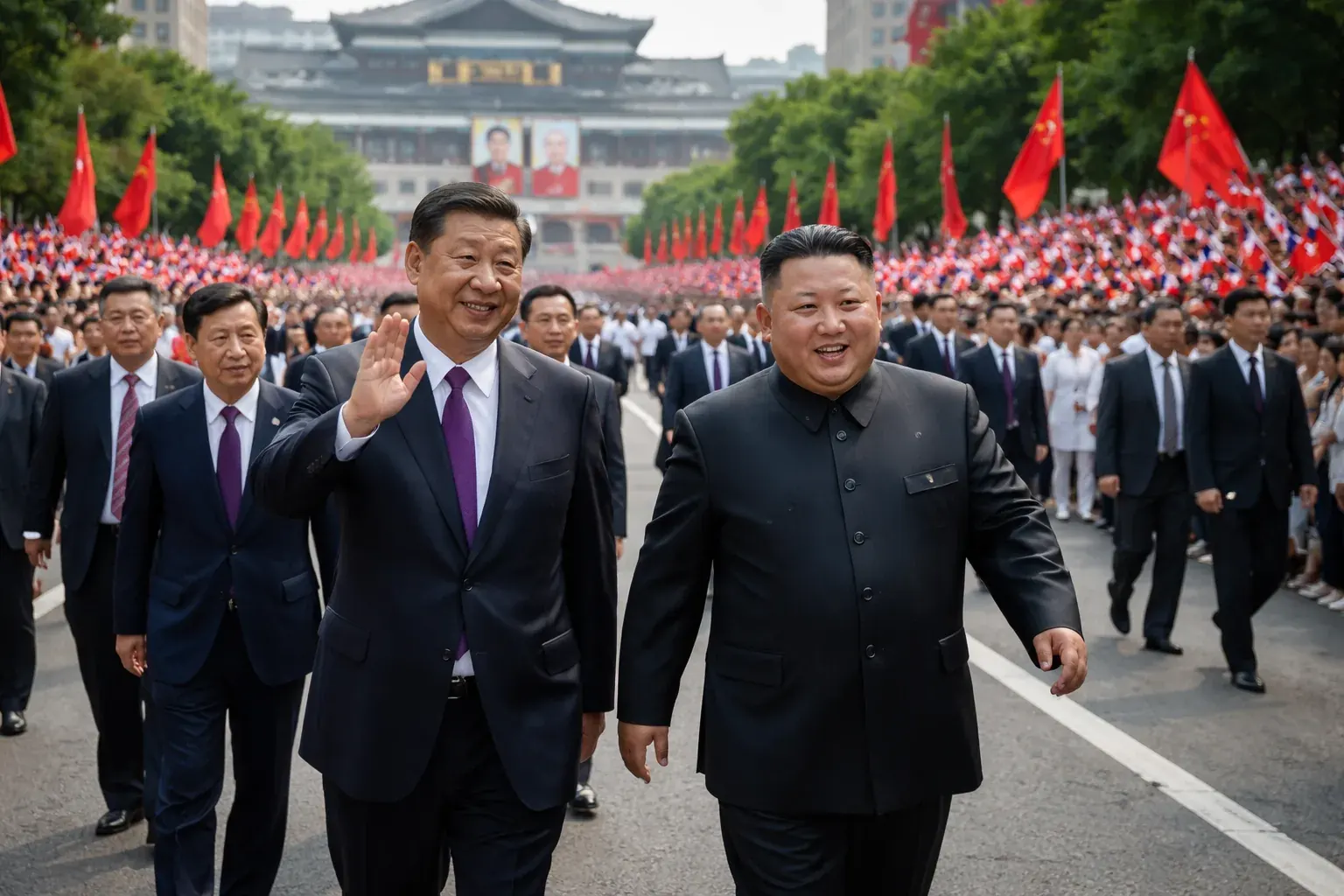
Chinese President Xi Jinping has concluded a two-day state visit to Pyongyang, his first official trip to North Korea since 2019. The visit was characterized by elaborate ceremonial displays, including a red-carpet welcome and acrobatic performances. Kim Jong Un hosted the Chinese leader at the Kumsusan State Guest House, an exclusive residence previously used to host leaders from Russia and Belarus.
What's new in this update
The state visit concluded with both leaders vowing to deepen high-level exchanges and people-to-people bonds. A significant shift was observed in the official communication: discussions regarding North Korea's denuclearization were entirely absent from state media readouts. This reflects Beijing's recent trend of toning down public calls for the denuclearization of the Korean peninsula in favor of maintaining stability and bilateral solidarity.
Key details
Xi was accompanied by some of China's most senior officials, including Foreign Minister Wang Yi, Defense Minister Dong Jun, and Commerce Minister Wang Wentao. During the trip, Xi and Kim visited the Friendship Tower to honor Chinese soldiers who fought in the Korean War and planted a fir tree at a top cadre school. The leaders also noted that 2024 marks the 65th anniversary of their mutual defense pact, the only such agreement China maintains with any nation.
Background and context
China remains North Korea's most vital political and economic partner, providing a critical lifeline against international sanctions. This visit served to remind the international community—and specifically the United States—of Beijing's influence over the unpredictable regime. It follows a period of heightened diplomatic activity where Kim Jong Un has met with both Vladimir Putin and Donald Trump, as well as a warming of relations between Pyongyang and Moscow.
What to watch next
Following the "important consensus" reached in Pyongyang, observers will be monitoring for increased economic cooperation or military coordination. The absence of denuclearization talk suggests that China may continue to shield North Korea from further international pressure at the UN Security Council, prioritizing its strategic buffer against Western influence in the region.
Why it matters
The meeting signals China's intent to reassert its role as North Korea's primary benefactor at a time when Pyongyang is increasingly strengthening its military ties with Russia.
Read next
Follow this story through the topic hub, more world coverage, and the latest updates.
Weekly briefing
Get the week's key developments in one concise email.
Get a fast catch-up on the biggest stories, the context behind them, and the links worth your time.
Cadence
Weekly, for a quick catch-up
Coverage
AI, business, world, security, sports
Format
Clear takeaways and useful context
Request the briefing
Leave your email to open a prepared request and get on the list for the weekly briefing.
Author

The Northstar Herald editorial desk assembles wire-driven and source-linked coverage, verifies core facts against published materials, and updates stories as new reporting becomes available.
Sources and methodology