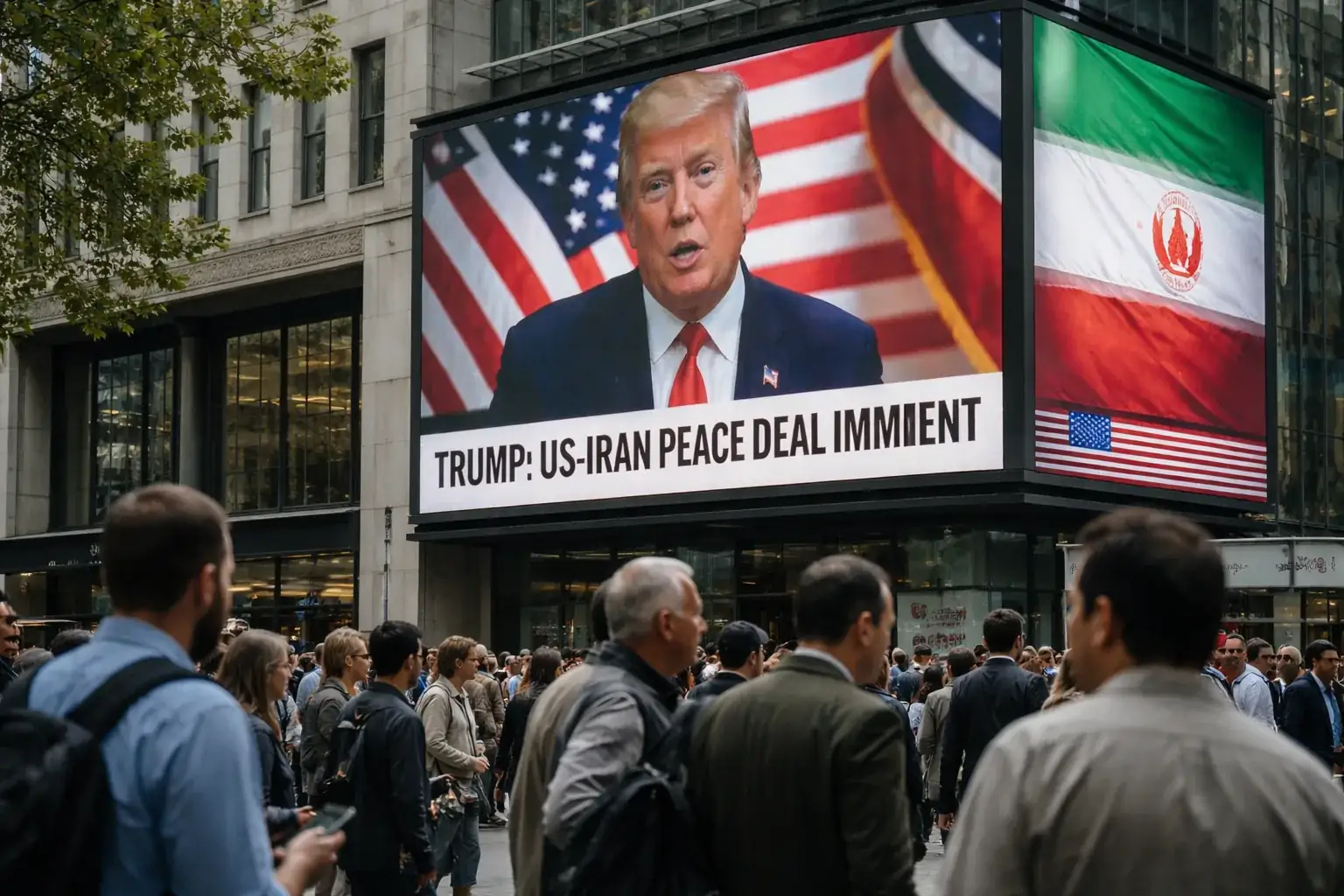
Trump Announces Sunday Signing for US-Iran Peace Deal as Tehran Signals Delay
The U.S. president says a pact to end hostilities and reopen the Strait of Hormuz is imminent, but Iranian officials suggest the timeline may be premature.
Primary source: BBC World News. Full source links, newsroom standards, and correction details are below.
Fast summary
Start here
- President Donald Trump announced via social media that a peace deal with Iran is scheduled to be signed this Sunday, which would reopen the Strait of Hormuz.
- Iranian Foreign Ministry spokesman Esmail Baghaei expressed caution, stating that while a memorandum is in progress, the signing will likely not occur on Sunday.
- Mediators from Pakistan and Qatar are actively involved, with Pakistan preparing for an electronic signing while a Qatari delegation meets with officials in Tehran.
What happened
President Donald Trump has publicly declared that a comprehensive agreement to end hostilities between the United States and Iran is slated for a formal signing on Sunday. In a series of social media communications, the president emphasized that the conclusion of this deal would lead to the immediate reopening of the Strait of Hormuz, a critical maritime corridor for global oil and liquefied natural gas shipments. However, the announcement has been met with a more measured response from Tehran, where officials have raised questions regarding the feasibility of concluding the memorandum of understanding by the date specified by Washington. This development marks a high-stakes moment in international diplomacy, as mediators from Pakistan and Qatar work to bridge the final gaps between the two adversarial nations.
What's new in this update
The primary tension in this latest update involves the conflicting timelines presented by the various parties. While President Trump asserted on Truth Social that the deal is scheduled to get signed tomorrow, Iranian Foreign Ministry spokesman Esmail Baghaei urged caution. Baghaei stated that while progress has been made, the exact date for the signing of the memorandum of understanding remains to be seen, specifically noting that it would likely not occur on Sunday. Simultaneously, Pakistan has emerged as a vocal proponent of the timeline; Prime Minister Shehbaz Sharif noted on Saturday that a peace deal is closer than ever, with preparations underway for an electronic signing within a 24-hour window. Adding to the diplomatic activity, a delegation from Qatar arrived in Tehran on Sunday, though it remains unclear if their presence is intended to finalize the documents or address late-stage revisions requested by the Iranian leadership.
Key details
The proposed agreement encompasses several significant concessions and logistical milestones. President Trump highlighted that once the deal is ratified, the Strait of Hormuz—which Iran effectively closed during the recent escalation—will be open to all. Furthermore, the president addressed Iran's enriched uranium stockpiles, referring to them as Nuclear Dust that the U.S. intends to eventually secure and destroy when regional stability is restored. Trump also issued a stern warning, suggesting that if the transition does not proceed smoothly, the United States retains the ultimate alternative, an apparent reference to potential military escalation. On the economic front, U.S. officials have indicated that any financial benefits or sanctions relief for Iran would be strictly contingent upon Tehran's adherence to the obligations outlined in the final text of the agreement.
Background and context
The current crisis traces back to February 28, when a series of U.S. and Israeli strikes across Iranian territory triggered a direct military response from Tehran. This cycle of violence expanded to include attacks on Israel and U.S.-allied states in the Gulf, leading to the closure of vital shipping lanes. Although a ceasefire was tentatively brokered in April, it has proven fragile, characterized by intermittent exchanges of fire. A major point of contention has been the inclusion of the conflict between Israel and the Iran-backed Hezbollah in Lebanon. While Iranian Foreign Minister Seyed Abbas Araghchi recently suggested a deal would include an end to the conflict in Lebanon, previous reports from the U.S. indicated that the Israel-Hezbollah front might be handled separately. Israel, which is not a party to the US-Iran deal, has continued its military campaign in Lebanon, conducting fresh air strikes on Beirut's southern suburbs as recently as Sunday.
What to watch next
The immediate focus remains on whether the electronic signing ceremony discussed by Pakistani officials will materialize within the president's stated timeframe. If the Sunday deadline passes without a signature, attention will shift to the Qatari mediators in Tehran to see if they can reconcile the scheduling discrepancies. Observers are also monitoring the technical level talks scheduled for next week, which are intended to hammer out the specific implementation phases of the deal. Crucially, the impact of ongoing Israeli military actions in Beirut and Southern Lebanon will be a deciding factor; if Israel continues to strike Hezbollah strongholds despite Tehran's expectations of a broader regional de-escalation, the fragile progress toward a U.S.-Iran peace deal could be jeopardized before the agreement is fully ratified.
Why it matters
A finalized deal could stabilize global energy markets by reopening the Strait of Hormuz and potentially de-escalate a direct military conflict between the U.S. and Iran.
Read next
Follow this story through the topic hub, more world coverage, and the latest updates.
Weekly briefing
Get the week's key developments in one concise email.
Get a fast catch-up on the biggest stories, the context behind them, and the links worth your time.
Cadence
Weekly, for a quick catch-up
Coverage
AI, business, world, security, sports
Format
Clear takeaways and useful context
Request the briefing
Leave your email to open a prepared request and get on the list for the weekly briefing.
Author

The world desk follows geopolitics, humanitarian crises, diplomacy, and major international developments with an emphasis on fast updates and public-interest context.
Sources and methodology