Massive Russian Air Assault on Kyiv Leaves 13 Dead and Scores
A wave of 74 missiles and nearly 500 drones battered the Ukrainian capital overnight, targeting residential buildings and energy infrastructure in a major

World correspondent
Reports on international affairs, diplomacy, and humanitarian developments with an emphasis on official statements, multilateral institutions, and regional context.
Editorial responsibility: Lead reviewer for geopolitics, international institutions, and crisis coverage
Primary source: BBC World News. Full source links and update notes are below.
Fast summary
Start here
- Russian forces launched 74 missiles and 496 drones, marking the largest coordinated attack on Kyiv in more than two weeks.
- At least 13 civilians were killed, including children, with over 30 others injured as strikes hit apartment buildings and a hotel.
- Ukrainian President Volodymyr Zelensky had warned of the 'massive' attack hours before it began, having received intelligence while in Dublin.
What happened
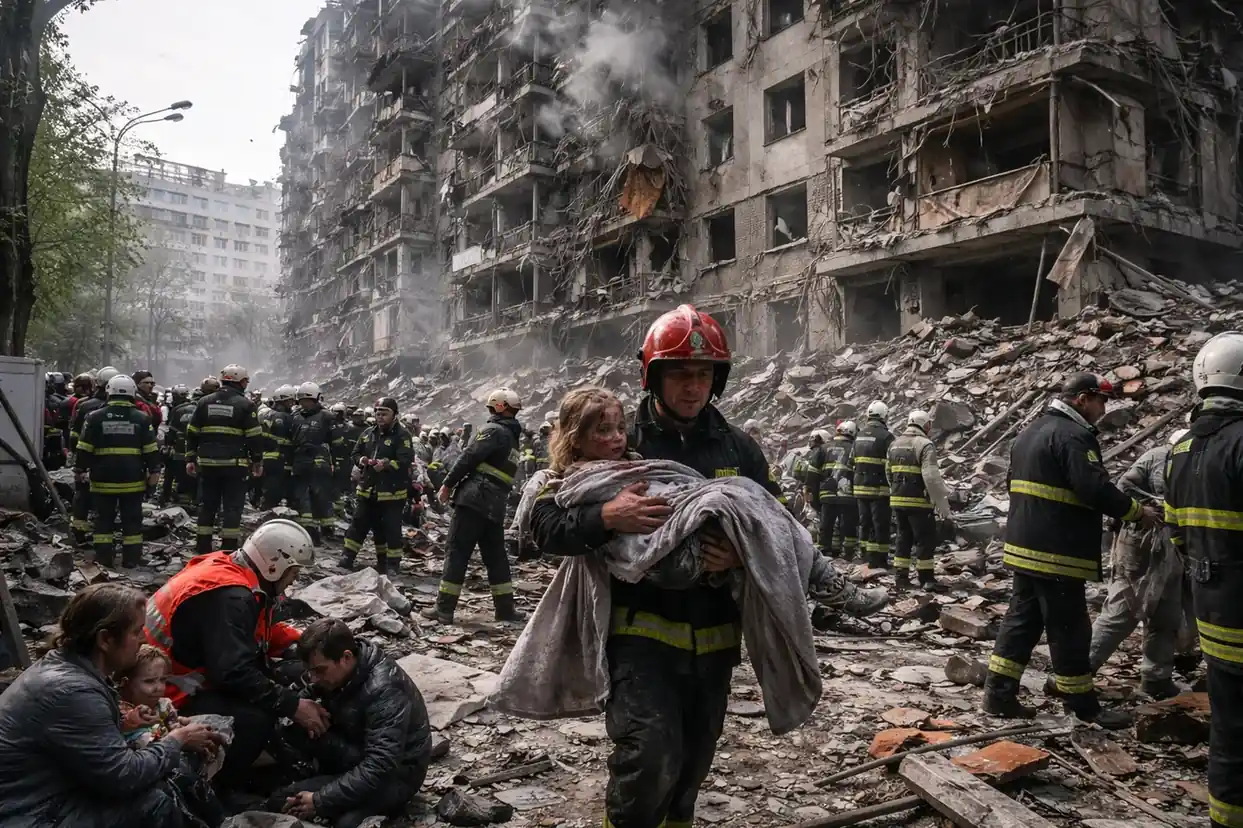
Russian forces executed a large-scale aerial offensive against Kyiv, deploying an arsenal of 74 missiles and 496 drones in a coordinated overnight assault. This marks the most significant barrage directed at the Ukrainian capital in over two weeks, shattering a period of relative calm. While Ukraine's air defense networks successfully intercepted the majority of the incoming projectiles, the sheer volume of the attack ensured that 25 ballistic missiles and 12 drones struck 33 separate locations across the city. The strikes triggered widespread fires, destroyed residential infrastructure, and forced the evacuation of several neighborhoods as buildings were rocked by consecutive impacts. Officials have confirmed that at least 13 people were killed, including children, as the bombardment targeted densely populated areas and critical utility hubs.
What's new in this update
The latest reports from Kyiv’s military administration emphasize the deliberate nature of the strikes on civilian zones. Tymur Tkachenko, head of the administration, stated that the enemy is once again targeting residential buildings, with a 'significant number' of casualties reported among the civilian population. Emergency services are currently battling intense blazes, including a major fire at a hotel on a central boulevard and another at a high-rise apartment complex. An ambulance station was also severely damaged, leaving at least one person in critical condition. Ukrainian Foreign Minister Andriy Sybiha has escalated calls for international partners to provide more than just condemnation, urging the immediate delivery of advanced air defense systems and the imposition of tougher sanctions on Moscow to halt what he described as 'Russian terror.'
Key details
The technical scale of the assault reveals a sophisticated attempt to overwhelm Kyiv's defensive umbrella. According to the Ukrainian air force, the mix of 74 missiles and nearly 500 drones created a saturated environment that tested the limits of surface-to-air systems. Residents and journalists on the ground reported hearing at least 10 major explosions by 3:30 a.m. local time, with tracer fire lighting up the night sky as anti-aircraft units attempted to down the incoming threats. By daybreak, the extent of the devastation became clear, with massive craters appearing near bombed-out buildings and smouldering debris littering the streets. In addition to the capital, the Russian Ministry of Defence claimed it successfully hit military bases in central and eastern Ukraine, asserting that the operation was a direct response to recent Ukrainian strikes on Russian energy infrastructure.
Background and context
This escalation follows a specific warning from President Volodymyr Zelensky, who cut short a diplomatic visit to Dublin after receiving intelligence that a 'massive' Russian strike was imminent. The timing of the attack coincides with a rare admission from Russian President Vladimir Putin regarding domestic fuel shortages, which Moscow attributes to recent Ukrainian drone strikes on power stations and refineries ranging from Moscow to the Black Sea. The Kremlin has characterized this latest wave of strikes as a 'retaliatory' measure against Ukrainian energy facilities. For Kyiv, the attack represents a return to the high-intensity missile campaigns that characterized earlier phases of the conflict, following a two-week period where large-scale aerial operations had seemingly subsided.
What to watch next
As rescue operations continue at sites across south-east Kyiv, the death toll is expected to fluctuate as search teams navigate the rubble of collapsed apartment floors. The international community’s response will likely focus on the urgent request from Ambassador Olha Stefanishyna and Foreign Minister Sybiha for enhanced military aid. Observers are watching for whether Western allies will accelerate the delivery of Patriot missile batteries or other sophisticated defense platforms in the wake of this civilian tragedy. Additionally, the diplomatic fallout of Putin’s admission regarding fuel shortages may signal a shift in Russian strategic priorities, potentially leading to further 'tit-for-tat' strikes on energy infrastructure as both nations enter a new phase of economic and utility-focused warfare.
Why it matters
The scale of the attack underscores Russia's continued strategy of targeting civilian infrastructure to pressure the population. It also highlights the critical need for advanced air defense systems as Kyiv struggles to intercept high volumes of ballistic missiles.
Read next
Follow this story through the topic hub, more world coverage, and the latest updates.
Weekly briefing
Get the week's key developments in one concise email.
Get a fast catch-up on the biggest stories, the context behind them, and the links worth your time.
Cadence
Weekly, for a quick catch-up
Coverage
AI, business, world, security, sports
Format
Clear takeaways and useful context
Request the briefing
Leave your email to open a prepared request and get on the list for the weekly briefing.
About the byline
World correspondent
Leila Haddad covers world affairs, diplomacy, and humanitarian crises, with a focus on how fast-moving international developments affect public policy, conflict response, and cross-border institutions.
Sources and methodology