Dublin Commits €228m to Transform Cross-Border Rail and
Significant funding from the Shared Island Fund will secure hourly Belfast-Dublin train services and support environmental and sporting projects across the

World correspondent
Reports on international affairs, diplomacy, and humanitarian developments with an emphasis on official statements, multilateral institutions, and regional context.
Editorial responsibility: Lead reviewer for geopolitics, international institutions, and crisis coverage
Primary source: BBC World News. Full source links and update notes are below.
Fast summary
Start here
- The Irish government is contributing €228m (£197m) to enhance rail links between Dublin, Belfast, and Londonderry.
- Funding includes €35m to maintain hourly train services between Dublin and Belfast until at least 2030.
- Additional allocations target the restoration of the Ulster Canal and major water quality improvements at Lough Neagh.
What happened
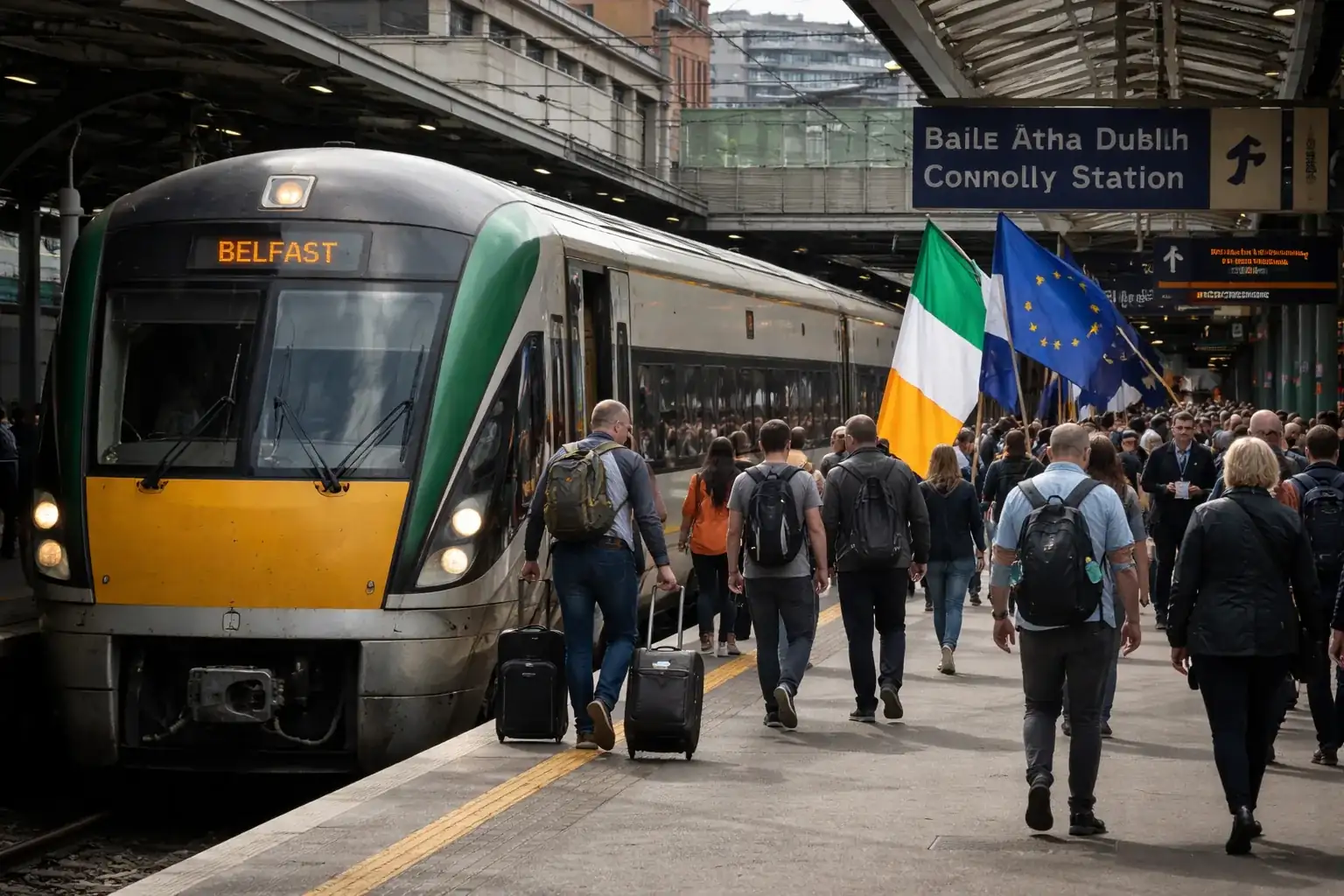
The Irish government has pledged €228 million for cross-border rail and infrastructure, using the Shared Island Fund to support transport upgrades and a wider set of all-island projects. The package includes major backing for rail connections between Dublin, Belfast, and Londonderry, with one of the clearest headline commitments being support for hourly Dublin-Belfast train services through at least 2030.
For both the Republic of Ireland and Northern Ireland, the announcement is about more than construction budgets. It signals that cross-border connectivity remains a strategic political priority, especially at a time when infrastructure, environmental cooperation, and post-Brexit coordination continue to shape how the island works in practice.
What's new in this update
The immediate development is that ministers in Dublin have approved a fresh set of Shared Island Fund investments, with €228m specifically directed at cross-border rail and related infrastructure priorities. That includes direct support for the Belfast-Dublin corridor as well as other linked projects with environmental and economic significance.
This matters because the Irish government cross-border rail funding is not being framed as a one-off gesture. It is being presented as part of a longer-term effort to improve journey times, frequency, and the reliability of shared systems that affect people on both sides of the border.
Key details
A substantial portion of the funding is focused on improving the Derry-Belfast-Dublin line, while another €35 million is intended to help secure hourly rail services between Dublin and Belfast until at least 2030. That commitment is especially important because frequency improvements can have an immediate impact on public transport usage, commuter behavior, and business connectivity even before bigger engineering changes are completed.
The package also goes beyond rail. Other allocations support:
- Environmental remediation linked to Lough Neagh
- Continued restoration of the Ulster Canal
- Port and infrastructure development
- Sporting facilities tied to future major event planning
This broader spread shows that the Shared Island approach is not limited to transport alone. It is also being used to address practical areas where cooperation across the island can produce visible public value.
Background and context
The Shared Island Fund was created to finance projects that benefit both jurisdictions on the island of Ireland. In recent years, it has become one of the clearest financial expressions of the idea that cooperation can be deepened through everyday systems rather than only through abstract political statements.
Rail is an especially symbolic and practical area for that effort. Better cross-border rail infrastructure improves mobility for workers, students, tourists, and businesses while also reinforcing a sense that key corridors should function more efficiently regardless of constitutional boundaries. The Dublin-Belfast route, in particular, is one of the island's most important transport links.
The environmental dimension matters too. Lough Neagh has become a major concern because of water-quality degradation and algae issues, and cross-border problems of that kind are difficult to solve without coordinated funding and policy effort. That makes the package notable not just for how much money is involved, but for how it combines transport, environment, and regional planning in one political statement.
What to watch next
The obvious next question is implementation. Funding commitments create momentum, but delivery depends on procurement, engineering timelines, cooperation between agencies, and the pace of government follow-through in both jurisdictions.
Three areas will be worth watching:
- Whether hourly Dublin-Belfast services remain on track through 2030
- How quickly rail upgrades translate into shorter and more reliable journeys
- Whether Lough Neagh and canal projects show measurable progress on the ground
If the projects move efficiently, the funding announcement could become a visible example of how cross-border cooperation can improve daily life. If progress stalls, critics may argue that the headline is stronger than the delivery.
Why this matters
The Irish government pledges €228m for cross-border rail and infrastructure story matters because it links money, mobility, and politics in one of the most sensitive and important regions in Europe. Better rail services and shared infrastructure can strengthen economic ties, make public transport more useful, and support cooperation in a period when cross-border systems remain strategically important.
More broadly, the package shows that infrastructure policy is also constitutional and social policy. Decisions about trains, waterways, and environmental repair help define how connected the island of Ireland becomes in everyday reality.
Why it matters
This investment strengthens economic and social ties between Northern Ireland and the Republic of Ireland by improving transit connectivity and addressing shared environmental challenges.
Read next
Follow this story through the topic hub, more world coverage, and the latest updates.
Weekly briefing
Get the week's key developments in one concise email.
Get a fast catch-up on the biggest stories, the context behind them, and the links worth your time.
Cadence
Weekly, for a quick catch-up
Coverage
AI, business, world, security, sports
Format
Clear takeaways and useful context
Request the briefing
Leave your email to open a prepared request and get on the list for the weekly briefing.
About the byline
World correspondent
Leila Haddad covers world affairs, diplomacy, and humanitarian crises, with a focus on how fast-moving international developments affect public policy, conflict response, and cross-border institutions.
Sources and methodology