Mass Arrests and Police Injuries Follow Champions League Final
French authorities reported 780 arrests and over 200 injuries after celebrations for Paris St-Germain's victory turned into violent clashes with security

World correspondent
Reports on international affairs, diplomacy, and humanitarian developments with an emphasis on official statements, multilateral institutions, and regional context.
Editorial responsibility: Lead reviewer for geopolitics, international institutions, and crisis coverage
Primary source: BBC World News. Full source links and update notes are below.
Fast summary
Start here
- Interior Minister Laurent Nunez confirmed 780 arrests nationwide, with more than 450 individuals currently in custody.
- A total of 219 people were injured, including 57 police officers; eight individuals remain in serious condition.
- One fatality was reported after a 24-year-old man crashed a motorcycle into concrete blocks on the Paris ring road during attempts to block traffic.
What happened
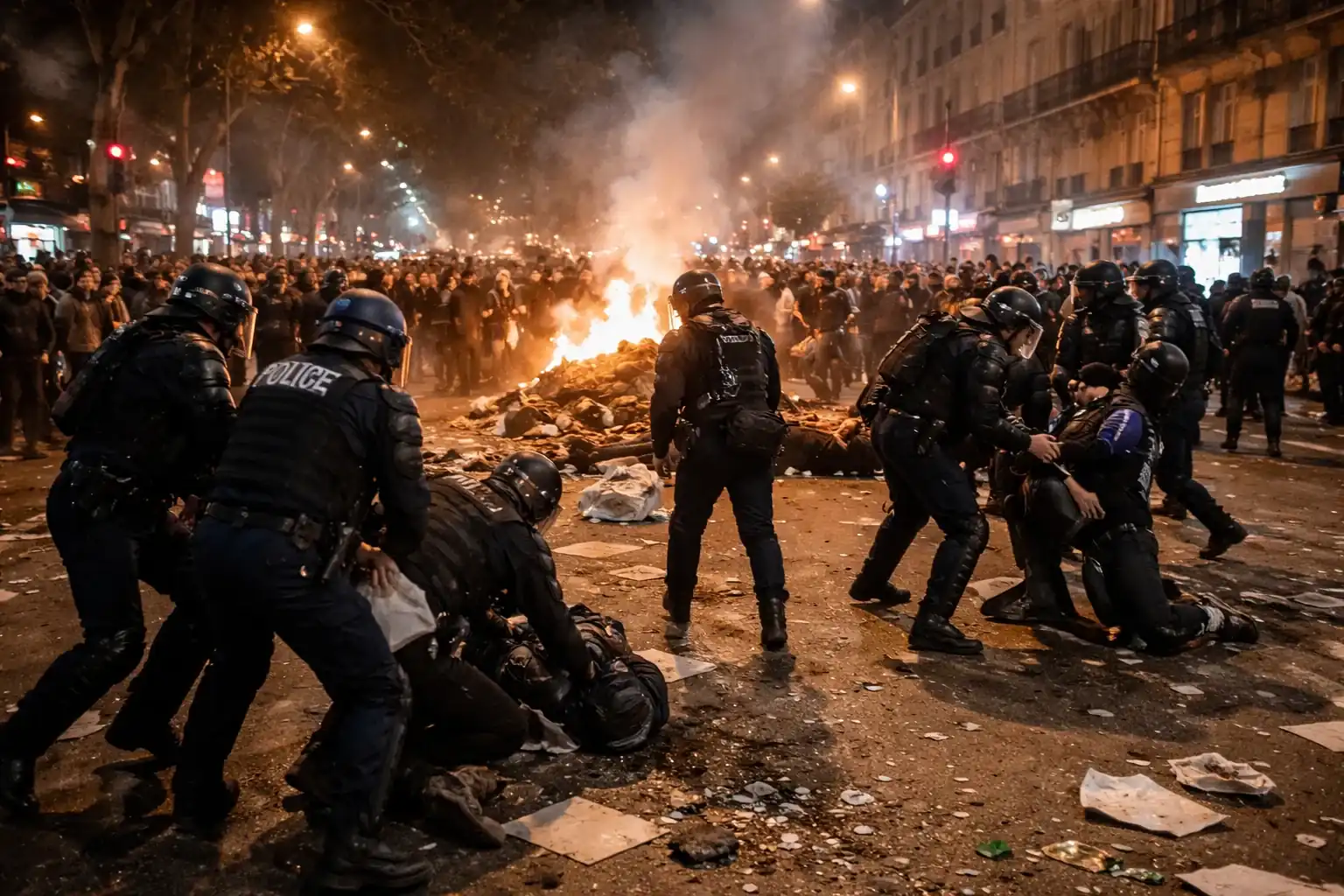
More than 780 people were arrested and dozens of police officers were injured after violent unrest spread through parts of France following Paris St-Germain's Champions League triumph. What began as football celebration turned into a much larger public order crisis involving street battles, vandalism, fires, injuries, and mass police deployments. The scale of the arrests and injuries suggests that this was not a brief flare-up on the margins of celebration, but a significant night of nationwide disruption that immediately reopened arguments about French policing, crowd violence, and political authority.
The case matters because public disorder of this kind now follows a recognizable script in France: a major football victory creates genuine euphoria, large crowds gather spontaneously, and parts of those gatherings are overtaken by destruction, confrontation, and opportunistic violence. Each repetition makes the phenomenon harder for authorities to describe as exceptional.
Why the injury count changes the story
The figure of 57 injured police officers is significant because it moves the story beyond damage to property and into a more direct conflict between crowds and the state. Injuries on that scale indicate sustained confrontation rather than scattered unrest. The same is true of the broader injury total, which suggests that the night's violence affected not only officers and rioters but also bystanders and others caught in unstable urban scenes.
Once the number of injured security personnel rises that high, the political language hardens quickly. Public order becomes a national issue rather than a local policing problem.
PSG celebrations and repeat unrest
Paris St-Germain's victories carry a particular emotional and political charge in France because the club sits at the center of national attention and Parisian symbolism. When PSG wins a major European title, the celebration is not confined to fans inside a stadium. It spills into symbolic public spaces, from the ring road to central boulevards to areas near monuments and transport hubs. That scale creates excitement, but it also creates conditions in which violent actors can merge into the crowd.
This is why officials repeatedly argue that many of those involved are not ordinary supporters. Whether or not that distinction is entirely satisfying, the operational challenge is real.
The political reaction in France
Interior Minister Laurent Nunez's response, combined with criticism from figures such as Marine Le Pen, shows how quickly sporting unrest becomes partisan ammunition. For the government, the key question is whether it can present the deployment and arrests as proof of control. For its critics, the same facts can be used to argue that France has failed to secure its own capital and public celebrations.
That political struggle matters because it shapes future policing decisions. Governments under pressure often respond by increasing deployments, broadening detention powers, or adopting harder crowd-control tactics.
A death and the atmosphere of escalation
The reported fatality near the Paris ring road intensifies the seriousness of the episode. Even when the exact circumstances remain under investigation, deaths linked to riot nights give the disorder a heavier social and political weight. At that point, the story is no longer about embarrassing scenes after a football match. It is about whether public celebration has become an environment where fatalities and mass injury are increasingly plausible outcomes.
That is a profound failure for any city trying to host victory celebrations safely.
What comes next
Authorities will continue processing arrests, deciding charges, and examining how minors and repeat offenders were involved. Security planning for future PSG events will come under special scrutiny, as will the question of whether current policing models can contain these moments without reproducing the same cycle of escalation.
For now, the mass arrests and dozens of police injuries following Champions League riots in France show that football unrest is no longer a marginal or occasional embarrassment. It is an entrenched public safety and political problem. The numbers alone make that clear: when hundreds are arrested and dozens of officers are injured, France is not dealing with celebration gone slightly wrong. It is dealing with a recurring breakdown of urban order under the cover of sporting triumph.
Why it matters
The recurring violence following major sporting events in France has intensified domestic political pressure on the government regarding public order and security management.
Read next
Follow this story through the topic hub, more world coverage, and the latest updates.
Weekly briefing
Get the week's key developments in one concise email.
Get a fast catch-up on the biggest stories, the context behind them, and the links worth your time.
Cadence
Weekly, for a quick catch-up
Coverage
AI, business, world, security, sports
Format
Clear takeaways and useful context
Request the briefing
Leave your email to open a prepared request and get on the list for the weekly briefing.
About the byline
World correspondent
Leila Haddad covers world affairs, diplomacy, and humanitarian crises, with a focus on how fast-moving international developments affect public policy, conflict response, and cross-border institutions.
Sources and methodology