Germany's Rail Services Resume Following Nationwide IT Disruption
All train services were held at stations for over two hours after a failure in the digital radio network paralyzed communications.

World correspondent
Reports on international affairs, diplomacy, and humanitarian developments with an emphasis on official statements, multilateral institutions, and regional context.
Editorial responsibility: Lead reviewer for geopolitics, international institutions, and crisis coverage
Primary source: BBC World News. Full source links and update notes are below.
Fast summary
Start here
- A malfunction in the GSM-R digital radio network forced a total halt of Deutsche Bahn services on Tuesday night.
- The outage lasted over two and a half hours before IT experts successfully resolved the communication failure.
- Deutsche Bahn is offering taxi and hotel vouchers as regional and long-distance services gradually return to normal.
What happened
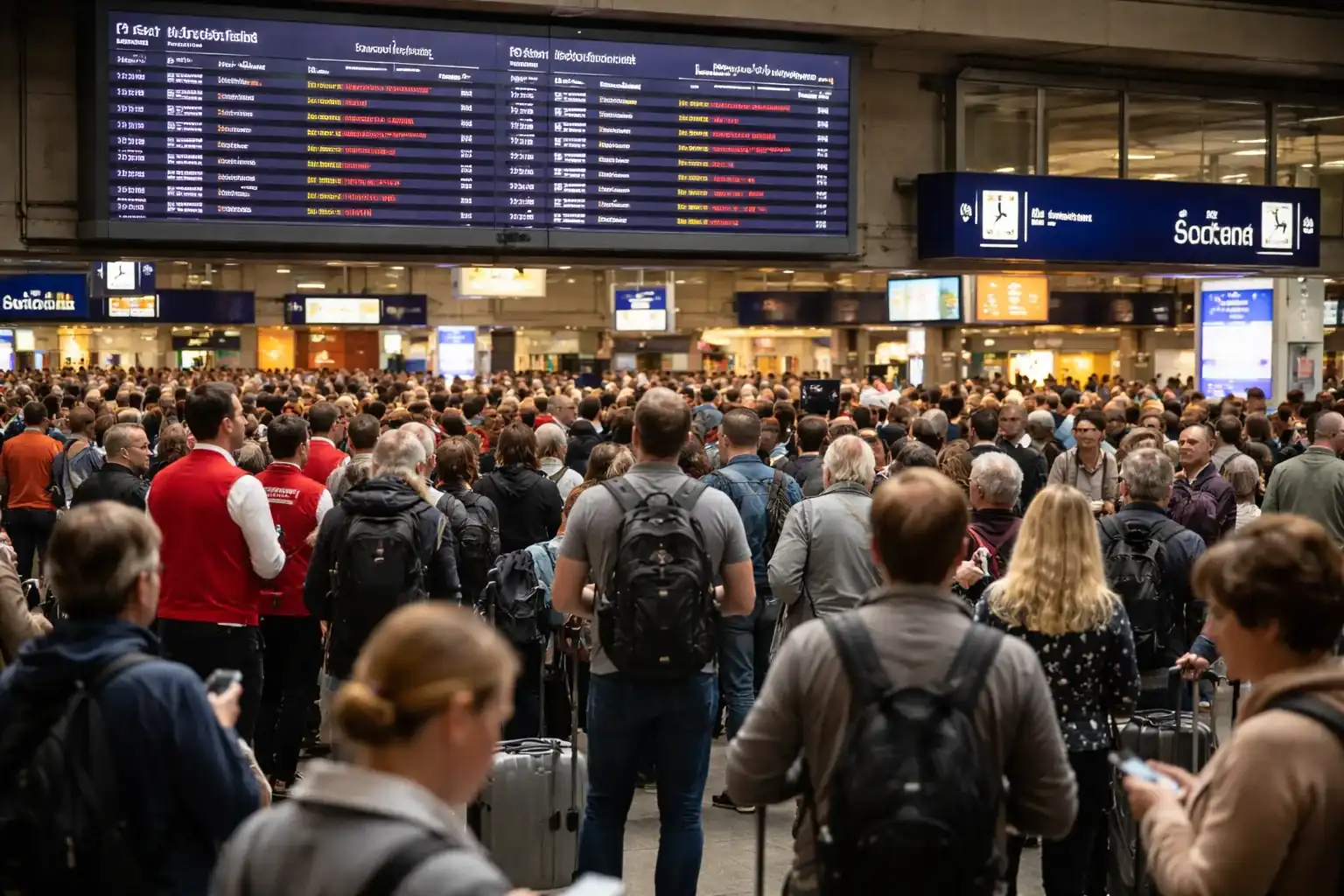
Germany's rail network was briefly brought to a nationwide standstill after an IT malfunction hit the GSM-R communications system used by Deutsche Bahn, forcing trains to remain at stations for more than two hours while technicians worked to restore safe operating conditions. Although services later resumed, the outage disrupted one of Europe's busiest rail systems and left passengers facing major delays, cancellations, and overnight travel complications.
That matters because the incident was not caused by weather, a labor action, or an isolated line problem. It exposed how dependent modern rail operations are on centralized digital communications infrastructure.
Why the GSM-R failure was so disruptive
GSM-R, the specialized mobile communications system used in railway operations, is not a background convenience. It is part of the safety backbone that allows train drivers and control centers to communicate reliably. If that system fails nationally, operators cannot simply improvise normal traffic movement. Trains must often be stopped because the communication layer required for safe control is no longer dependable.
This is why the outage produced such a sweeping effect. A communication failure in rail is not like a delayed customer app update. It can instantly become a network-wide operational shutdown.
Why Deutsche Bahn had little choice
To many passengers, a total halt may look drastic. From an operations standpoint, it was likely unavoidable. Railway safety systems are designed precisely so that if critical communication fails, movement becomes more restricted rather than more permissive. That approach protects passengers, but it also means one malfunction can ripple across regional, long-distance, and urban services all at once.
In that sense, the shutdown was a sign of safety logic working, even while the infrastructure failure itself raised serious questions.
Why this matters for Germany
Germany relies heavily on rail as a national transport artery for commuters, regional movement, business travel, and intercity mobility. A nationwide disruption therefore lands differently there than it might in a country with weaker dependence on rail. It affects not only individuals trying to get home, but also the credibility of transport planning, economic punctuality, and public trust in infrastructure reliability.
That is why this incident is politically relevant as well as operationally significant.
The wider infrastructure lesson
The outage highlights a broader issue facing advanced transport systems: digital centralization creates efficiency, but it also creates single points of failure. The more a network depends on integrated communication layers, the more serious the consequences become when one of those layers goes down. This is especially sensitive in Europe, where public transport systems are often expected to perform as national strategic assets, not just customer-facing services.
The immediate disruption may end quickly, but the infrastructure lesson does not.
The passenger impact
For travelers, the incident was likely felt less as a systems story and more as a sudden breakdown of certainty. Long-distance passengers risked missed connections, overnight disruption, and extra costs. Commuters faced stranded routes. Deutsche Bahn's decision to offer taxi and hotel vouchers reflects how severe the passenger fallout can become even after the technical problem itself is solved.
Recovery in rail systems is rarely instant. Once schedules collapse, the aftereffects can continue long after trains technically start moving again.
What comes next
The next important question is not just whether the immediate malfunction has been repaired, but whether Deutsche Bahn can explain what caused it and what redundancy measures exist to prevent a repeat. Passengers will care about compensation and reliability, while policymakers and infrastructure experts will care about system resilience.
For now, the nationwide halt of Germany's rail services due to a GSM-R IT malfunction is a sharp reminder of how vulnerable critical transport infrastructure can be to digital failure. The trains are moving again, but the disruption has already made one point clear: in modern rail systems, communication breakdowns can stop an entire country far faster than many passengers realize.
Why it matters
The incident underscores the vulnerability of national rail infrastructure to centralized IT failures, disrupting one of Europe's busiest transport networks.
Read next
Follow this story through the topic hub, more world coverage, and the latest updates.
Weekly briefing
Get the week's key developments in one concise email.
Get a fast catch-up on the biggest stories, the context behind them, and the links worth your time.
Cadence
Weekly, for a quick catch-up
Coverage
AI, business, world, security, sports
Format
Clear takeaways and useful context
Request the briefing
Leave your email to open a prepared request and get on the list for the weekly briefing.
About the byline
World correspondent
Leila Haddad covers world affairs, diplomacy, and humanitarian crises, with a focus on how fast-moving international developments affect public policy, conflict response, and cross-border institutions.
Sources and methodology