Mass Casualty Incident as Overcrowded Bus Skids Off Mountain Pass in
A passenger bus carrying 48 people veered off a mountain road in south-western Pakistan on Friday morning, killing dozens. Authorities indicate the vehicle

World correspondent
Reports on international affairs, diplomacy, and humanitarian developments with an emphasis on official statements, multilateral institutions, and regional context.
Editorial responsibility: Lead reviewer for geopolitics, international institutions, and crisis coverage
Primary source: BBC World News. Full source links and update notes are below.
Fast summary
Start here
- At least 32 passengers died and 16 others sustained injuries when the bus fell 80 feet into a ravine in the Dana Sar mountain range.
- Preliminary investigations suggest a mechanical steering fault caused the driver to lose control while traveling from Quetta to Peshawar.
- Balochistan provincial officials confirmed the bus was over its legal capacity after boarding passengers from another broken-down vehicle earlier in the trip.
What happened
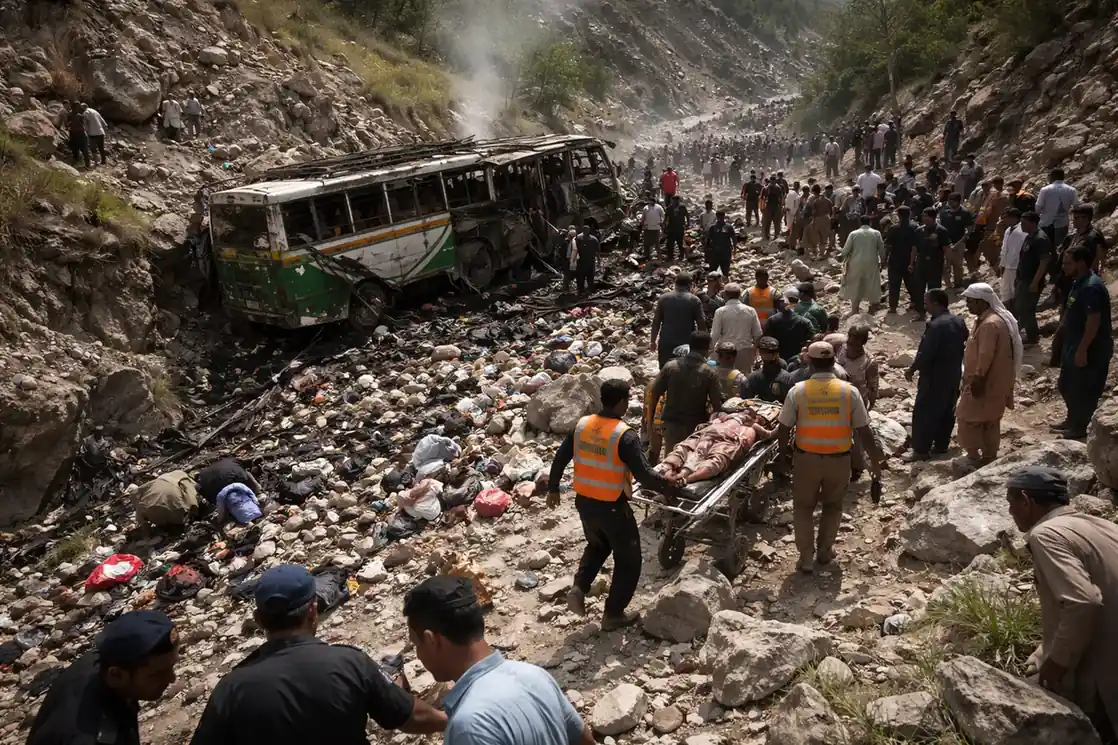
At least 32 people were confirmed dead on Friday morning after a passenger bus veered off a cliff and plunged into a deep ravine in south-western Pakistan. The incident occurred at approximately 08:00 local time (03:00 GMT) while the vehicle was traversing the Dana Sar mountain range. This rugged geographical feature marks the administrative border between the Balochistan and Khyber Pakhtunkhwa provinces. The bus was operating on a routine long-distance route between the cities of Quetta and Peshawar when the driver reportedly lost control on a winding section of the highway. Emergency responders who arrived at the scene found the bus heavily damaged at the bottom of a drop estimated to be between 70 and 80 feet deep. While 32 individuals died at the scene or shortly after, another 16 survivors were rescued and transported for urgent medical care.
What's new in this update
New disclosures from provincial authorities have shed light on the circumstances that may have exacerbated the severity of the crash. Shahid Rind, a spokesperson for the Balochistan chief minister, revealed that the bus was significantly overcrowded at the time of the accident. According to initial reports, the bus driver had stopped earlier in the journey to pick up several passengers from another bus that had broken down on the roadside. This influx of additional travelers pushed the total number of people on board to at least 48, including a number of women and children. In response to the high death toll, Balochistan Chief Minister Sarfraz Bugti has formally ordered a high-level inquiry to determine the exact sequence of events and investigate potential negligence by the transport company. National leaders, including President Asif Ali Zardari and Prime Minister Shehbaz Sharif, have expressed their official sorrow over the loss of life.
Key details
The rescue and recovery operation was hampered by the difficult terrain and the steepness of the Dana Sar ravine. Sanaullah Sherani, the head of the Zhob district emergency service, noted that dozens of ambulances and emergency personnel were deployed to the site, but navigating the 80-foot descent to the wreckage proved challenging. The 16 injured survivors were eventually moved to the District Headquarters hospital in Zhob, located about 68 kilometers from the crash site. Many of the survivors are reported to be in critical condition. Officials are currently in the process of identifying the deceased to facilitate the transport of their bodies to their respective hometowns by ambulance. While the investigation is ongoing, a preliminary technical assessment suggests that a steering fault was the primary cause of the accident, leading to an uncontrollable skid before the bus left the roadway.
Background and context
Fatal road accidents are a recurring public safety crisis in Pakistan, often resulting from a combination of aging vehicle fleets, poorly maintained road surfaces, and a lack of stringent traffic law enforcement. The mountainous corridors of Balochistan are particularly notorious for such incidents, as the routes feature sharp turns and steep drops with minimal safety barriers. This tragedy is not an isolated event; in 2024, at least 17 pilgrims were killed when their bus fell into a ravine while traveling through Balochistan for religious celebrations. Public safety advocates frequently criticize the commercial transport sector for the practice of overloading buses to maximize profit, which places undue stress on vehicle components like brakes and steering systems. This latest accident in the Dana Sar range underscores the continued danger faced by commuters relying on long-haul bus services in the region.
What to watch next
In the immediate term, the focus remains on the medical status of the 16 survivors receiving treatment in Zhob. Observers are also waiting for the results of the formal inquiry ordered by Chief Minister Bugti, which is expected to clarify whether the transport operators will face criminal charges for overcrowding. There is growing pressure on the National Highway and Motorway Police to increase inspections of long-distance buses, particularly those traversing the border between Balochistan and Khyber Pakhtunkhwa. Future policy debates in the provincial and federal governments may address the need for mandatory mechanical certifications and stricter weight limits for passenger vehicles. Furthermore, the identification and repatriation of the deceased to their families remains a priority for local district administration as the rescue phase concludes.
Why it matters
This tragedy highlights persistent infrastructure and vehicle maintenance issues in Pakistan, where mountain roads and unregulated passenger transport often lead to high-casualty accidents.
Read next
Follow this story through the topic hub, more world coverage, and the latest updates.
Weekly briefing
Get the week's key developments in one concise email.
Get a fast catch-up on the biggest stories, the context behind them, and the links worth your time.
Cadence
Weekly, for a quick catch-up
Coverage
AI, business, world, security, sports
Format
Clear takeaways and useful context
Request the briefing
Leave your email to open a prepared request and get on the list for the weekly briefing.
About the byline
World correspondent
Leila Haddad covers world affairs, diplomacy, and humanitarian crises, with a focus on how fast-moving international developments affect public policy, conflict response, and cross-border institutions.
Sources and methodology