OpenRouter Reaches Unicorn Status with $113 Million Series B Led by
The AI gateway provider more than doubled its valuation in one year as enterprise demand shifts toward multi-model inference and agentic workflows.

AI reporter
Reports on model launches, frontier labs, developer platforms, and AI policy with an emphasis on claims verification and rollout context.
Editorial responsibility: Lead reviewer for AI coverage, launch claims, and policy context
Primary source: TechCrunch AI. Full source links and update notes are below.
Fast summary
Start here
- OpenRouter secured $113 million in Series B funding led by Alphabet's growth venture fund, CapitalG.
- The startup is now valued at approximately $1.3 billion, up from an estimated $547 million valuation in June 2025.
- Usage has surged to 100 trillion tokens per month, representing a fivefold increase in processing volume over the last six months.
What happened
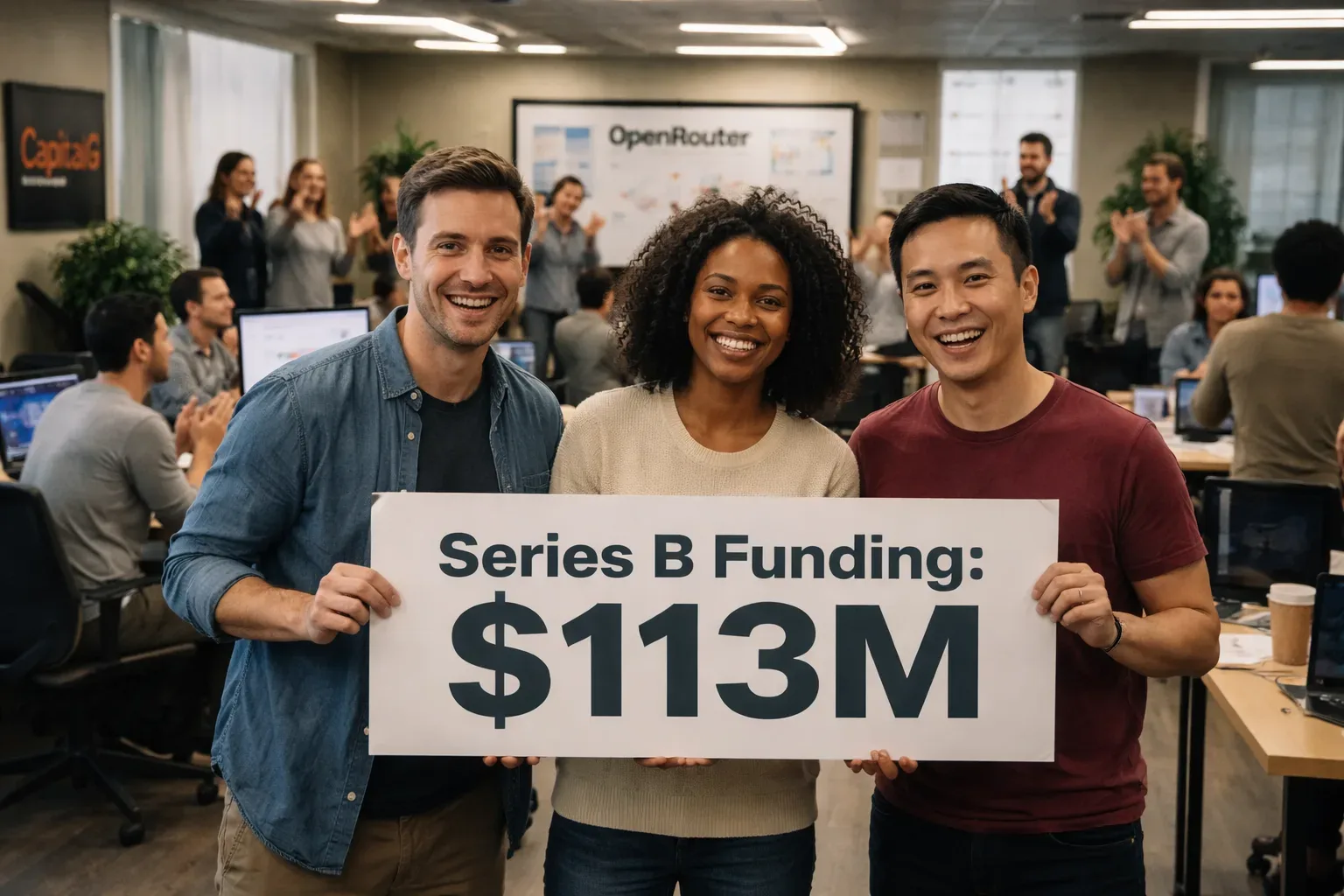
OpenRouter has raised $113 million in a Series B round led by CapitalG, lifting the startup to a reported $1.3 billion valuation and formally pushing it into unicorn territory. The company, founded in 2023, has become one of the most visible examples of a new AI infrastructure category: the model gateway layer that sits between developers and the growing universe of foundation-model providers.
That category is attracting more attention because the AI market is no longer only about who builds the best model. It is increasingly about who helps customers choose, route, compare, and manage models efficiently in production. For many enterprises, the practical problem is not access to one powerful model. It is how to operate across many models without hard-coding the business into a single vendor's pricing, speed, reliability, or policy stack.
What's new in this update
The scale numbers around OpenRouter's business are the immediate draw. The company says usage has climbed to 100 trillion tokens per month, a dramatic jump from the levels it was handling just months earlier. That kind of growth suggests that multi-model inference is no longer a niche developer convenience. It is becoming a real layer of enterprise AI operations.
The investor mix also matters. CapitalG's involvement signals that Alphabet sees value in the routing and orchestration layer even though Google itself is also a model provider. That is a strong sign that the infrastructure around AI deployment may become as strategically important as the models underneath it.
Key details
OpenRouter gives customers a unified interface to hundreds of models from providers such as OpenAI, Anthropic, Google, xAI, and DeepSeek. In effect, it allows developers to treat models as interchangeable engines that can be selected based on cost, latency, context window, reasoning quality, or task-specific performance.
That flexibility is especially relevant for agentic systems, where applications may call models repeatedly, switch between specialized tasks, and optimize for different tradeoffs inside one workflow. In that environment, a router can deliver value by deciding which model is best for each step rather than forcing every request through one provider.
Key forces driving the company's rise include:
- Enterprises want leverage in pricing negotiations instead of full vendor lock-in.
- Developers increasingly need fallback options when one provider throttles, fails, or changes terms.
- Agent workflows require more routing logic than traditional single-call chatbot use cases.
- Inference cost management has become a core business concern as token volumes explode.
Background and context
The startup's rise reflects a broader change in the AI market. During the earliest phase of the generative AI boom, attention centered on training frontier models and securing raw compute. As the ecosystem matured, a second problem emerged: how to manage a fragmented model landscape without rebuilding applications every time a better or cheaper model appears.
That is the opening OpenRouter is trying to own. Rather than competing head-to-head with frontier labs on model quality, it is positioning itself as neutral infrastructure for a multi-model world. If that vision holds, the value of the router grows as the model ecosystem becomes more crowded, not less.
What to watch next
The next question is whether OpenRouter can convert token growth into a durable moat. Routing layers can be valuable, but they can also face pressure if cloud platforms and model vendors build similar abstraction features directly into their own offerings. OpenRouter will need to prove that its neutrality, scale, and developer adoption are hard to replicate.
Why this matters
The funding round is a signal that investors increasingly believe AI infrastructure will be shaped not only by the labs training models, but also by the companies helping everyone else use those models intelligently. OpenRouter's rise points to an AI market where orchestration and inference management may become foundational businesses in their own right.
Reader context
This story belongs to Northstar Herald's Generative AI and AI Infrastructure coverage, with related entities including OpenRouter, CapitalG, Alphabet, Series B. The report is based on TechCrunch AI source material.
Related coverage
Why it matters
The funding signals a market shift where enterprises prefer flexible AI gateways over single-model lock-in to manage costs and optimize performance.
Read next
Follow this story through the topic hub, more ai coverage, and the latest updates.
Weekly briefing
Get the week's key developments in one concise email.
Get a fast catch-up on the biggest stories, the context behind them, and the links worth your time.
Cadence
Weekly, for a quick catch-up
Coverage
AI, business, world, security, sports
Format
Clear takeaways and useful context
Request the briefing
Leave your email to open a prepared request and get on the list for the weekly briefing.
About the byline
AI reporter
Alex Rivera reports on artificial intelligence with an emphasis on model launches, frontier lab strategy, developer tooling, and the policy decisions shaping commercial deployment.
Sources and methodology