Startup Human Archive Raises $8.2 Million to Map Human Labor for
The Silicon Valley firm is partnering with Indian service providers to collect first-person data, despite friction with major industry players.

AI reporter
Reports on model launches, frontier labs, developer platforms, and AI policy with an emphasis on claims verification and rollout context.
Editorial responsibility: Lead reviewer for AI coverage, launch claims, and policy context
Primary source: TechCrunch AI. Full source links and update notes are below.
Fast summary
Start here
- Human Archive secured $8.2 million in funding led by Wing Venture Capital and NVP Capital to scale its physical AI training data operations.
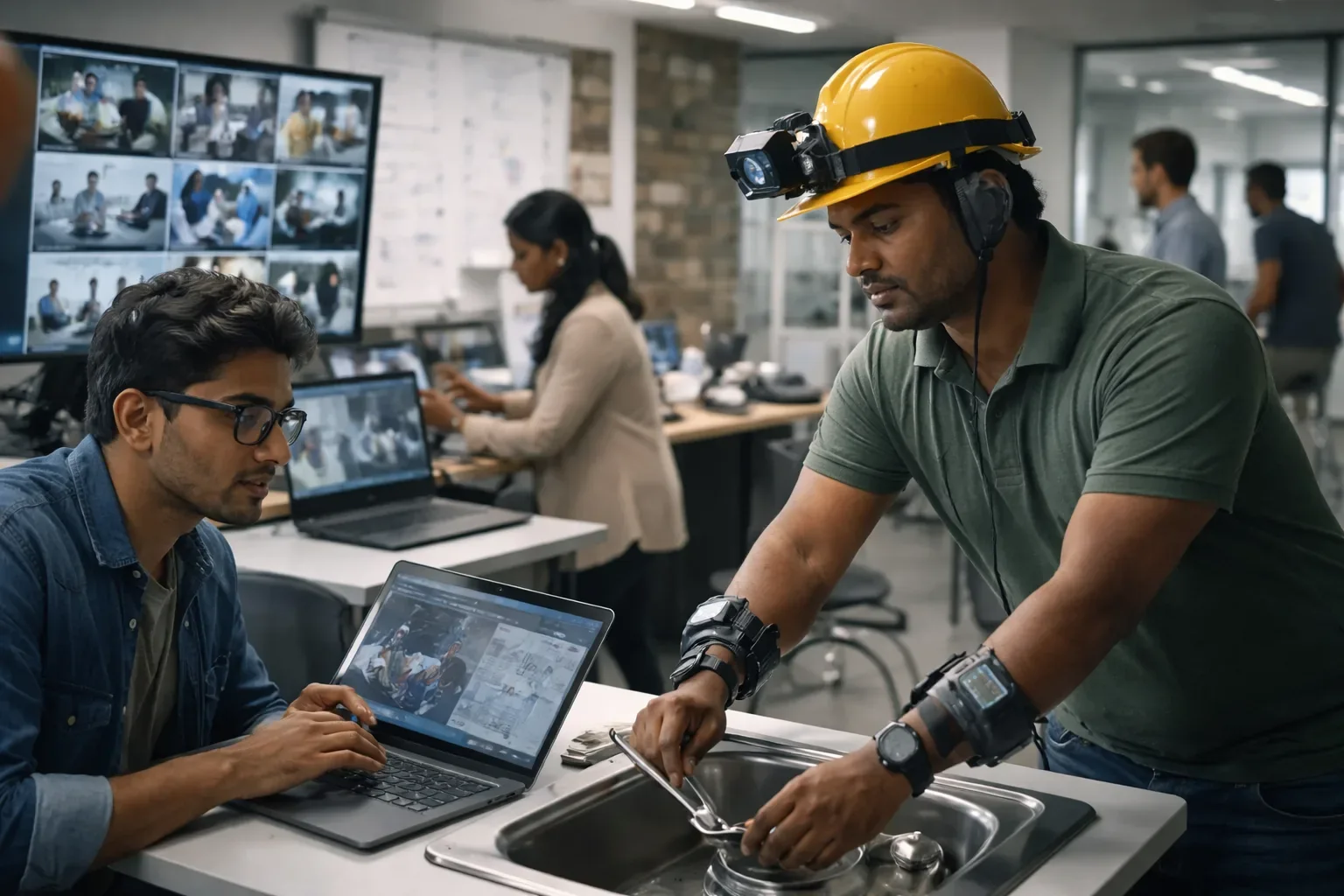
- The startup uses specialized camera headsets and tactile sensors to record gig workers in India performing everyday household and service tasks.
- The initiative has faced public pushback from major Indian platforms like Urban Company and Pronto over the ethics and feasibility of worker data partnerships.
What happened
Human Archive has raised $8.2 million to expand a business that sits at the intersection of robotics, machine learning, and labor data: collecting first-person recordings of people doing real-world work so robots can later learn from those actions. The company is focusing heavily on India, where large service and gig-economy workforces create a vast pool of everyday physical tasks that can be observed, labeled, and converted into training data for what the industry increasingly calls physical AI.
The startup's argument is simple but consequential: robotics will not scale on language data alone. If machines are expected to clean, sort, cook, carry, repair, or assist inside human environments, they need dense records of how people actually move through those tasks, what they see, and how much force they apply while doing them.
What's new in this update
The financing round, led by investors including Wing Venture Capital and NVP Capital, gives Human Archive more resources to expand headset deployment and build more specialized data-capture equipment. The company says it is moving beyond simple first-person video and toward richer sensing systems such as gloves, motion rigs, and tactile capture tools. That matters because visual observation alone is often not enough for robotic learning. A robot may need to know not just where a hand moved, but how pressure changed when gripping an object or how posture adjusted in a constrained workspace.
The company has also made clear that India is central to its expansion strategy. That has triggered both interest and criticism, especially from prominent local service platforms that are wary of turning worker activity into training fuel for future automation systems.
Key details
Human Archive reportedly equips workers with camera-based headsets and related sensors to gather egocentric data while they perform everyday service tasks. The resulting dataset can then be packaged for robotics developers looking to train models for manipulation, navigation, and task planning in human environments. In effect, the company is trying to build a foundational data layer for embodied AI in the same way text archives fueled large language models.
Several aspects of the approach stand out:
- India offers scale and task diversity across home services, hospitality, and maintenance work.
- Multimodal data collection includes video, depth, and eventually tactile signals.
- The business depends on turning real labor into reusable machine-learning training assets.
- Ethical objections focus on worker consent, compensation, and the possibility of automation replacing the same people who generated the data.
Those objections are not incidental. They go to the heart of whether physical-AI progress will be treated as a neutral technical advance or as a new form of labor extraction.
Background and context
The AI industry is increasingly confronting a data problem in robotics. Vision-language models and simulations have improved quickly, but real-world physical intelligence remains difficult because models need grounded demonstrations of human action. That is why companies such as Human Archive are attracting venture capital: they are selling the picks-and-shovels of robotics scaling. If they can collect enough structured, high-quality data, they may become critical suppliers to labs building household robots, warehouse systems, or service automation tools.
India's role adds another layer. The country has a large, youthful labor force and a rapidly growing technology ecosystem, but it also contains sharp inequalities that make questions of worker bargaining power especially relevant. When a Silicon Valley company wants to collect physical data from gig workers in India to train global robotics systems, the commercial opportunity and the ethical controversy arrive together.
What to watch next
The next major test is whether Human Archive can secure durable partnerships without triggering stronger public backlash from Indian platforms, workers, or regulators. If the company fails to convince stakeholders that the arrangement is fair, scalable, and transparent, access to high-quality data may become much harder.
It will also be important to watch whether robotics buyers truly see this type of dataset as indispensable. If the demand from model builders is strong enough, companies that control human-demonstration archives could become powerful gatekeepers in the physical AI supply chain.
Why this matters
This matters because Human Archive, India, the gig economy, training data, robotics, and physical AI are now part of the same industrial story. The next frontier in artificial intelligence is not only generating text or images. It is teaching machines how to operate in the physical world. If that future depends on harvesting large-scale human labor data, then the fight over who supplies it, who profits from it, and who bears the automation risk will become one of the defining debates in robotics.
Reader context
This story belongs to Northstar Herald's Machine Learning and Robotics coverage, with related entities including Human Archive, Gig Economy, India, Training Data. The report is based on TechCrunch AI source material.
Related coverage
Why it matters
As AI developers move toward physical robotics, the availability of high-quality, real-world data showing human movement and force is becoming the industry's next major bottleneck.
Read next
Follow this story through the topic hub, more ai coverage, and the latest updates.
Weekly briefing
Get the week's key developments in one concise email.
Get a fast catch-up on the biggest stories, the context behind them, and the links worth your time.
Cadence
Weekly, for a quick catch-up
Coverage
AI, business, world, security, sports
Format
Clear takeaways and useful context
Request the briefing
Leave your email to open a prepared request and get on the list for the weekly briefing.
About the byline
AI reporter
Alex Rivera reports on artificial intelligence with an emphasis on model launches, frontier lab strategy, developer tooling, and the policy decisions shaping commercial deployment.
Sources and methodology