OpenAI Strengthens Technical and Policy Ranks with High-Profile
AI pioneer Noam Shazeer and former White House official Dean Ball join the firm as it builds a new Strategic Futures unit ahead of its IPO.

AI reporter
Reports on model launches, frontier labs, developer platforms, and AI policy with an emphasis on claims verification and rollout context.
Editorial responsibility: Lead reviewer for AI coverage, launch claims, and policy context
Primary source: TechCrunch AI. Full source links and update notes are below.
Fast summary
Start here
- OpenAI has hired Transformer co-author Noam Shazeer from Google DeepMind to bolster its technical leadership.
- Former White House official Dean Ball will lead a newly created Strategic Futures team focused on risk and policy.
- The recruitment occurs as OpenAI prepares for a public debut and rival Anthropic faces new U.S. export restrictions.
What happened
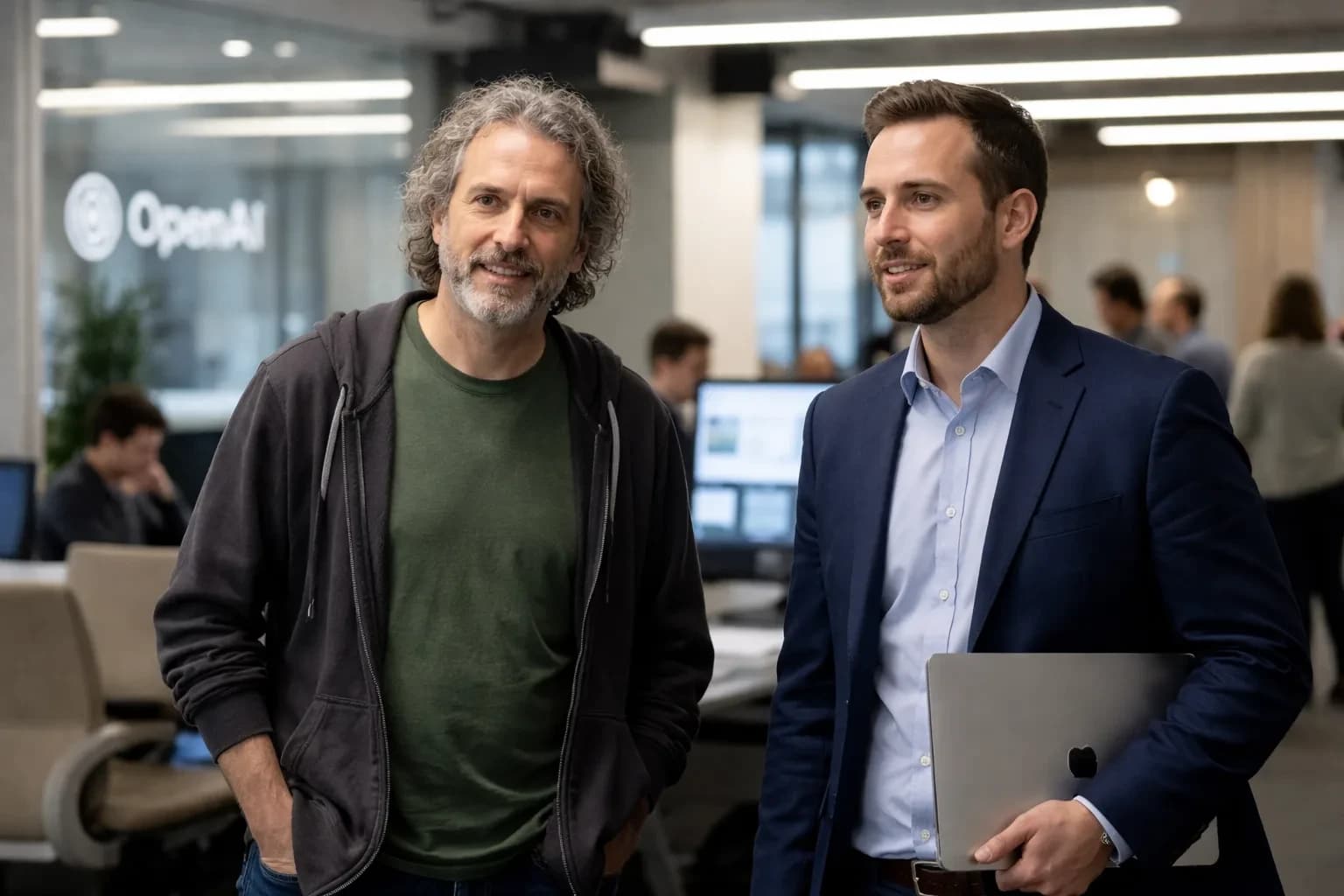
OpenAI has recruited Noam Shazeer and Dean Ball as part of a broader effort to strengthen both its technical leadership and its policy posture ahead of a possible public debut. On its face, the story is about two hires. In practice, it reveals what OpenAI appears to believe it will need most in the next phase of competition: deeper research credibility, sharper institutional governance, and stronger capacity to operate under growing regulatory and political scrutiny.
That is why the OpenAI hires matter. They are not just personnel additions. They are signals about how the company is preparing for scale, scrutiny, and public-market expectations.
Why Noam Shazeer matters to OpenAI
Noam Shazeer carries outsized importance because of his role in the technical history of modern AI. A researcher associated with foundational transformer work brings immediate prestige and serious engineering weight. For OpenAI, adding someone with that profile helps reinforce the idea that the company intends to remain a central technical leader even as rivals continue spending aggressively on talent, compute, and product expansion.
In a talent market where top researchers can materially influence capability trajectories, the symbolic value of a hire like Shazeer is almost as important as the direct technical contribution.
Why Dean Ball matters differently
Dean Ball represents a different kind of strategic need. OpenAI is no longer just a lab competing on models. It is also a company operating in the middle of export-control debates, catastrophic-risk arguments, labor-market concerns, and federal policy competition. Bringing in a policy operator to lead a Strategic Futures team suggests OpenAI wants a more deliberate internal function for thinking about regulation, government alignment, and longer-horizon institutional risk.
That matters because policy pressure is no longer external background noise for AI companies. It is becoming part of the core operating environment.
Why the Strategic Futures team matters
The creation of a Strategic Futures unit is revealing in itself. It suggests OpenAI sees governance, risk framing, and public positioning as areas that need dedicated organizational structure, not just ad hoc executive attention. In other words, the company seems to be institutionalizing the idea that frontier AI development must be paired with a more explicit internal response to downstream consequences.
For a company that may eventually face public shareholders, that kind of structure can also help tell a governance story. Investors and regulators both want to know how serious labs think about power, risk, and oversight.
The public debut angle
The possibility of an OpenAI public debut changes how these hires are interpreted. In a private environment, marquee recruits can be framed mainly around ambition and competition. In a pre-IPO environment, they also become part of the narrative a company may eventually present to markets: strong leadership, credible technical depth, and responsible preparation for a highly consequential industry.
That does not guarantee confidence, but it does help shape the case that OpenAI is building something more durable than a fast-growing product company with headline momentum alone.
The competitive context
OpenAI is not making these moves in isolation. Rival labs and major technology companies are all trying to lock in scarce talent, stronger policy influence, and deeper infrastructure. The AI race increasingly has three fronts at once: research capability, commercial execution, and regulatory positioning. A company weak on any one of those fronts may struggle to convert model leadership into stable long-term advantage.
Seen this way, the OpenAI hires are less about filling roles and more about strengthening all three fronts at the same time.
Why this matters for AI governance
There is also a broader governance implication. As AI systems become more economically and politically important, the internal composition of top labs matters more. Who sits at the intersection of technical decisions, public-risk framing, and policy engagement can affect how aggressively companies ship, how they communicate hazards, and how they respond to government demands.
That is part of what makes Shazeer and Ball notable together. One hire signals technical seriousness. The other signals institutional seriousness about policy and strategic risk.
What comes next
The next question is how visible these hires become in actual product, research, and policy decisions. Observers will watch whether OpenAI's Strategic Futures team emerges as a real force inside the company and whether any eventual public filing frames governance and leadership depth as major pillars of investor confidence.
For now, OpenAI's recruitment of Shazeer and Ball shows a company preparing for a more exposed stage of its life. Technical excellence alone is no longer enough. The next phase of AI leadership also requires policy fluency, governance structure, and a credible story about how power will be managed.
Why it matters
These hires solidify OpenAI's technical foundation and political influence at a time when regulatory scrutiny and market expectations are peaking ahead of a public offering.
Read next
Follow this story through the topic hub, more ai coverage, and the latest updates.
Weekly briefing
Get the week's key developments in one concise email.
Get a fast catch-up on the biggest stories, the context behind them, and the links worth your time.
Cadence
Weekly, for a quick catch-up
Coverage
AI, business, world, security, sports
Format
Clear takeaways and useful context
Request the briefing
Leave your email to open a prepared request and get on the list for the weekly briefing.
About the byline
AI reporter
Alex Rivera reports on artificial intelligence with an emphasis on model launches, frontier lab strategy, developer tooling, and the policy decisions shaping commercial deployment.
Sources and methodology