Microsoft Trains Sales Team to Target OpenAI and Anthropic
The tech giant is pivoting its sales strategy to emphasize the efficiency of its own AI systems over rivals it previously partnered with exclusively.

AI reporter
Reports on model launches, frontier labs, developer platforms, and AI policy with an emphasis on claims verification and rollout context.
Editorial responsibility: Lead reviewer for AI coverage, launch claims, and policy context
Primary source: TechCrunch AI. Full source links and update notes are below.
Fast summary
Start here
- Internal meetings reveal Microsoft is training staff to compare its AI favorably against OpenAI, Google, and Anthropic.
- Executives claim Microsoft's end-to-end system is superior to the individual components sold by competitors.
- The company is increasingly replacing third-party models in flagship apps like Word and Excel with its own in-house technology.
What happened
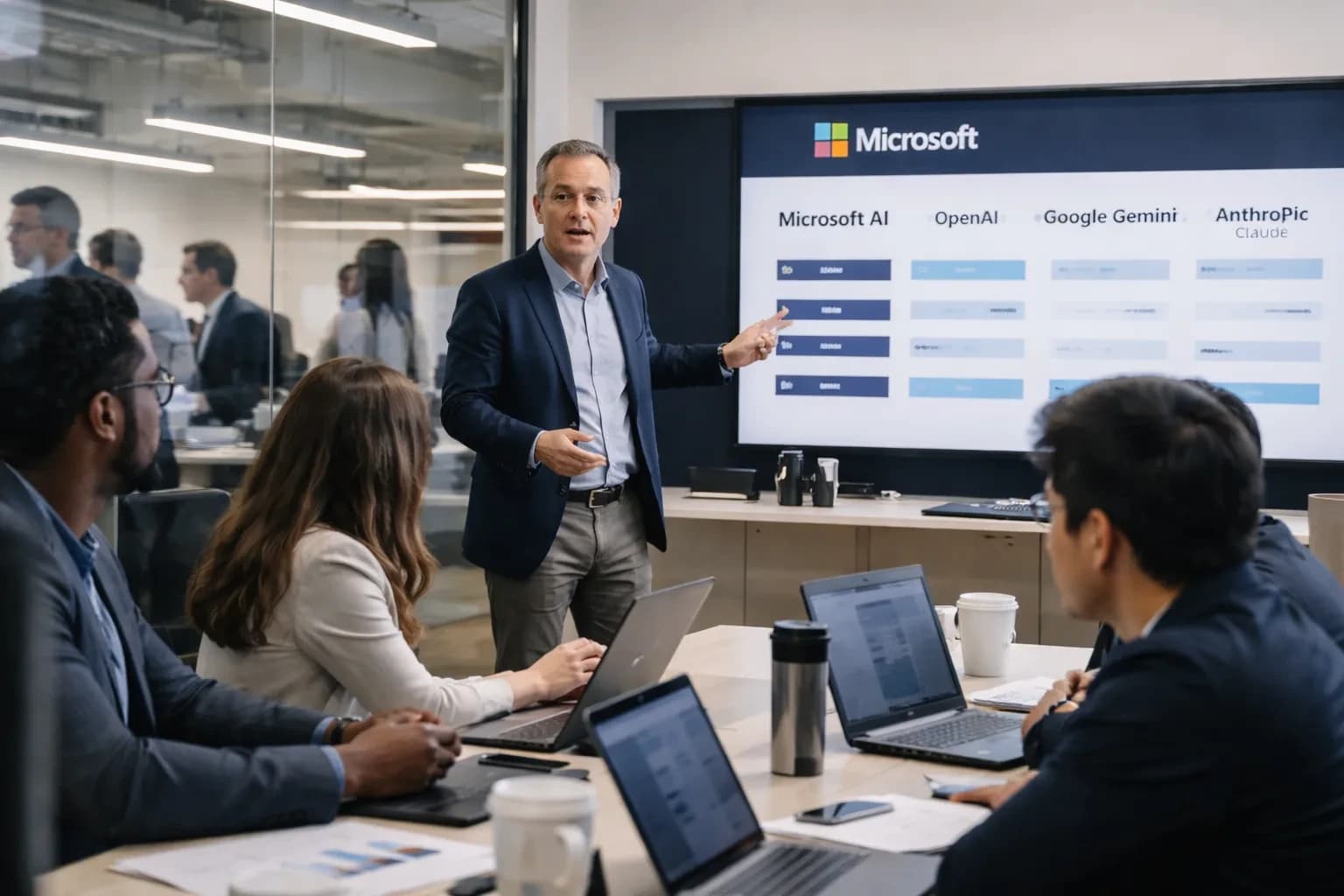
Microsoft has initiated a new competitive strategy for its sales department, reportedly instructing employees to point out the flaws in AI models produced by its closest rivals and partners. During a strategy session for the upcoming fiscal year, high-level executives outlined a plan to frame Microsoft’s AI offerings as more integrated and cost-effective than those from companies like OpenAI, Anthropic, and Google. The shift marks a departure from the collaborative tone Microsoft previously maintained with its AI partners. By positioning its full end-to-end system against the individual parts offered by others, Microsoft aims to capture more market share in the enterprise AI space. This aggressive posture comes as the tech giant looks to maximize the returns on its massive infrastructure investments.
What's new in this update
The latest reports indicate that internal meetings held on Tuesday, July 15, 2026, featured specific presentations designed to undermine competitors. Executive Vice President Jacob Andreou reportedly compared Microsoft’s Copilot directly to Anthropic’s Claude chatbot. In his presentation, Andreou claimed that Anthropic’s models were slower, less accurate, and lacked the necessary security integrations required for Microsoft’s suite of office applications. This direct criticism of a partner is a notable escalation in the competitive landscape. Furthermore, Executive Vice President Jay Parikh emphasized that the company's story for the 2027 fiscal year should focus on the completeness of the Microsoft ecosystem, rather than just the raw power of external models that lack deep integration.
Key details
This internal pivot involves more than just rhetoric; it reflects a technical shift within Microsoft’s product lineup. Recent reports suggest Microsoft is actively swapping out models from OpenAI and Anthropic within flagship applications like Word and Excel. These third-party models are being replaced by Microsoft’s own in-house AI technology. This transition is largely seen as a cost-cutting measure, reducing the fees paid to outside developers while increasing Microsoft's control over its software stack. By leveraging its proprietary models, Microsoft can offer tighter integration within the Windows and Microsoft 365 environments, which the sales team is now tasked with highlighting as a primary selling point to enterprise customers looking for streamlined workflows.
Background and context
The relationship between Microsoft and OpenAI was once considered one of the most exclusive and significant alliances in the tech world. Microsoft provided billions in capital and massive amounts of compute power in exchange for exclusive access to OpenAI’s most advanced models. However, the partnership was amended in April, dropping the exclusivity clause and allowing OpenAI to sell its services to Microsoft’s direct competitors. This change, combined with Microsoft’s recent stock fluctuations, has put pressure on the company to prove its AI investments can yield high-margin results. Investors have grown increasingly skeptical of the high costs associated with AI development, prompting Microsoft to find ways to reduce reliance on expensive third-party APIs through internal innovation.
What to watch next
As the 2027 fiscal year approaches, the industry will be watching how OpenAI and Anthropic respond to this new competitive friction. The shift suggests that the coopetition phase of the AI boom is entering a more aggressive stage where platform owners prioritize their own intellectual property. Market analysts will likely monitor Microsoft’s enterprise adoption rates to see if this end-to-end sales pitch resonates with corporate buyers who are currently navigating a fragmented and expensive AI market. Additionally, any further updates to the partnership agreements between these firms could indicate whether the alliance will continue to fray or if a new equilibrium can be found as Microsoft continues to mature its own in-house AI capabilities.
Why it matters
This shift signals a significant cooling in the partnership between Microsoft and its AI providers as the company prioritizes cost-cutting and internal model development.
Read next
Follow this story through the topic hub, more ai coverage, and the latest updates.
Weekly briefing
Get the week's key developments in one concise email.
Get a fast catch-up on the biggest stories, the context behind them, and the links worth your time.
Cadence
Weekly, for a quick catch-up
Coverage
AI, business, world, security, sports
Format
Clear takeaways and useful context
Request the briefing
Leave your email to open a prepared request and get on the list for the weekly briefing.
About the byline
AI reporter
Alex Rivera reports on artificial intelligence with an emphasis on model launches, frontier lab strategy, developer tooling, and the policy decisions shaping commercial deployment.
Sources and methodology