Jensen Huang Targets $200 Billion Market with Nvidia’s Agentic
The new Vera processor aims to dominate the CPU market for autonomous agents, marking a strategic expansion into territory traditionally held by Intel and

AI reporter
Reports on model launches, frontier labs, developer platforms, and AI policy with an emphasis on claims verification and rollout context.
Editorial responsibility: Lead reviewer for AI coverage, launch claims, and policy context
Primary source: TechCrunch AI. Full source links and update notes are below.
Fast summary
Start here
- Nvidia identifies a new $200 billion total addressable market for its purpose-built Vera CPU.
- The Vera CPU is optimized specifically for agentic AI tasks, prioritizing token processing over traditional multi-core application performance.
- Nvidia has already recorded $20 billion in standalone Vera CPU sales this year following its March introduction.
What happened
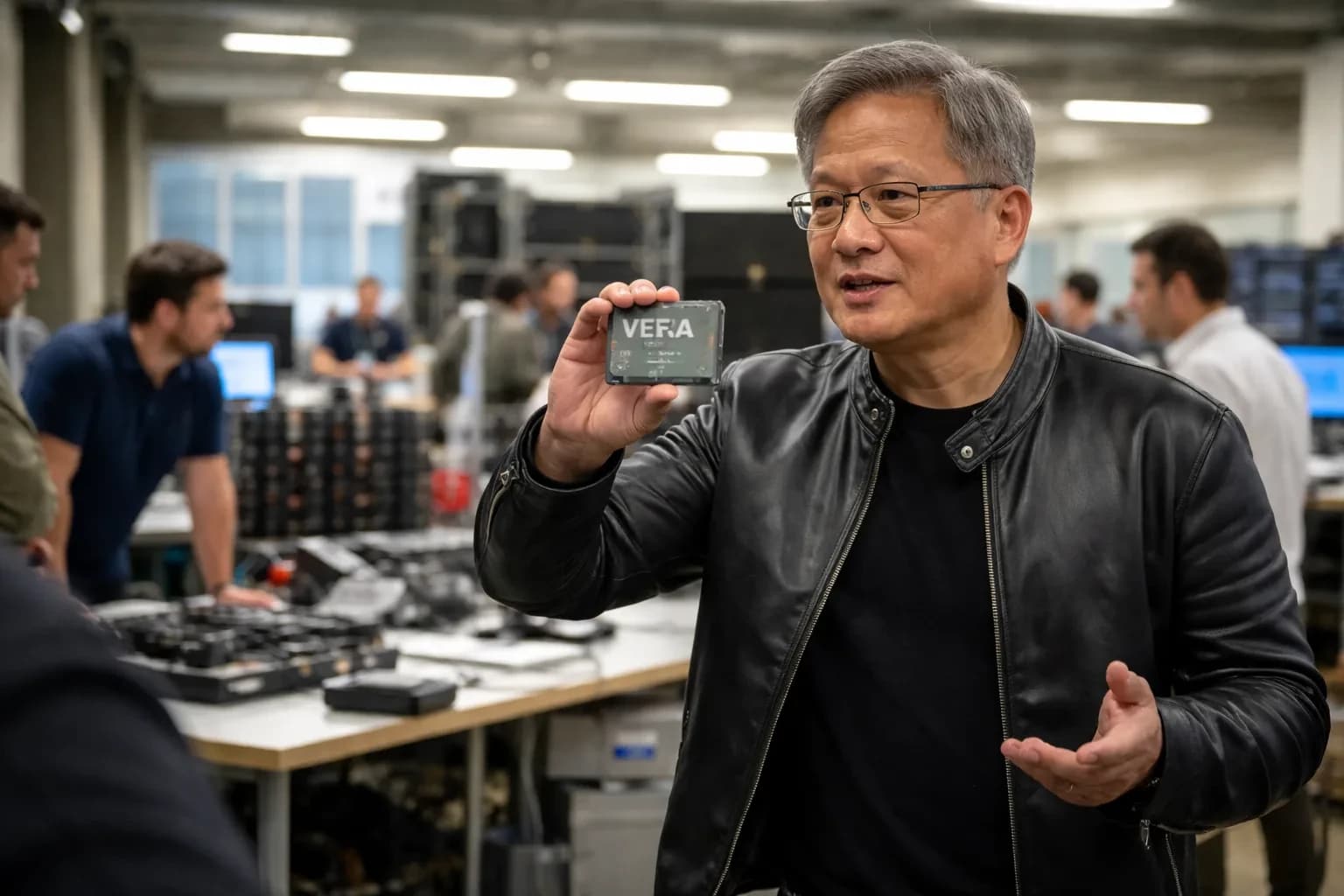
Nvidia chief executive Jensen Huang says the company has identified a new $200 billion market opportunity for its Vera CPU, a processor designed specifically for the rise of agentic AI and robotic physical AI. The claim is strategically significant because Nvidia is not just defending its dominance in GPUs. It is expanding into a neighboring territory historically associated with Intel, AMD, and cloud-specific in-house silicon. In Huang's telling, the future of AI will not only require accelerators that train and run models. It will also require enormous numbers of CPUs tailored to the way AI agents actually operate.
That reframes the CPU conversation. Instead of treating CPUs as generic support chips in an AI system, Nvidia is trying to position them as central infrastructure for the next wave of autonomous software.
What's new in this update
The strongest new point is the scale of Nvidia's ambition. Huang is not presenting Vera as a modest portfolio extension. He is presenting it as a route into a vast new addressable market built around token handling, orchestration, inference support, and billions of future agents interacting with tools, data, and environments. That suggests Nvidia sees the next AI infrastructure battle as much broader than the GPU race it already leads.
The early revenue claim around standalone Vera sales also matters because it implies there is already hyperscaler or enterprise willingness to buy into this vision. Whether those numbers scale sustainably is a separate question, but the signal is that Nvidia does not intend to leave CPU economics to incumbents while it captures only the accelerator layer.
Key details
Vera is being marketed as a purpose-built CPU for agentic systems, with optimization centered more on token processing and AI workflow efficiency than on the traditional CPU benchmark logic of general-purpose app multitasking. That reflects a view that AI agents will increasingly behave as active software workers, each requiring compute coordination that does not map cleanly onto older cloud assumptions.
Several implications follow:
- Nvidia is using AI momentum to challenge Intel and AMD in CPU-adjacent infrastructure.
- Vera is being framed as a CPU designed for AI-native workloads rather than legacy server norms.
- Hyperscalers are a crucial target because they decide which chips become default infrastructure.
- The success of Vera depends on whether agentic AI actually drives the scale Huang predicts.
This is why the product launch is strategically larger than a new chip SKU. It is a claim about how the architecture of AI-era computing will evolve.
Background and context
Nvidia's dominance in GPUs has made it the center of the AI hardware boom, but that position also creates pressure to extend control into adjacent layers of the stack. Cloud providers such as Amazon, Google, and Microsoft are all pursuing their own silicon strategies, while Intel and AMD remain important in general CPU infrastructure. If Nvidia can make customers believe that agentic AI needs a purpose-built CPU paired naturally with its accelerator ecosystem, it strengthens the company's vertical reach and reduces reliance on partners.
The timing also makes sense. The AI industry is moving from model training spectacle toward a broader operational question: what hardware stack supports billions of ongoing AI interactions economically? Huang wants Nvidia's answer to include not only GPUs, but the CPUs that sit beside them.
What to watch next
The next question is whether hyperscalers and major enterprises adopt Vera in meaningful volume or keep betting on in-house CPUs and incumbent alternatives. The chip will need to prove that "AI-native" CPU design produces concrete cost, throughput, or orchestration advantages in real workloads, not just compelling investor language.
It will also be worth watching whether Nvidia can avoid strategic backlash from partners. The more aggressively it expands into adjacent silicon markets, the more it pressures companies that currently buy from it while also competing with it.
Why this matters
This matters because Nvidia, Jensen Huang, Vera CPU, agentic AI, robotic physical AI, hyperscalers, and the semiconductor market are all converging around a bigger infrastructure fight. If Vera succeeds, Nvidia will have extended its AI dominance beyond accelerators into the CPU layer that coordinates a large share of next-generation autonomous workloads. If it fails, it will suggest that even Nvidia cannot easily redraw long-standing chip boundaries simply by attaching AI rhetoric to them.
Reader context
This story belongs to Northstar Herald's Generative AI and AI Infrastructure coverage, with related entities including Nvidia, Jensen Huang, Vera CPU, Agentic AI. The report is based on TechCrunch AI source material.
Related coverage
Why it matters
Nvidia is leveraging its AI dominance to challenge incumbents Intel and AMD in the CPU space, specifically targeting the infrastructure needed for billions of future AI agents.
Read next
Follow this story through the topic hub, more ai coverage, and the latest updates.
Weekly briefing
Get the week's key developments in one concise email.
Get a fast catch-up on the biggest stories, the context behind them, and the links worth your time.
Cadence
Weekly, for a quick catch-up
Coverage
AI, business, world, security, sports
Format
Clear takeaways and useful context
Request the briefing
Leave your email to open a prepared request and get on the list for the weekly briefing.
About the byline
AI reporter
Alex Rivera reports on artificial intelligence with an emphasis on model launches, frontier lab strategy, developer tooling, and the policy decisions shaping commercial deployment.
Sources and methodology