SpaceX IPO Filing Discloses $6.4 Billion Operating Loss for xAI Unit
Audited filings show the AI startup's losses widened as revenue reached $3.2 billion. Capital expenditures are projected to double this year to fund

AI reporter
Reports on model launches, frontier labs, developer platforms, and AI policy with an emphasis on claims verification and rollout context.
Editorial responsibility: Lead reviewer for AI coverage, launch claims, and policy context
Primary source: TechCrunch AI. Full source links and update notes are below.
Fast summary
Start here
- xAI lost $6.4 billion on $3.2 billion in revenue in 2025, a significant widening from the $1.56 billion loss recorded in 2024.
- SpaceX plans to scale its Grok model to multiple trillions of parameters, requiring an annualized capital expenditure run rate of over $30 billion.
- Only 117 million of the ecosystem's 550 million monthly active users currently utilize Grok AI features, representing roughly 21% adoption.
What happened
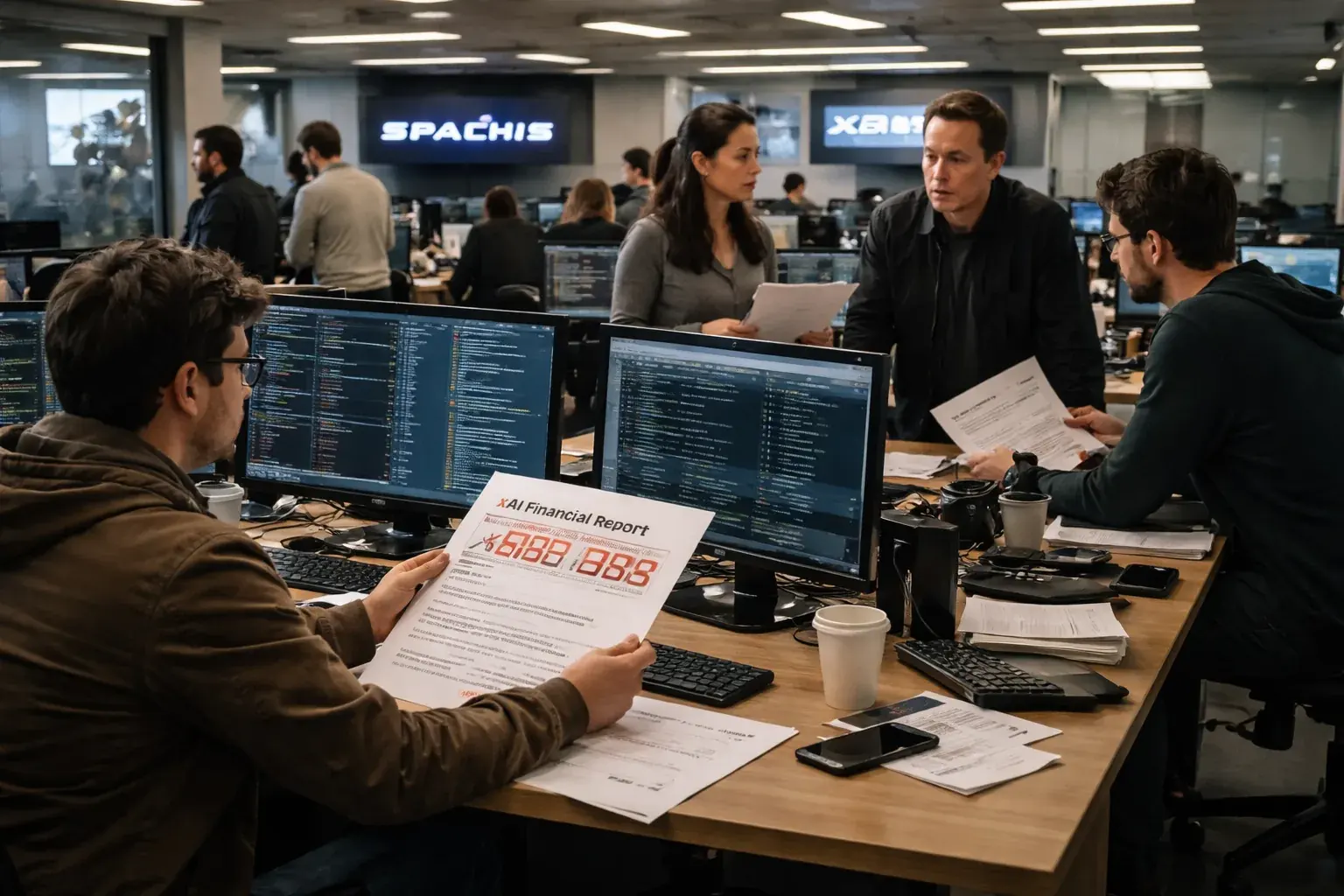
SpaceX's IPO filing has provided the first audited financial view into xAI's operations, revealing that the business recorded a $6.4 billion operating loss in 2025 on $3.2 billion in revenue. The numbers give public investors and competitors a clearer picture of just how expensive Elon Musk's artificial intelligence strategy has become. They also show that xAI is pursuing a classic frontier-model playbook: burn heavily now, build compute aggressively, and hope scale produces both technical relevance and future monetization.
The losses widened sharply from the prior year, when xAI posted a much smaller but still substantial deficit. That change matters because it confirms the company is not yet nearing efficiency. It is accelerating deeper into capital-intensive expansion as it tries to build out Grok, integrate with X, and compete against better-established AI labs.
What's new in this update
The filing indicates that spending is still climbing, not stabilizing. SpaceX reported an annualized capital expenditure run rate above $30 billion for the AI segment based on first-quarter 2026 spending, suggesting that infrastructure costs could more than double from prior levels. This is not the financial profile of a company trying to optimize margins. It is the profile of a company trying to buy time, compute, and model capacity in a race where being underbuilt can be fatal.
The documents also point to an ambitious roadmap for Grok, including the goal of scaling the model family toward multiple trillions of parameters. Whether that target proves technically meaningful or commercially efficient is another question, but it does make clear that xAI intends to compete on frontier-model scale rather than settling into a narrower product niche.
Key details
Revenue came from a mix of AI solutions, infrastructure-related activity, subscriptions tied to X and Grok, data licensing, and advertising. Yet even with billions in revenue, the business remains deeply unprofitable. One important detail is adoption: while the broader X and Grok ecosystem reportedly reaches hundreds of millions of monthly active users, only a fraction of that base actively uses Grok features. That gap shows xAI has distribution, but not yet universal engagement.
This matters because a large social platform can provide an installed audience, but it does not automatically create a sticky AI business. Users still have to find the product valuable enough to return, pay, and trust it for more than curiosity or occasional interaction. If Grok adoption remains limited relative to the platform's scale, xAI may struggle to turn infrastructure spending into efficient monetization.
Background and context
xAI's combination with SpaceX created an unusual corporate structure that ties one of Musk's AI bets to one of his most valuable industrial companies. Supporters may see that as strategic integration around compute, capital access, and long-term ambition. Skeptics may see it as a way to absorb enormous AI spending into a larger corporate story before public markets fully price the risk.
The broader context is brutal competition. OpenAI, Anthropic, Google, Meta, and others are all spending heavily on models, chips, and data centers. Some rivals appear to be moving closer to operating leverage in certain product lines, while xAI is still proving whether Grok can become a product with large-scale, defensible demand. Musk's advantage is his willingness to spend aggressively and his control of a wider ecosystem. His disadvantage is that burning cash alone does not guarantee model leadership.
The reference to future orbital compute infrastructure is another signal of how expansive the strategy has become. xAI is not just trying to train better models. It is part of a larger vision about owning as much of the physical stack as possible, from power and data-center capacity to eventual space-linked compute assets.
What to watch next
Investors will be watching two things in parallel: model progress and monetization progress. If Grok meaningfully improves and user adoption expands across X, the losses may look like the cost of building a strategic AI platform. If user conversion stays limited and technical gains lag competitors, the burn rate will look much harder to justify.
The SpaceX IPO angle matters too. Public-market investors will need to decide whether xAI's losses are a bold growth investment attached to a broader Musk ecosystem or a major drag that complicates the valuation story. The answer will shape how much patience markets grant this strategy.
Why this matters
The disclosure provides the first audited financial look at Elon Musk's AI ambitions and confirms a high-burn strategy intended to achieve frontier model status before a public listing. It also illustrates a core truth of the current AI market: revenue growth alone is not enough when compute expansion and model competition are swallowing capital at extraordinary speed.
Reader context
This story belongs to Northstar Herald's Generative AI and AI Infrastructure coverage, with related entities including xAI, SpaceX, Elon Musk, Grok. The report is based on TechCrunch AI source material.
Related coverage
Why it matters
The disclosure provides the first audited financial look at Elon Musk's AI ambitions and confirms a high-burn strategy intended to achieve frontier model status before a public listing.
Read next
Follow this story through the topic hub, more ai coverage, and the latest updates.
Weekly briefing
Get the week's key developments in one concise email.
Get a fast catch-up on the biggest stories, the context behind them, and the links worth your time.
Cadence
Weekly, for a quick catch-up
Coverage
AI, business, world, security, sports
Format
Clear takeaways and useful context
Request the briefing
Leave your email to open a prepared request and get on the list for the weekly briefing.
About the byline
AI reporter
Alex Rivera reports on artificial intelligence with an emphasis on model launches, frontier lab strategy, developer tooling, and the policy decisions shaping commercial deployment.
Sources and methodology