Hello Robot Moves Home Assistance Robotics From Lab to Living Room
The startup's fourth-generation Stretch robot prioritizes human-in-the-loop control to help users with mobility impairments perform daily tasks.
Primary source: TechCrunch AI. Full source links and update notes are below.
Fast summary
Start here
- Hello Robot released the fourth iteration of Stretch, a home assistance robot featuring a telescoping arm and sensor-studded head.
- The company focuses on human-in-the-loop control rather than full autonomy, allowing users to direct tasks via voice-operated apps.
- Real-world deployment in homes provides the company with unique operational data and 'site-specific recovery loops' that simulation cannot replicate.
What happened
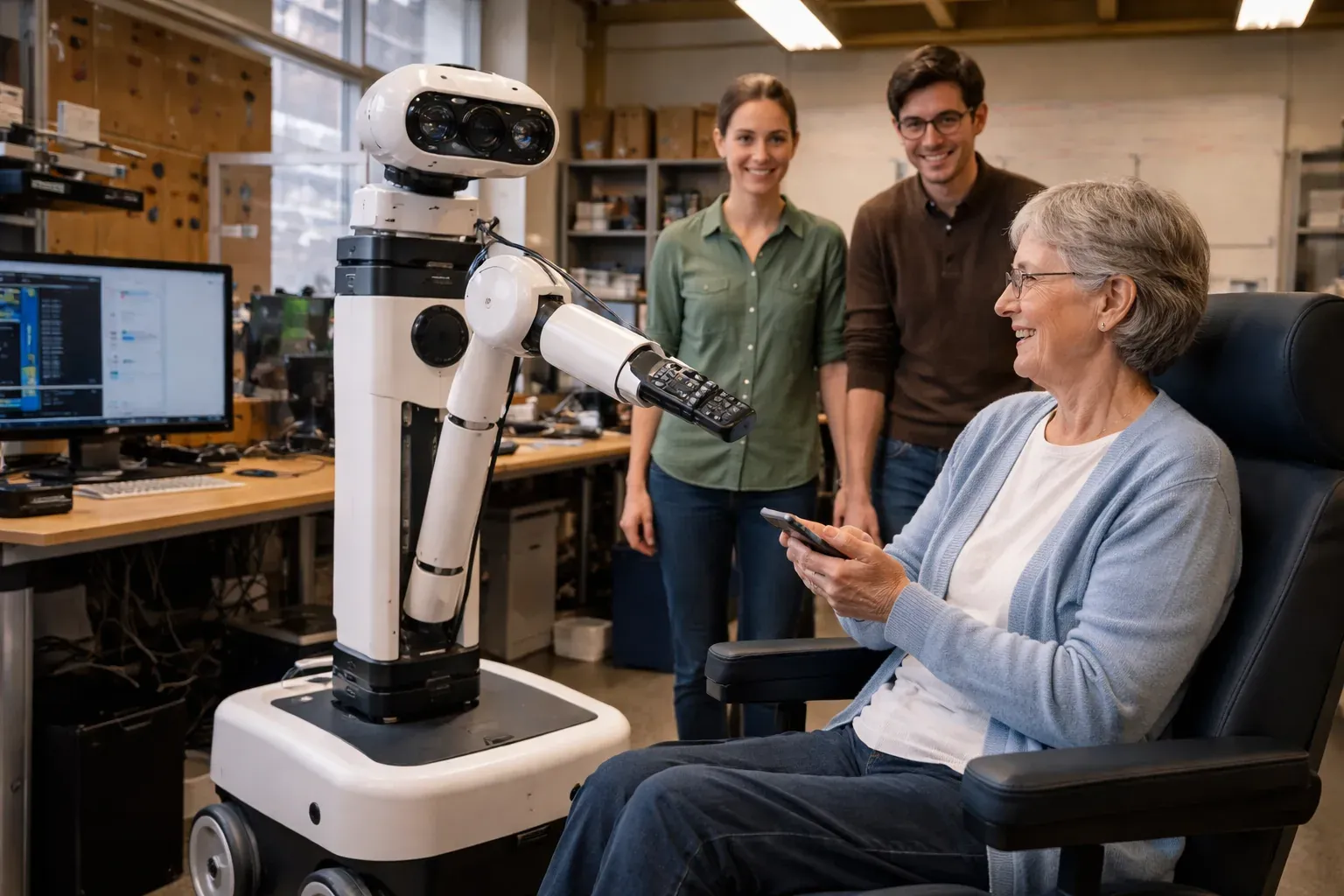
Hello Robot has transitioned its Stretch home assistance robot out of the laboratory and into the homes of users with mobility challenges. Founded by former Google robotics director Aaron Edsinger and Georgia Tech professor Charlie Kemp, the startup recently released the fourth iteration of its Stretch hardware. Unlike the humanoid robots under development by competitors in Silicon Valley, Stretch utilizes a telescoping arm on a heavy, wheeled base to perform specific, high-utility tasks such as assisting with meals and personal care.
What's new in this update
The latest version of Stretch is being utilized by early adopters like Keith Platt, a quadriplegic investor who uses the machine to perform tasks that previously required human intervention. Using a voice-operated iPhone app, Platt can task the robot to move autonomously to a location before taking direct manual control to manipulate objects. This hybrid approach has allowed users to reduce the time needed for tasks—like drinking a protein shake—from two hours to just a few minutes.
Key details
The Stretch robot is designed with a 'human-in-the-loop' philosophy, where being in control is considered a core feature for the user. The hardware consists of an omnidirectional wheeled base, a telescoping arm with pinchers, and a sensor-equipped head. To support its deployment, Hello Robot includes an occupational therapist on its team to assist users with specific physical conditions in integrating the technology into their daily routines.
Background and context
Since its founding in 2017, Hello Robot has avoided the maximalist humanoid promises of larger robotics firms, focusing instead on practical embodiment. Industry analysts note that the 'moat' in robotics is increasingly defined by accumulated operating hours under real-world liability rather than just intellectual property. By placing robots in actual homes, Hello Robot is gathering the site-specific data necessary to refine workflow tolerances and recovery loops that are difficult to synthesize in simulations.
What to watch next
The company continues to focus on how robotic assistants can enable people with mobility challenges to spend full days at home safely. Future developments are likely to focus on further reducing the time required for complex manual tasks and exploring how these robots can alleviate the physical and emotional burden on family caregivers and professional medical staff.
Why it matters
The deployment of functional robots in residential settings marks a shift from experimental AI to practical assistive technology that can reduce dependence on professional caregivers.
Read next
Follow this story through the topic hub, more ai coverage, and the latest updates.
Weekly briefing
Get the week's key developments in one concise email.
Get a fast catch-up on the biggest stories, the context behind them, and the links worth your time.
Cadence
Weekly, for a quick catch-up
Coverage
AI, business, world, security, sports
Format
Clear takeaways and useful context
Request the briefing
Leave your email to open a prepared request and get on the list for the weekly briefing.
Author
See who assembled this story and follow more of their work.
Sources and methodology