Google Unveils Gemini-Powered Smart Glasses in Partnership with
The new audio glasses feature deep Gemini integration and were designed in collaboration with Samsung and Gentle Monster.

AI reporter
Reports on model launches, frontier labs, developer platforms, and AI policy with an emphasis on claims verification and rollout context.
Editorial responsibility: Lead reviewer for AI coverage, launch claims, and policy context
Primary source: TechCrunch AI. Full source links and update notes are below.
Fast summary
Start here
- Google announced a new line of AI-powered audio glasses developed with Warby Parker, Gentle Monster, and Samsung.
- The devices utilize Google's Gemini AI to process verbal commands and interact with Android and iOS ecosystems.
- The glasses are scheduled for release later in 2026, marking Google's return to the consumer eyewear market.
What happened
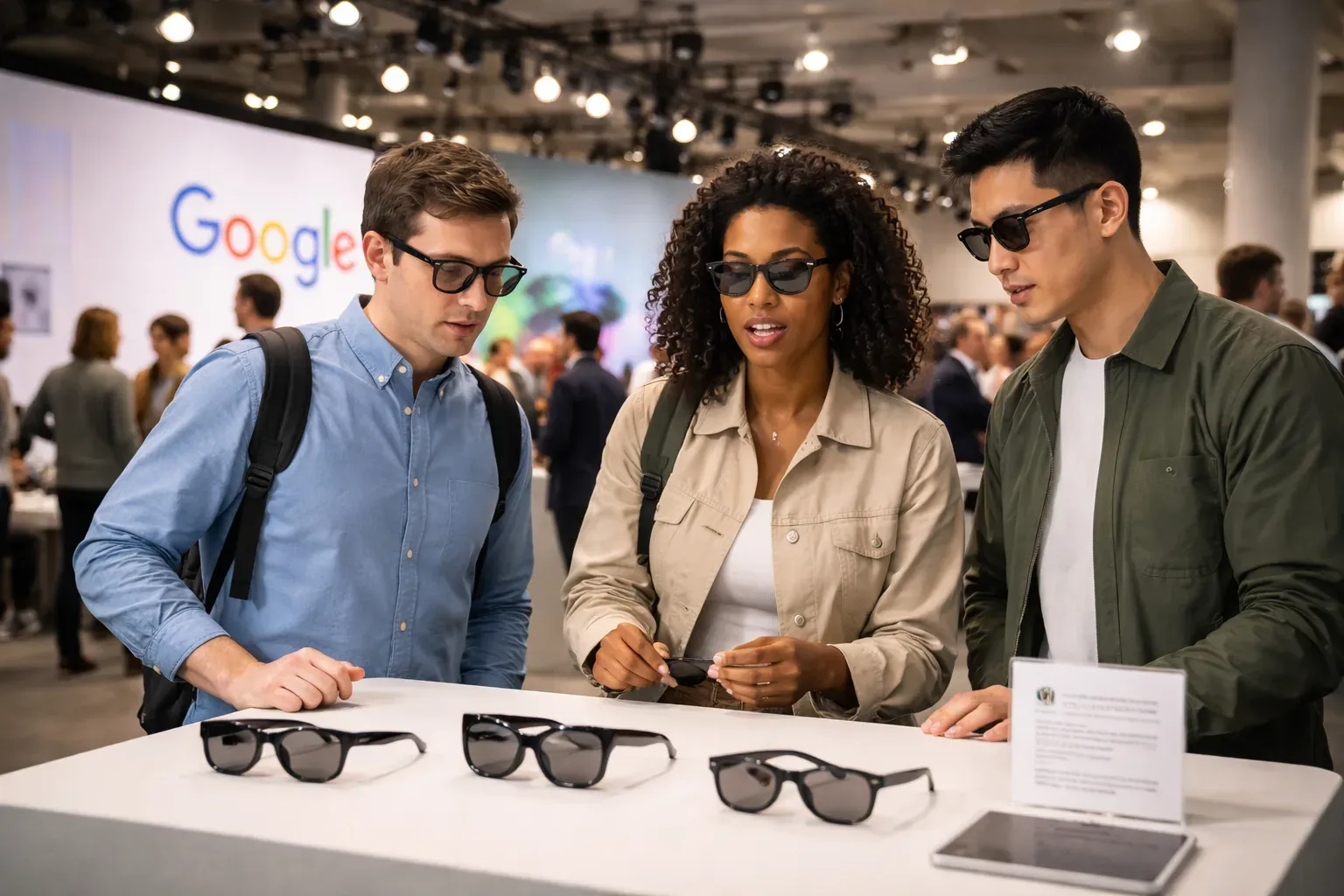
At Google I/O 2026, Google announced a new generation of AI audio glasses built with partners including Warby Parker, Gentle Monster, and Samsung, marking a serious return to wearable eyewear after the long shadow of the original Google Glass. This time, the company is emphasizing style, audio-first interaction, and Gemini integration rather than obvious visual-display experimentation.
That choice matters because Google appears to have learned a central lesson from the last decade of wearable computing: if smart glasses do not look socially acceptable, users will reject them before the software even gets a chance.
Why these AI audio glasses matter
The Google smart glasses launch is not just another hardware experiment. It is part of the broader race to determine where AI assistants live. Phones remain dominant, but companies increasingly want to move assistants into always-available wearables that can listen, respond, and act without requiring a user to look down at a screen.
That is why the Gemini-powered smart glasses strategy is important. Google is trying to place its AI closer to the user's senses and daily routines, where it can become a persistent interface rather than an occasional app.
Why the fashion partnerships are strategic
The inclusion of Warby Parker and Gentle Monster is one of the most revealing parts of the announcement. It suggests Google understands that eyewear is not only a computing platform. It is also a fashion object. If a wearable sits on a person's face, design legitimacy is not optional.
This is where Google is taking a page from the more successful playbook that Meta helped normalize with its own eyewear strategy: partner with brands that already know how to make people want to wear the product.
Why Gemini is central to the pitch
The glasses are reportedly built around Gemini AI, which means the value proposition is not just hands-free audio. It is contextual assistance, voice-driven commands, and deeper integration with the broader Google ecosystem. That could include navigation, communication, reminders, search, and task completion without constant phone interaction.
If the experience works well, the device becomes more than a headset. It becomes a lightweight AI interface layer for everyday life.
Why this is also about competing with Meta
The Google partners with Warby Parker and Gentle Monster story is also clearly a competitive move against Meta's growing wearable presence. Meta has already shown that AI-enabled glasses can gain traction if they feel usable and socially acceptable. Google does not want to cede that category, especially if AI assistants are increasingly shifting into multimodal, always-available hardware.
This makes the new glasses part of a larger question: who gets to define the mainstream AI wearable before the category hardens around one ecosystem?
The privacy challenge has not disappeared
Even if the product is audio-first, smart glasses still bring privacy concerns. Microphones, potential cameras, and constant AI presence create anxiety around consent, recording, and ambient data collection. Google's earlier history with Google Glass makes that issue even harder to ignore.
That means success will depend on more than style and AI capability. Google will need a convincing answer to the question of what the glasses are doing, when they are doing it, and how obvious that is to both the wearer and everyone nearby.
What to watch next
The biggest questions are price, battery life, real-world usefulness, and whether Google can make the glasses feel meaningfully better than using a phone plus earbuds. Watch too for how deeply Gemini is integrated and whether the company can position these glasses as a daily product rather than a niche demo for early adopters.
Why this matters
The Google partners with Warby Parker and Gentle Monster for new AI audio glasses story matters because it shows the next AI battle is shifting into hardware that people can wear all day. If Google succeeds, Gemini gains a new distribution layer. If it fails, it will reinforce how difficult it is to turn ambient AI into a product people actually want on their face.
Related coverage
Why it matters
This move signals Google's intent to compete directly with Meta's smart glasses while leveraging Gemini AI in a form factor intended to be more socially acceptable than the original Google Glass.
Read next
Follow this story through the topic hub, more ai coverage, and the latest updates.
Weekly briefing
Get the week's key developments in one concise email.
Get a fast catch-up on the biggest stories, the context behind them, and the links worth your time.
Cadence
Weekly, for a quick catch-up
Coverage
AI, business, world, security, sports
Format
Clear takeaways and useful context
Request the briefing
Leave your email to open a prepared request and get on the list for the weekly briefing.
About the byline
AI reporter
Alex Rivera reports on artificial intelligence with an emphasis on model launches, frontier lab strategy, developer tooling, and the policy decisions shaping commercial deployment.
Sources and methodology