Google Previews Android XR Glasses with Integrated In-Lens Display
New prototypes tested at Google I/O feature visual overlays and Gemini AI integration, bridging the gap between audio wearables and augmented reality.

AI reporter
Reports on model launches, frontier labs, developer platforms, and AI policy with an emphasis on claims verification and rollout context.
Editorial responsibility: Lead reviewer for AI coverage, launch claims, and policy context
Primary source: TechCrunch AI. Full source links and update notes are below.
Fast summary
Start here
- Google demonstrated prototype Android XR glasses featuring an in-lens display for widgets like live translation and directions.
- The devices integrate Google’s Gemini AI, activated via a physical press on the frame to trigger voice and camera functions.
- Developed in partnership with Warby Parker, Samsung, and Gentle Monster, the glasses will eventually support both iOS and Android.
What happened
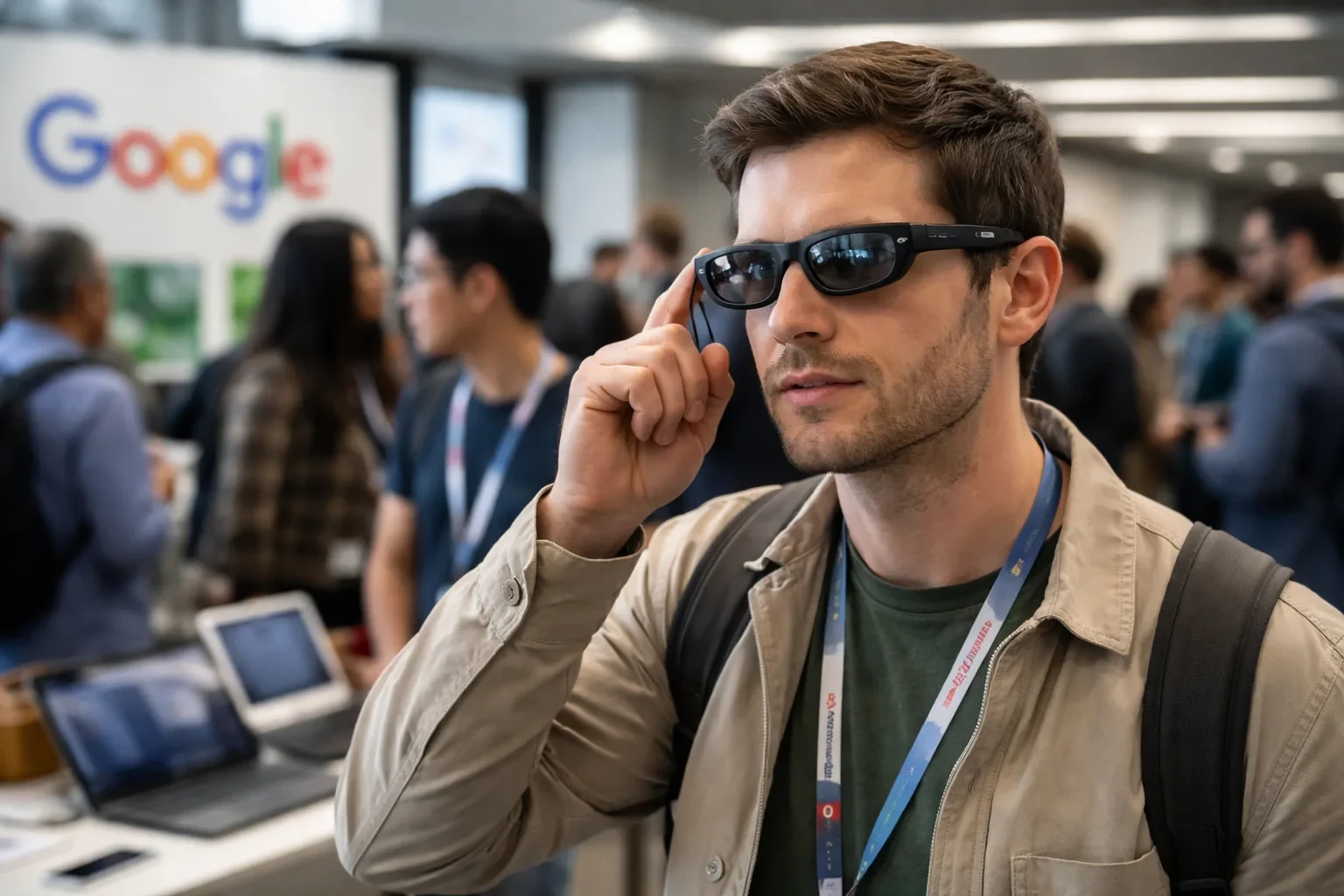
Google gave a hands-on preview of its prototype Android XR glasses at I/O 2026, offering a closer look at how the company wants Gemini-powered wearables to evolve beyond simple audio assistants. The prototype includes an in-lens display that can show information such as directions, translations, widgets, and contextual prompts, pushing the device into a middle ground between smart glasses and lightweight augmented reality.
The significance of the preview is not just technical. It shows Google trying to re-enter consumer wearables with a product category that now has a more plausible use case than earlier smart-glasses experiments. Instead of betting on full immersive computing right away, Google is betting on glasses that still look socially acceptable while adding AI assistance and discreet visual overlays.
What's new in this update
The in-lens display is the main change that separates this prototype from the audio-first smart glasses Google had previously discussed. During the demo, the glasses surfaced navigation cues, weather widgets, and other glanceable information without forcing the wearer to pull out a phone. That kind of overlay is important because it moves the product from "voice gadget" territory toward a more integrated daily interface.
Google also demonstrated a clearer interaction pattern for Gemini. A long press on the frame activates the assistant, turning on listening and camera-related context. That suggests Google sees multimodal interaction as central to the product: the device is not just hearing the user, it is observing the environment and layering AI interpretation onto what the user sees.
Key details
The glasses are being developed with partners including Samsung, Warby Parker, and Gentle Monster, a combination that signals Google's attempt to balance software capability with industrial design and mainstream wearability. That partnership structure matters because smart glasses tend to fail when they feel too experimental, too bulky, or too socially awkward for ordinary use.
Several practical elements stand out from the prototype phase:
- The device can display small but useful visual cues in real time.
- Gemini integration allows voice-plus-vision assistance rather than voice alone.
- Photo capture and phone pairing worked in demos, though audio challenges remain in noisy settings.
- The shipping path appears staged, with audio-focused models arriving before more advanced display versions.
That staged rollout suggests Google knows this category still has hardware tradeoffs to solve, especially around battery life, heat, privacy signaling, and sound quality.
Background and context
Google's history with smart glasses makes this launch especially interesting. Google Glass arrived too early and became culturally defined as much by privacy backlash and awkward social signaling as by technical ambition. The current AI cycle gives the company a second chance because the value proposition is now easier to explain: hands-free access to a powerful assistant that can understand what the user is looking at.
The broader market also looks more favorable than it did a decade ago. Consumers are increasingly familiar with voice assistants, wireless earbuds, and ambient computing, while AI models such as Gemini provide a more compelling software layer than earlier mobile assistants could. That does not guarantee success, but it means the product can now solve more real problems than before.
What to watch next
The next question is whether Google can turn a polished prototype into hardware people actually want to wear every day. Release timing, battery performance, price, privacy controls, and developer support for Android XR will all matter. The audio-only phase may provide an early clue about consumer appetite before the display version is ready.
Why this matters
This matters because AI wearables remain one of the most contested frontiers in consumer tech. If Google can combine Gemini, Android XR, and normal-looking eyewear into a product that feels genuinely useful, it could reopen the smart-glasses category on far better terms than the first time around.
Reader context
This story belongs to Northstar Herald's Generative AI and Artificial Intelligence coverage, with related entities including Google, Android XR, Gemini, Wearables. The report is based on TechCrunch AI source material.
Related coverage
Why it matters
This represents Google's move to reclaim space in the wearable market by blending generative AI with hardware that resembles traditional eyewear.
Read next
Follow this story through the topic hub, more ai coverage, and the latest updates.
Weekly briefing
Get the week's key developments in one concise email.
Get a fast catch-up on the biggest stories, the context behind them, and the links worth your time.
Cadence
Weekly, for a quick catch-up
Coverage
AI, business, world, security, sports
Format
Clear takeaways and useful context
Request the briefing
Leave your email to open a prepared request and get on the list for the weekly briefing.
About the byline
AI reporter
Alex Rivera reports on artificial intelligence with an emphasis on model launches, frontier lab strategy, developer tooling, and the policy decisions shaping commercial deployment.
Sources and methodology