Google Unveils AI Design App 'Pics' to Challenge Canva
The new Workspace tool allows users to generate and edit complex graphics using the Nano Banana 2 model and Gemini-driven feedback layers.

AI reporter
Reports on model launches, frontier labs, developer platforms, and AI policy with an emphasis on claims verification and rollout context.
Editorial responsibility: Lead reviewer for AI coverage, launch claims, and policy context
Primary source: TechCrunch AI. Full source links and update notes are below.
Fast summary
Start here
- Google launched Pics, a generative AI design app integrated directly into the Google Workspace ecosystem.
- The tool is powered by the Nano Banana 2 model, which enables precise text rendering and detailed visual output.
- Users can modify specific parts of an image through direct editing, text prompts, or a comment-based feedback system similar to Google Docs.
What happened
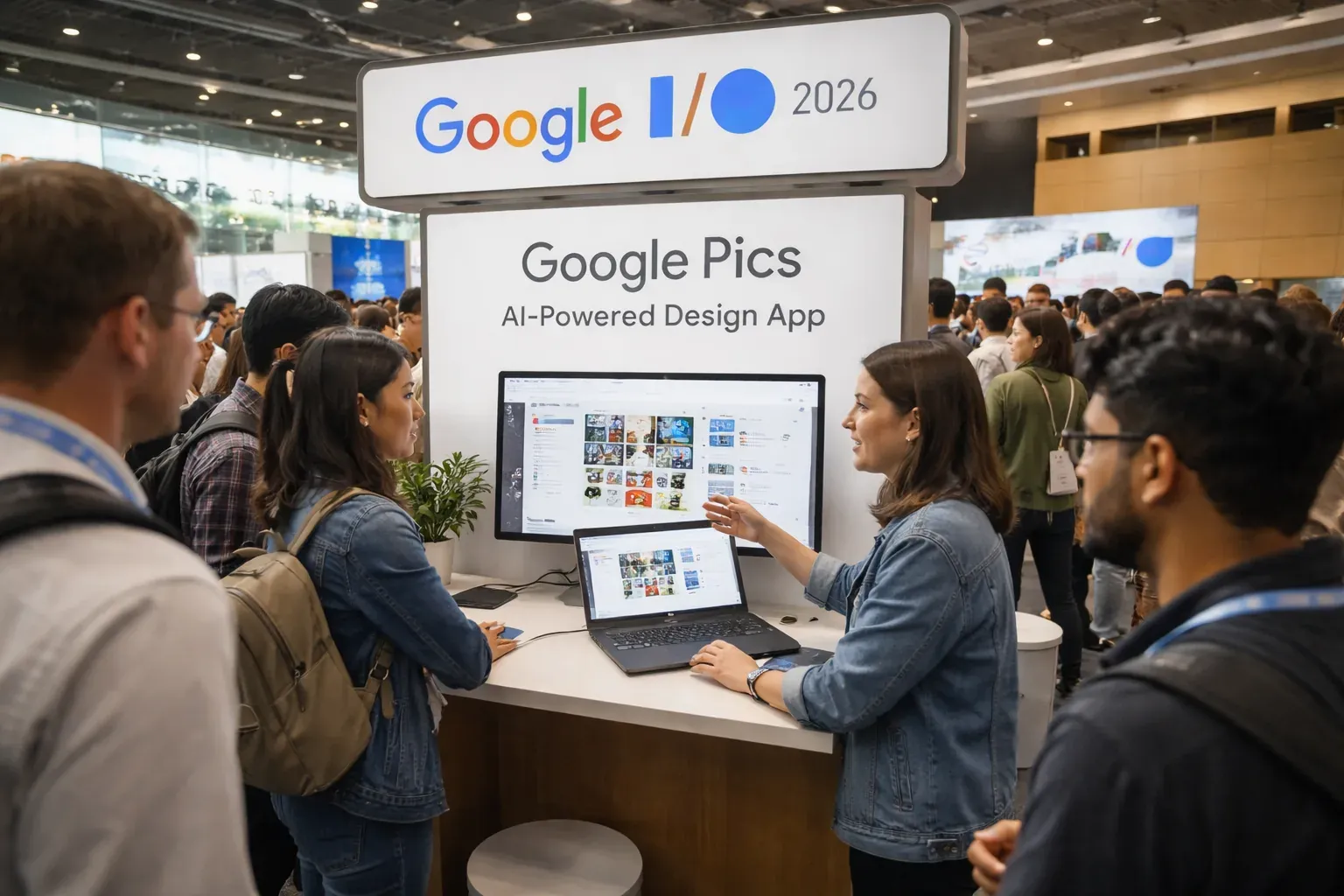
Google has launched Pics, a new AI-powered design application built into Google Workspace, marking a direct move into the increasingly competitive market for generative design tools. Announced at Google I/O 2026, the product is aimed at users who need marketing visuals, presentations, invitations, product mockups, and other graphics without relying on traditional design software. In effect, Google is trying to make visual creation inside Workspace as frictionless as writing a document or building a slide deck.
What's new in this update
The key new feature is not just generation, but editability. Google says Pics allows users to generate visuals from prompts and then refine specific areas rather than starting from scratch each time. That solves one of the most common frustrations in AI image workflows: once an image is close to correct, even a tiny change often requires regenerating the whole thing and losing the parts that already worked.
Google is addressing that problem through a Gemini-driven feedback layer and an interface that lets users click into individual elements, leave comments, and request targeted changes. The company is essentially borrowing the collaborative editing logic of Google Docs and applying it to AI-generated design.
Key details
Pics runs on Google's Nano Banana 2 model, which the company says is optimized for visual fidelity and more accurate text rendering. That matters because text inside AI-generated graphics has long been a weakness across the industry. If Google can produce cleaner typography and more reliable visual layouts than competitors, that alone would make Pics more practical for everyday business use.
The Workspace integration is also central to the pitch. Users are not being asked to leave Google's productivity environment, export assets repeatedly, or manage complicated handoff steps. A team could generate a design, annotate it collaboratively, revise it in real time, and then deploy it into a document, slide deck, or communication workflow.
That positioning makes Pics less like a standalone art toy and more like an extension of workplace productivity. It is meant to turn design into another native office task rather than a separate professional discipline reserved for specialized software.
Background and context
This launch shows Google moving aggressively into a market where Canva, Adobe-adjacent workflows, and AI-native creative tools have already trained users to expect fast visual output. The company clearly sees generative design as the next battleground in productivity software, especially as AI assistants become more capable of handling both language and image tasks in the same environment.
The competitive context matters. Canva dominates simplified design for non-designers, while AI platforms from OpenAI, Anthropic, and others are expanding user expectations around multimodal creation. Google does not want Workspace users leaving its ecosystem every time they need an event flyer, an internal graphic, or a social asset.
Pics therefore fits a larger Google strategy: take core productivity functions and wrap them with generative AI until Workspace feels like a fully assisted operating system for knowledge work and content production.
What to watch next
The main question is whether users find Pics reliable enough for real work rather than demo-friendly tasks. AI design tools often look impressive in controlled examples but fail when teams need precise branding, clean text, or repeatable asset quality. If Nano Banana 2 and the granular editing workflow hold up under real use, Pics could become a serious threat to established design platforms.
Rollout scope will also matter. Google said the product would begin with select users and Google AI Ultra subscribers, which suggests the company is treating Pics as both a premium differentiator and an early-stage experiment. If adoption is strong, expect Google to push the tool deeper into Workspace and connect it more tightly with Docs, Slides, Gmail, and other collaboration layers.
More broadly, Pics signals that AI design is no longer a side category. Google now views it as a core productivity battleground, and that raises the stakes for every company trying to define how non-designers create visual content in the AI era.
Why it matters
The move marks Google's direct entry into the creative design space, intensifying competition with established players like Canva and AI-native rivals like Anthropic.
Read next
Follow this story through the topic hub, more ai coverage, and the latest updates.
Weekly briefing
Get the week's key developments in one concise email.
Get a fast catch-up on the biggest stories, the context behind them, and the links worth your time.
Cadence
Weekly, for a quick catch-up
Coverage
AI, business, world, security, sports
Format
Clear takeaways and useful context
Request the briefing
Leave your email to open a prepared request and get on the list for the weekly briefing.
About the byline
AI reporter
Alex Rivera reports on artificial intelligence with an emphasis on model launches, frontier lab strategy, developer tooling, and the policy decisions shaping commercial deployment.
Sources and methodology