Google Introduces Conversational AI Search for Gmail
The new 'Gmail Live' feature allows users to query their inboxes using natural language voice commands to surface specific details buried in messages.

AI reporter
Reports on model launches, frontier labs, developer platforms, and AI policy with an emphasis on claims verification and rollout context.
Editorial responsibility: Lead reviewer for AI coverage, launch claims, and policy context
Primary source: TechCrunch AI. Full source links and update notes are below.
Fast summary
Start here
- Gmail Live uses Gemini AI to answer natural language questions about specific emails, such as flight details, door codes, or appointment times.
- The conversational interface supports follow-up questions and can infer information like hotel room numbers or identities not explicitly named.
- Initial rollout is scheduled for summer 2026 and will be exclusive to Google AI Ultra subscribers.
What happened
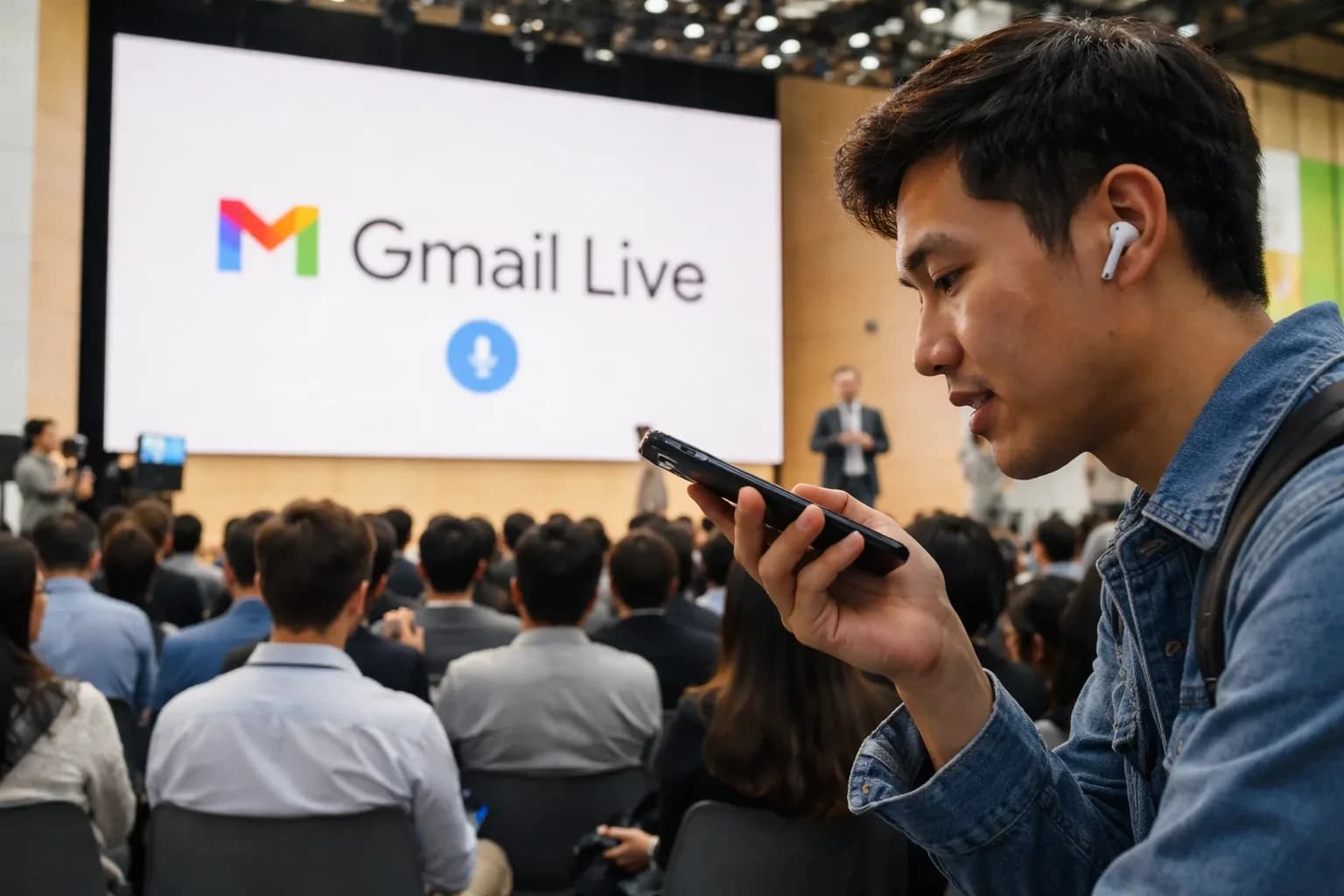
Google used I/O 2026 to introduce Gmail Live, a conversational AI feature that lets people search their inboxes with natural language and voice instead of relying only on keywords, filters, and date guesses. The core pitch is straightforward: rather than hunting manually through years of messages, users can ask Gmail a direct question such as when a flight lands, what a rental door code is, or which email mentioned a meeting change.
This is one of the clearest examples of Google trying to turn generative AI into a routine consumer utility rather than a novelty demo. Email is already a daily archive of receipts, reservations, school notices, logistics, and personal coordination. If Gemini can reliably surface details from that mess in a conversational way, Gmail Live could become the kind of AI feature that feels practical rather than experimental.
What's new in this update
What separates Gmail Live from a standard search upgrade is the conversational layer. Google says the system can handle follow-up questions, maintain context, and infer relationships between pieces of information buried across separate messages. A user might ask for a hotel confirmation, then follow with a question about the room number or check-in instructions without restating everything from the start.
That matters because normal inbox search often fails at exactly these tasks. People remember fragments of context, not precise keywords. They know a message exists but not who sent it, what the subject line was, or whether the information came in an attachment, thread, or reply. Gmail Live is meant to bridge that gap by letting users ask for meaning rather than syntax.
Key details
Google says Gmail Live is powered by Gemini and is being introduced as an optional feature rather than a forced redesign of inbox search. That choice likely reflects lessons from earlier backlash to AI-first changes in other Google products, where users objected when familiar workflows were replaced too aggressively.
The announcement also fits into a broader Gmail and Workspace push that includes draft assistance, faster file access, and AI-powered task handling. In that sense, Gmail Live is not an isolated feature. It is part of a larger effort to make Google Workspace feel like a coordinated assistant layer sitting on top of email, documents, notes, and scheduling data.
Several questions will shape adoption:
- Whether answers are accurate enough for high-trust use cases like travel, work deadlines, and billing.
- Whether people are comfortable speaking aloud to search personal email.
- Whether Gemini can handle ambiguity without hallucinating details.
- Whether Google can add utility without making privacy concerns feel more acute.
Background and context
The AI email category has become a major battleground because inboxes are among the richest and messiest personal data stores that mainstream users already maintain. Microsoft, Google, and other platform companies all see email and productivity tools as natural environments for AI assistants, because the problems are obvious and the daily usage is constant.
Google's challenge is to show that these features save time without making people feel they are handing over too much interpretive control to the model. That is especially important in Gmail, where users routinely store sensitive financial, medical, educational, and identity-related information. A useful AI inbox has to feel both smart and predictable.
What to watch next
The rollout will begin in summer 2026 for Google AI Ultra subscribers, making access initially limited. The real test will come when users try it on messy real inboxes full of forwarded threads, attachments, spam-adjacent clutter, and inconsistent wording. Google also signaled that similar conversational retrieval may spread to other Workspace apps, including Google Keep.
Why this matters
Gmail Live matters because it takes one of the most ordinary frustrations in digital life, finding buried information in email, and turns it into a high-stakes test of whether consumer AI can deliver daily value. If it works well, it will strengthen the case for AI-native productivity tools. If it fails, it will reinforce skepticism about AI reliability in personal information systems.
Reader context
This story belongs to Northstar Herald's Generative AI and Artificial Intelligence coverage, with related entities including Google, Gmail, Gmail Live, Google IO 2026. The report is based on TechCrunch AI source material.
Related coverage
Why it matters
This update attempts to turn AI into a practical tool for everyday organization, addressing common user friction when searching through massive email archives.
Read next
Follow this story through the topic hub, more ai coverage, and the latest updates.
Weekly briefing
Get the week's key developments in one concise email.
Get a fast catch-up on the biggest stories, the context behind them, and the links worth your time.
Cadence
Weekly, for a quick catch-up
Coverage
AI, business, world, security, sports
Format
Clear takeaways and useful context
Request the briefing
Leave your email to open a prepared request and get on the list for the weekly briefing.
About the byline
AI reporter
Alex Rivera reports on artificial intelligence with an emphasis on model launches, frontier lab strategy, developer tooling, and the policy decisions shaping commercial deployment.
Sources and methodology