Turkish Riot Police Storm Opposition Headquarters After Leadership
Security forces used tear gas and force to enter the Republican People's Party building in Ankara following a court ruling that nullified the leadership of

World correspondent
Reports on international affairs, diplomacy, and humanitarian developments with an emphasis on official statements, multilateral institutions, and regional context.
Editorial responsibility: Lead reviewer for geopolitics, international institutions, and crisis coverage
Primary source: BBC World News. Full source links and update notes are below.
Fast summary
Start here
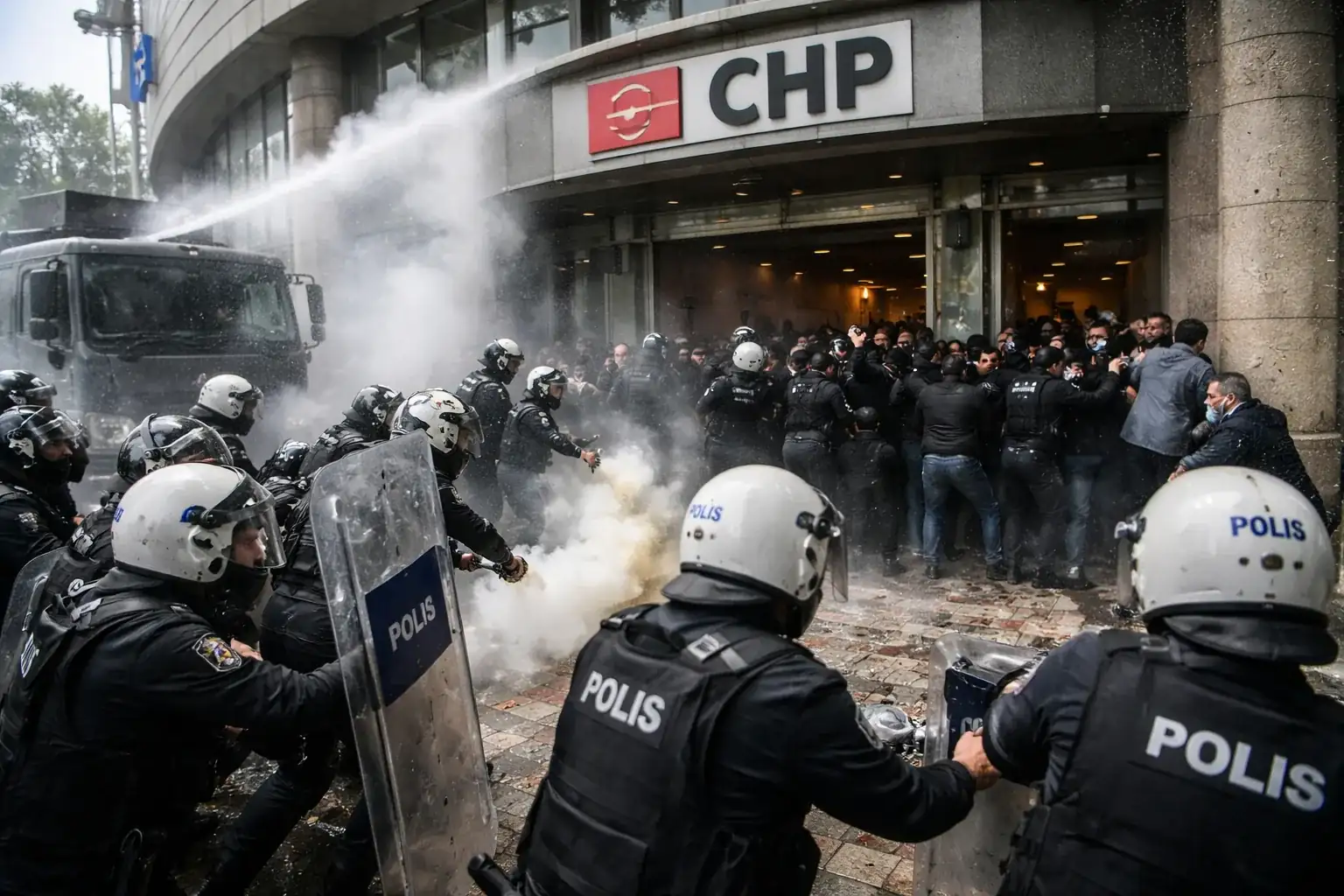
- Turkish riot police forced entry into the CHP headquarters in Ankara using tear gas and water cannons on Sunday.
- The raid follows an appeal court decision that declared Ozgur Ozel's leadership null and void, reinstating 77-year-old Kemal Kilicdaroglu.
- Clashes were reported between supporters of Ozel and Kilicdaroglu inside the building as police sought to implement the handover.
What happened
Turkish riot police forced their way into the headquarters of the Republican People's Party, or CHP, in Ankara after a court-ordered leadership change triggered a confrontation inside and outside the main opposition party's building. Officers used tear gas, hoses, and crowd-control force after supporters blocked entrances with makeshift barricades in an attempt to resist the takeover.
The immediate trigger was an appeals court decision that nullified the leadership of Ozgur Ozel and restored veteran politician Kemal Kilicdaroglu. What might have remained an internal opposition dispute became a national political crisis once police were sent to physically enforce the ruling at party headquarters. That intervention gave the episode far wider significance than a routine court fight over party procedure.
What's new in this update
After police entered the building, Ozel released a video message describing the party as being under attack and later emerged to address supporters in person. He said the fight would continue in public squares and political institutions, signaling that his faction does not intend to recognize the change as legitimate simply because security forces carried it out.
Authorities in Ankara said police acted after Kilicdaroglu's representatives requested state assistance in implementing the handover. That detail is central to the dispute, because critics say the government is using courts and police power to reshape the leadership of the country's main opposition force from the outside.
Key details
The legal case revolves around allegations tied to the CHP leadership contest and whether the internal process that elevated Ozel can stand. By overturning the result, the court did more than replace one figure with another. It also disrupted the legitimacy of the party's executive structure and cast uncertainty over decisions taken by the current leadership team.
Clashes between rival supporters reportedly broke out inside the building as police pushed forward. Human rights groups and opposition figures have pointed to those scenes as evidence that the issue is no longer just about party bylaws or internal elections. It is now about whether the Turkish state can intervene directly to reorder the opposition when political pressure alone is not enough.
Background and context
The CHP is Turkey's main opposition party and one of the few institutions capable of mounting a serious national challenge to President Recep Tayyip Erdogan and his ruling camp. Kilicdaroglu led the party for years and carried the opposition's failed presidential bid in 2023. Ozel's rise was widely seen as a generational shift and an effort to rebuild opposition energy after that defeat.
That background explains why the court ruling carries such weight. If the current opposition leadership can be displaced through litigation and enforced by riot police, many critics will see it as further evidence of shrinking democratic space in Turkey. Supporters of the ruling argue it restores legal order, but opponents view it as a state-backed intervention into party autonomy.
What to watch next
The next battle is likely to move beyond the CHP building itself. Ozel's supporters are expected to challenge the ruling politically and legally, while Kilicdaroglu's camp may try to consolidate institutional control over the party's offices, finances, and public representation. Any split in those areas could create prolonged confusion about who legitimately speaks for the opposition.
Observers are also watching whether Erdogan benefits from the turmoil by advancing constitutional or electoral maneuvers while the opposition is consumed by internal crisis. A weakened CHP would leave Turkey's broader opposition landscape more fragmented at a politically important moment.
Why this matters
This matters because the police action in Ankara turned a leadership dispute into a test of democratic resilience in Turkey. When riot police are used to impose a court-backed change inside the main opposition party, the issue is no longer only who leads the CHP. It becomes a question about state power, opposition rights, and the future of political competition under Erdogan.
Reader context
This story belongs to Northstar Herald's International Relations and Human Rights coverage, with related entities including Turkey, Recep Tayyip Erdogan, Ozgur Ozel, Kemal Kilicdaroglu. The report is based on BBC World News source material.
Related coverage
Why it matters
This move effectively neutralizes the current leadership of Turkey's main opposition party, further consolidating President Erdogan's control over the domestic political environment.
Read next
Follow this story through the topic hub, more world coverage, and the latest updates.
Weekly briefing
Get the week's key developments in one concise email.
Get a fast catch-up on the biggest stories, the context behind them, and the links worth your time.
Cadence
Weekly, for a quick catch-up
Coverage
AI, business, world, security, sports
Format
Clear takeaways and useful context
Request the briefing
Leave your email to open a prepared request and get on the list for the weekly briefing.
About the byline
World correspondent
Leila Haddad covers world affairs, diplomacy, and humanitarian crises, with a focus on how fast-moving international developments affect public policy, conflict response, and cross-border institutions.
Sources and methodology