Massive Wildfires on Colorado-Utah Border Claim Lives of Three
A tragic 'burnover incident' near the state line has left three dead and two injured as shifting winds merged separate blazes into the massive Snyder Mesa

World correspondent
Reports on international affairs, diplomacy, and humanitarian developments with an emphasis on official statements, multilateral institutions, and regional context.
Editorial responsibility: Lead reviewer for geopolitics, international institutions, and crisis coverage
Primary source: BBC World News. Full source links and update notes are below.
Fast summary
Start here
- Three federal firefighters were killed and two others injured when they were overtaken by flames during a 'burnover incident' while battling blazes near the Colorado-Utah border.
- The Knowles and Gore fires have merged to form the Snyder Mesa fire, which has consumed approximately 28,000 acres of land and remains largely uncontained.
- Colorado Governor Jared Polis has declared a state of emergency, authorizing the National Guard to support firefighting efforts across the western portion of the state.
What happened
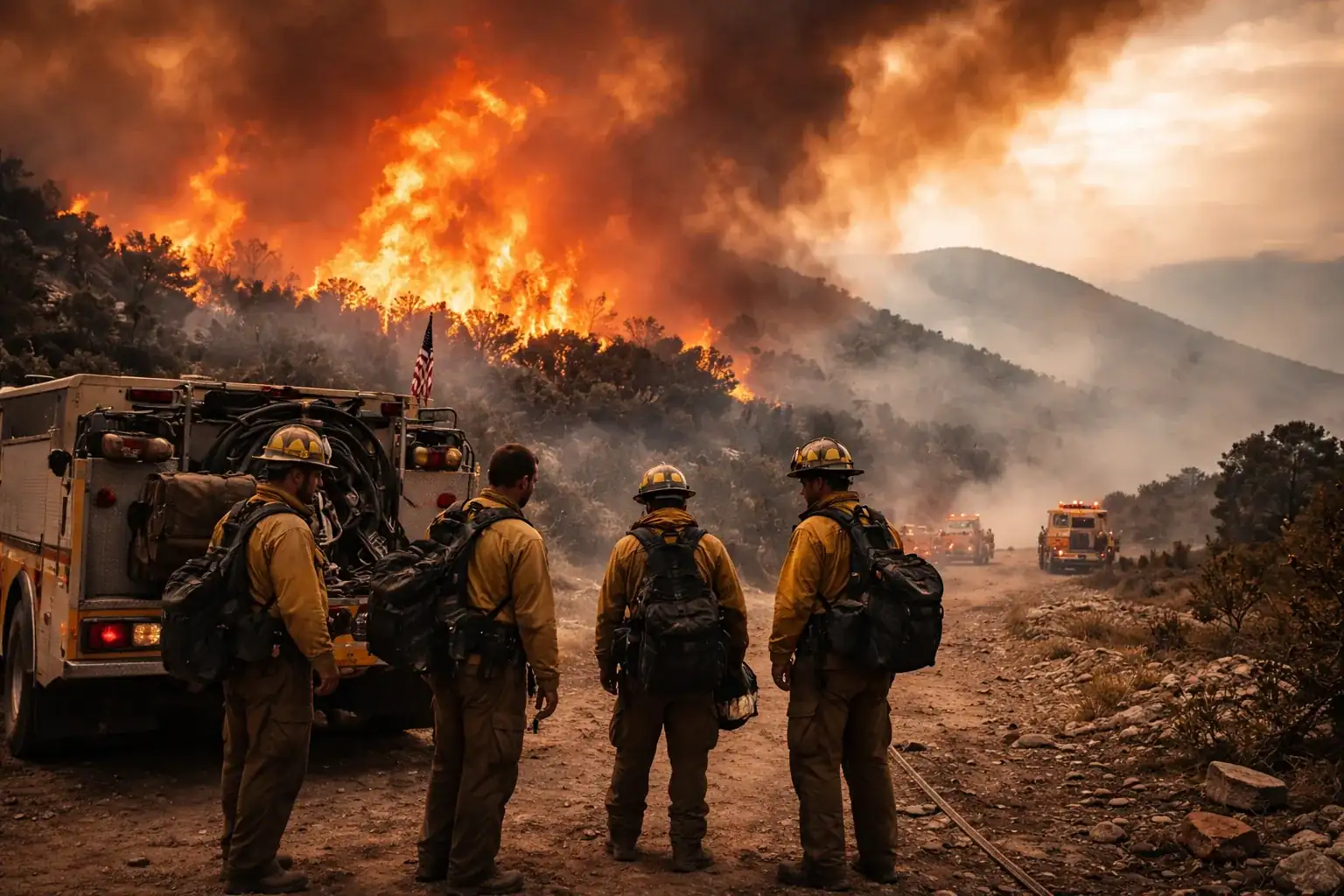
Tragic news emerged from the rugged border between Colorado and Utah this weekend as officials confirmed the deaths of three federal firefighters. The individuals were part of a specialized response team tasked with containing the Knowles and Gore fires when they were suddenly and violently overwhelmed by shifting flames on Saturday. According to the Department of the Interior, the crew attempted to deploy emergency shelters but was unable to escape the path of the fast-moving blaze. Two additional crew members sustained serious burns and were airlifted to a regional hospital for emergency treatment. This incident occurred during what fire officials describe as a 'burnover,' a nightmare scenario where fire advances so rapidly that all traditional escape routes are severed, leaving personnel with no choice but to utilize last-resort survival equipment like emergency shelter tents.
What's new in this update
In response to the escalating crisis, Colorado Governor Jared Polis officially declared a state of emergency on Saturday. This executive action authorizes the deployment of the state’s National Guard to bolster the efforts of federal and local crews who are already stretched thin by multiple active blazes. Governor Polis expressed his deep devastation over the loss of life, emphasizing that the state mourns alongside the families and crewmates of those who perished in the line of duty. Meanwhile, the Knowles and Gore fires have officially merged, forming a massive conflagration now designated as the Snyder Mesa fire. As of late Saturday, this single fire had already scorched roughly 28,000 acres. The names of the deceased firefighters have not yet been released, as authorities prioritize notifying the next of kin and providing support to surviving team members.
Key details
The five firefighters involved in the incident were representatives of two distinct federal entities: the US Forest Service and the US Wildland Fire Service. The latter was established only recently, in January 2026, with the specific intent of streamlining the federal response to wildfires across vast expanses of public lands. This organizational shift was designed to improve coordination and resource allocation, yet the current fire season is testing these new structures to their limit. Across the border in Utah, the situation remains equally dire. The Cottonwood Fire, currently the largest of eleven active blazes in the state, has ballooned to over 93,000 acres. Perhaps most concerning for incident commanders is the fact that the Cottonwood Fire reported 0% containment as of Sunday morning, despite a massive influx of regional resources and ground crews.
Background and context
This recent tragedy is part of a broader, more alarming trend of increasingly 'faster and more furious' wildfires across the Western United States. Scientists and land management experts have long warned that a combination of factors is creating a 'perfect storm' for catastrophic fire behavior. Warmer winters have led to reduced snowpack, which in turn accelerates the drying out of vegetation during the spring and summer months. When these conditions are paired with high winds and prolonged drought—both of which are being exacerbated by anthropogenic climate change—the result is a landscape primed for ignition. While the current blazes in Colorado and Utah are burning through mostly sparsely populated areas, they are increasingly threatening critical infrastructure, including mountain resorts and seasonal cabins, which complicates the strategic deployment of firefighting assets.
What to watch next
As the July 4 holiday weekend approaches, authorities are on high alert for new ignitions that could further strain an already exhausted workforce. Utah Governor Spencer Cox has taken the proactive step of issuing an emergency order banning the use of all fireworks to prevent accidental starts during celebrations. This is a critical move, as human-caused ignitions frequently peak during Independence Day festivities. Observers will also be watching the Snyder Mesa fire closely to see if it continues to merge with other smaller spot fires in the region. There is also an ongoing investigation into the specific circumstances of the burnover incident to determine if any tactical adjustments or safety protocol changes are necessary for the remainder of the season. The immediate focus, however, remains on the recovery of the injured and the stabilization of the fire perimeters.
Why it matters
These deaths underscore the increasing danger of wildland firefighting as climate-driven conditions lead to more erratic and intense fire behavior, placing unprecedented strain on federal response agencies.
Read next
Follow this story through the topic hub, more world coverage, and the latest updates.
Weekly briefing
Get the week's key developments in one concise email.
Get a fast catch-up on the biggest stories, the context behind them, and the links worth your time.
Cadence
Weekly, for a quick catch-up
Coverage
AI, business, world, security, sports
Format
Clear takeaways and useful context
Request the briefing
Leave your email to open a prepared request and get on the list for the weekly briefing.
About the byline
World correspondent
Leila Haddad covers world affairs, diplomacy, and humanitarian crises, with a focus on how fast-moving international developments affect public policy, conflict response, and cross-border institutions.
Sources and methodology