SpaceX to Open Public Share Trading as Interest Reaches Fever Pitch
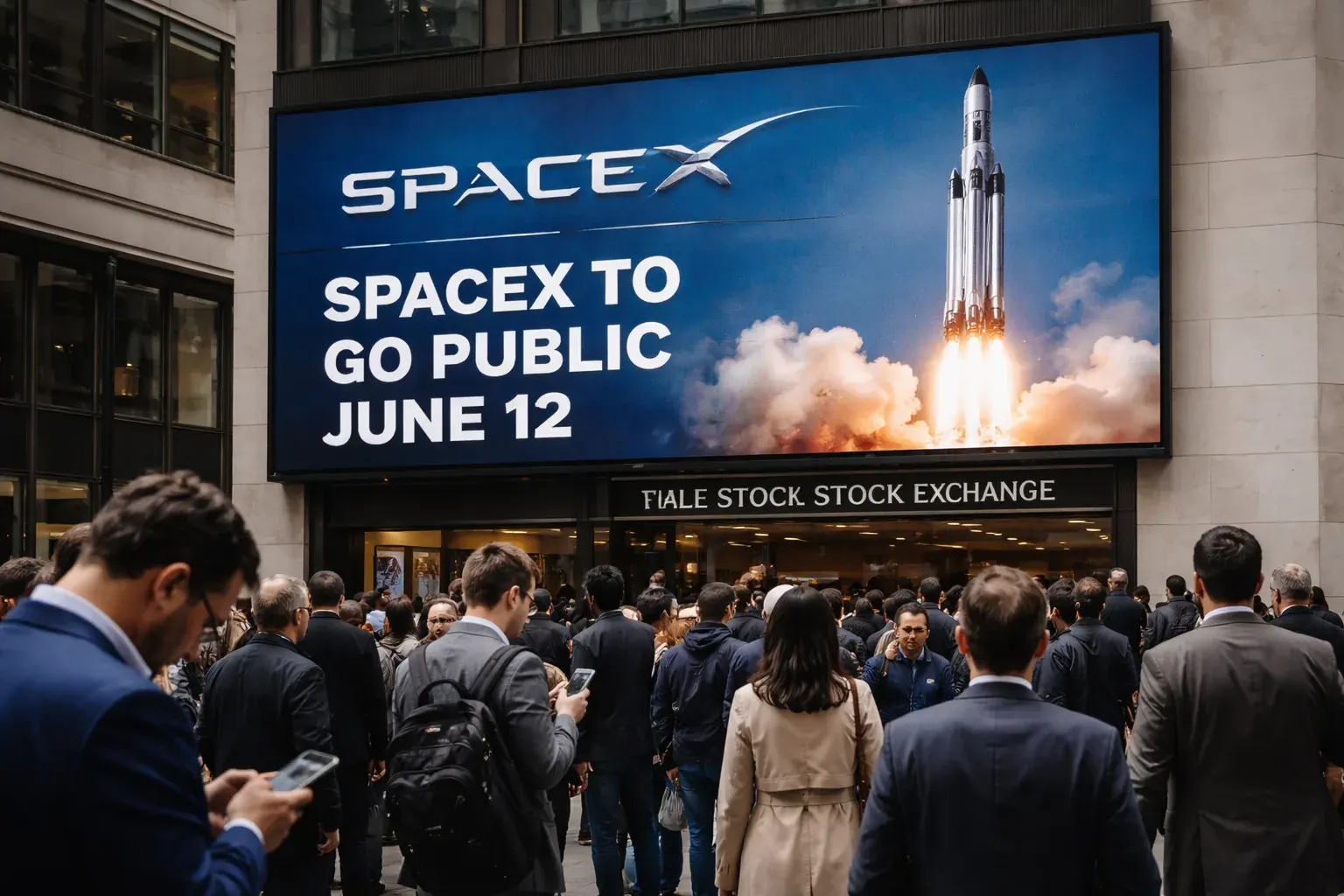
On June 12, retail and institutional investors will gain access to SpaceX shares, a move that could cement the company's role in both space exploration and

World correspondent
Reports on international affairs, diplomacy, and humanitarian developments with an emphasis on official statements, multilateral institutions, and regional context.
Editorial responsibility: Lead reviewer for geopolitics, international institutions, and crisis coverage
Primary source: BBC World News. Full source links and update notes are below.
Fast summary
Start here
- SpaceX is preparing for a partial public share offering with trading scheduled to begin on June 12.
- UK retail investors are expected to be allocated approximately 1.5 billion pounds worth of shares amid high demand.
- The valuation surge from the listing could potentially make Elon Musk the world's first trillionaire.
What happened
SpaceX is preparing for a public share offering that would give a wider group of investors access to one of the world's most closely watched private companies. The planned offering has triggered intense attention because SpaceX has spent years building a reputation as a rare private business with major influence over launch services, satellite infrastructure, national security, and the broader future of commercial space.
That is why investor interest has surged so quickly. A SpaceX share offering is not being treated as an ordinary market event. It is being viewed as a chance to buy into a company that sits at the center of aerospace ambition, communications infrastructure, and the public image of Elon Musk's empire.
Why the SpaceX share offering matters
For years, most ordinary investors have had no direct route into SpaceX because the company remained tightly held in private markets. A public share offering changes that relationship. It opens the possibility of broader ownership and puts a public price signal on a company that has long been valued through private transactions, internal sales, and investor speculation.
That matters because SpaceX has become too important to remain just another private startup success story. It now plays a major role in launch economics, satellite deployment, and strategic infrastructure conversations well beyond the space sector.
Why investor demand is so intense
The enthusiasm around a SpaceX public share offering comes from a mixture of scarcity and story. Scarcity matters because high-profile private companies with this level of recognition rarely open access widely. Story matters because SpaceX is associated with reusable rockets, Starship development, Starlink connectivity, and the larger promise of a company trying to change the economics of space.
Investors are not only buying current revenue or assets. Many of them are buying into the idea that SpaceX could dominate multiple long-term industrial and technological layers at once.
The Elon Musk factor
Any SpaceX offering also carries the Elon Musk effect. Musk's personal brand attracts both loyalty and controversy, but either way it drives attention. That attention can amplify demand, especially among retail investors who see the company as part of a larger thesis about frontier technology, national influence, and future infrastructure.
The flip side is concentration risk. A SpaceX share offering does not separate the company from the wider questions surrounding Musk's management style, political profile, or the overlapping influence of his businesses. Investors are buying into the business, but they are also buying into that ecosystem.
Why SpaceX is more than a rocket company
The offering attracts unusual interest partly because SpaceX is no longer understood only as a launch provider. Through Starlink, defense relationships, and the strategic role of launch capacity itself, the company increasingly looks like infrastructure. That changes how a SpaceX share offering is interpreted. It becomes not just an aerospace bet, but a bet on communications, government dependence, and the future architecture of orbital industry.
This is one reason the company can attract both institutional and retail demand at such scale.
The risks beneath the excitement
A SpaceX public share offering also raises harder questions. Public investors eventually demand clearer accountability, steadier disclosure, and more discipline around valuation than private-market mythmaking usually requires. Space projects remain capital-intensive, regulatory exposure is real, and ambitious timelines do not always translate into linear execution.
That means enthusiasm alone cannot sustain the story forever. Once public pricing begins, SpaceX will face more direct scrutiny over how investors should value launch economics, Starlink expansion, and long-term programs like Starship.
Why the market response will matter
The first reaction to the offering will be important not just for SpaceX, but for other high-profile private technology companies watching from the sidelines. A strong debut could reinforce the market's appetite for companies framed around strategic infrastructure and frontier technology. A weaker or more volatile debut could show that investor excitement has limits even for elite-name offerings.
This is especially relevant in a market where aerospace, AI, and infrastructure narratives increasingly overlap.
What comes next
The next step is straightforward: the opening of trading and the market's judgment on valuation, liquidity, and demand. After that, attention will turn to whether the public share offering changes how SpaceX communicates, governs itself, or prioritizes future capital needs.
For now, the SpaceX share offering represents a major shift from private exclusivity toward broader market participation. It is a financial event, but also a test of how much investors are willing to pay for access to a company that has become one of the most symbolically powerful names in modern industry.
Why it matters
This move marks a transition from exclusive private ownership to public market participation, testing investor appetite for high-stakes aerospace and AI infrastructure. It also concentrates significant geopolitical and economic influence in a single private entity.
Read next
Follow this story through the topic hub, more world coverage, and the latest updates.
Weekly briefing
Get the week's key developments in one concise email.
Get a fast catch-up on the biggest stories, the context behind them, and the links worth your time.
Cadence
Weekly, for a quick catch-up
Coverage
AI, business, world, security, sports
Format
Clear takeaways and useful context
Request the briefing
Leave your email to open a prepared request and get on the list for the weekly briefing.
About the byline
World correspondent
Leila Haddad covers world affairs, diplomacy, and humanitarian crises, with a focus on how fast-moving international developments affect public policy, conflict response, and cross-border institutions.
Sources and methodology