Hantavirus Scare Reaches Remote Pitcairn Islands Following Cruise
A woman who traveled on the virus-hit MV Hondius is isolating on the tiny British territory as French Polynesia blocks her re-entry.

World correspondent
Reports on international affairs, diplomacy, and humanitarian developments with an emphasis on official statements, multilateral institutions, and regional context.
Editorial responsibility: Lead reviewer for geopolitics, international institutions, and crisis coverage
Primary source: BBC World News. Full source links and update notes are below.
Fast summary
Start here
- A woman is under a 45-day isolation period on the Pitcairn Islands after exposure to hantavirus on a Dutch-flagged cruise ship.
- The individual traveled on the MV Hondius, a vessel where three passengers recently died during a confirmed hantavirus outbreak.
- French Polynesian authorities have barred the woman from re-entering their territory while she poses a potential infection risk.
What happened
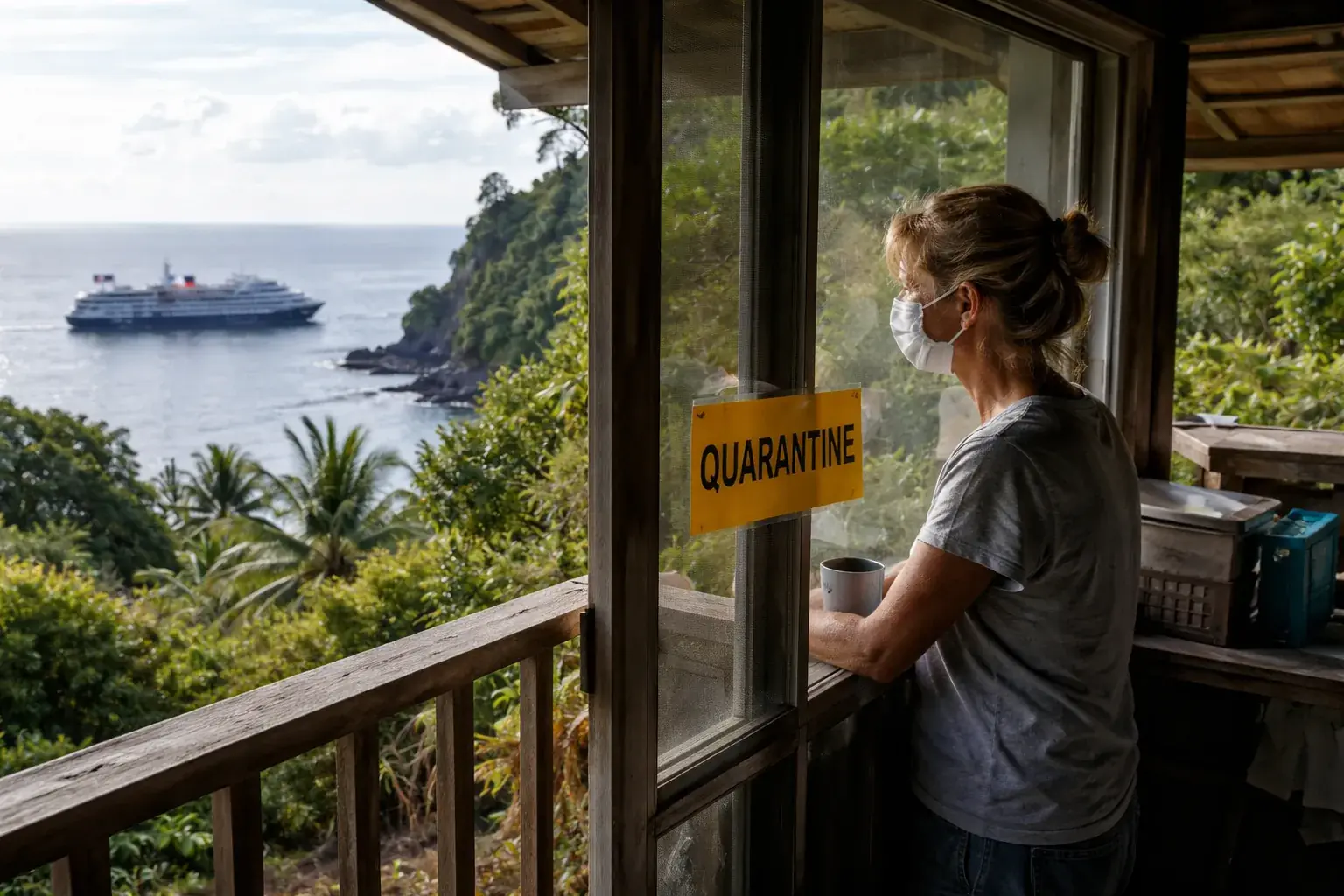
A hantavirus exposure case has reached one of the world's most isolated inhabited communities, with a woman now isolating on the Pitcairn Islands after traveling on the MV Hondius, the cruise ship linked to a deadly outbreak. Local officials say she remains asymptomatic, but the response has been necessarily strict because the Pitcairn Islands have a population of only about 50 people and extremely limited medical capacity.
What would be a serious but manageable public health issue in a larger city becomes much more complicated in a remote British Overseas Territory that sits deep in the South Pacific. The challenge is not only the virus itself. It is the combination of isolation, weak medical infrastructure, transport dependence, and the difficulty of safely moving anyone who may have been exposed.
Why the MV Hondius outbreak matters
The woman had contact with an exposed individual on the MV Hondius, a Dutch-flagged expedition cruise ship on which three passengers died during a confirmed hantavirus outbreak. Two of those deaths were laboratory-confirmed, while a third symptomatic person died before testing was completed. Health authorities believe the cases involved the Andes strain, a form of hantavirus associated with South America and notable because it can spread from person to person, unlike most hantavirus strains which are primarily linked to rodent exposure.
That detail is central to the seriousness of the case. Public health officials are not simply monitoring a theoretical infection. They are responding to a virus with an incubation pattern and transmission risk that requires extended caution, especially after known close contact in a closed travel setting such as a cruise vessel.
Why Pitcairn is especially vulnerable
The Pitcairn Islands are among the most remote inhabited places on earth, best known internationally as the home of descendants of the HMS Bounty mutineers. Their remoteness shapes everything about the current response. There is no large hospital system to absorb risk, no nearby emergency transfer network that can be activated quickly, and no margin for a cluster outbreak inside a tiny population.
That is why even one asymptomatic exposed person creates a territory-level public health challenge. Local authorities, the British Foreign Office, and the UK Health Security Agency are all involved because prevention is the only realistic first line of defense. Once a serious infectious illness began spreading in such a small and isolated community, the logistical consequences could escalate rapidly.
The French Polynesia complication
The situation has also become a diplomatic and transport problem. French Polynesian authorities have barred the woman from re-entering their territory while she remains within the risk window. Officials said she had previously transited through Tahiti and Mangareva without notifying territorial or national authorities about her exposure history. That decision means she cannot simply retrace her route home until the isolation period is completed or the public health risk is cleared.
This turns isolation into more than a medical instruction. It becomes a temporary geopolitical dead end. In remote Pacific travel networks, people often depend on a small number of routes, ships, and transit jurisdictions. When one jurisdiction closes its doors for health reasons, alternatives may be minimal or nonexistent in the short term.
Why the 45-day window is important
The UK Health Security Agency has reportedly set a 45-day isolation period for close contacts related to this strain. That is long enough to create practical hardship even if no symptoms ever develop. It also reflects the high caution required when dealing with rare viral outbreaks that involve uncertain timing and limited treatment options in remote environments.
For Pitcairn's residents, the aim is simple: keep the island safe. For the exposed traveler, the reality is far more complicated. She is effectively waiting out a medical clock in one of the least connected places in the world, under rules shaped by both health surveillance and international transit restrictions.
What comes next
If she remains symptom-free through the full monitoring period, officials will then need to arrange an acceptable travel solution, likely in coordination with French Polynesia and British authorities. Until then, the case remains a test of how public health systems function when geography is as important as medicine.
The broader lesson is that remote communities face a different scale of risk from rare outbreaks. On Pitcairn, one exposure linked to the MV Hondius is enough to trigger international coordination, local isolation, and immediate concern about system capacity. That is what makes this hantavirus case more than a personal health matter. It is a reminder that distance can protect a community, but it can also leave it extremely exposed when something infectious finally arrives.
Why it matters
The isolation highlights the logistical and medical challenges of managing a rare viral outbreak in extremely remote communities with limited infrastructure.
Read next
Follow this story through the topic hub, more world coverage, and the latest updates.
Weekly briefing
Get the week's key developments in one concise email.
Get a fast catch-up on the biggest stories, the context behind them, and the links worth your time.
Cadence
Weekly, for a quick catch-up
Coverage
AI, business, world, security, sports
Format
Clear takeaways and useful context
Request the briefing
Leave your email to open a prepared request and get on the list for the weekly briefing.
About the byline
World correspondent
Leila Haddad covers world affairs, diplomacy, and humanitarian crises, with a focus on how fast-moving international developments affect public policy, conflict response, and cross-border institutions.
Sources and methodology