Massive Evacuation in California Over Fears of Chemical Tank Explosion
Authorities have ordered tens of thousands to leave their homes near an aerospace facility as a compromised chemical tank threatens to fail or detonate.
Primary source: BBC World News. Full source links and update notes are below.
Fast summary
Start here
- A tank holding 7,000 gallons of methyl methacrylate at an aerospace facility in Garden Grove is at risk of failure or explosion.
- Orange County Fire Authority officials have expanded evacuation orders to include more than 40,000 residents.
- Hazmat teams are attempting to depressurize the tank after a cooling system failure led to physical bulging and temperature spikes.
What happened
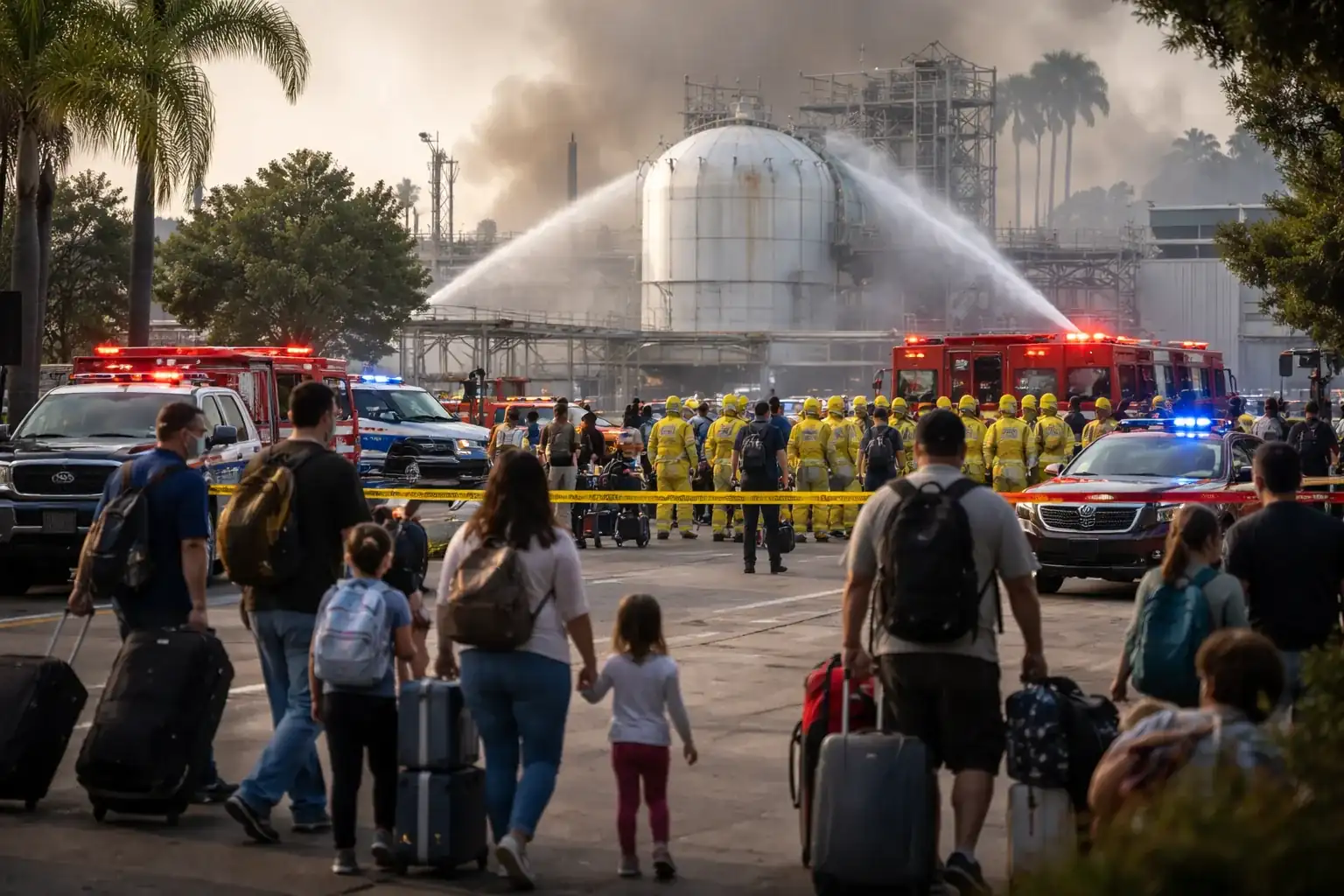
More than 40,000 residents in Garden Grove, California, were forced to evacuate their homes between Thursday and Friday after a chemical tank at an aerospace manufacturing facility began showing signs of imminent failure. The Orange County Fire Authority (OCFA) reported that a tank containing roughly 7,000 gallons of methyl methacrylate experienced a cooling system failure, leading to a dangerous rise in internal temperature and pressure.
What's new in this update
Orange County Fire Chief Craig Covey confirmed in a Friday press conference that the affected tank has physically "bulged," signaling that structural integrity is compromised. While hazmat teams have successfully prevented further temperature increases, the risk of a "thermal runaway"—a rapid, uncontrolled chemical reaction that could cause an explosion—remains a critical concern. Consequently, authorities have expanded the original evacuation zone.
Key details
Methyl methacrylate is a highly flammable and volatile liquid used in the production of plastics. Chief Covey outlined two primary danger scenarios: a structural breach that spills toxic chemicals into the immediate area, or a catastrophic detonation. An explosion is particularly concerning as it could affect adjacent tanks at the facility which contain additional fuels and hazardous chemicals.
Background and context
The incident began at the Garden Grove facility on Thursday afternoon when officials first noted a temperature increase in the tank. The OCFA has since established evacuation centers and a dedicated information hotline for displaced residents. Hazmat teams and industry experts are working together to find a method to depressurize the vessel without triggering a breach.
What to watch next
Evacuation orders will remain in place until the tank is stabilized and the immediate threat of explosion or spill is mitigated. Authorities are continuing to investigate the cause of the cooling system failure. Officials have explicitly asked the public to refrain from calling emergency lines with suggestions on how to handle the leak, as specialists are already on-site managing the technical response.
Why this matters
The situation involves a highly volatile substance in a densely populated area, presenting a severe risk of a toxic spill or a secondary explosion involving nearby chemical and fuel tanks.
Reader context
This story belongs to Northstar Herald's world coverage, with related entities including California, Garden Grove, Chemical Leak, Orange County Fire Authority. The report is based on BBC World News source material.
Related coverage
Why it matters
The situation involves a highly volatile substance in a densely populated area, presenting a severe risk of a toxic spill or a secondary explosion involving nearby chemical and fuel tanks.
Read next
Follow this story through the topic hub, more world coverage, and the latest updates.
Weekly briefing
Get the week's key developments in one concise email.
Get a fast catch-up on the biggest stories, the context behind them, and the links worth your time.
Cadence
Weekly, for a quick catch-up
Coverage
AI, business, world, security, sports
Format
Clear takeaways and useful context
Request the briefing
Leave your email to open a prepared request and get on the list for the weekly briefing.
Author
See who assembled this story and follow more of their work.
Sources and methodology