Milan Begins Restoration of Historic Bull Mosaic After Years of Tourist Wear
Artisans are repairing the damaged tiles of a 19th-century mosaic in the Galleria Vittorio Emanuele II arcade following a decade of physical degradation.
Primary source: BBC World News. Full source links and update notes are below.
Fast summary
Start here
- Restoration has commenced on a famous bull mosaic in Milan that has been physically worn down by tourists seeking good luck.
- The ritual involves visitors grinding their heels into a specific spot on the bull and spinning three times, which has created a visible crater.
- City officials noted that the pink tiles representing the bull's testicles were previously replaced in 2017 due to similar damage.
What happened
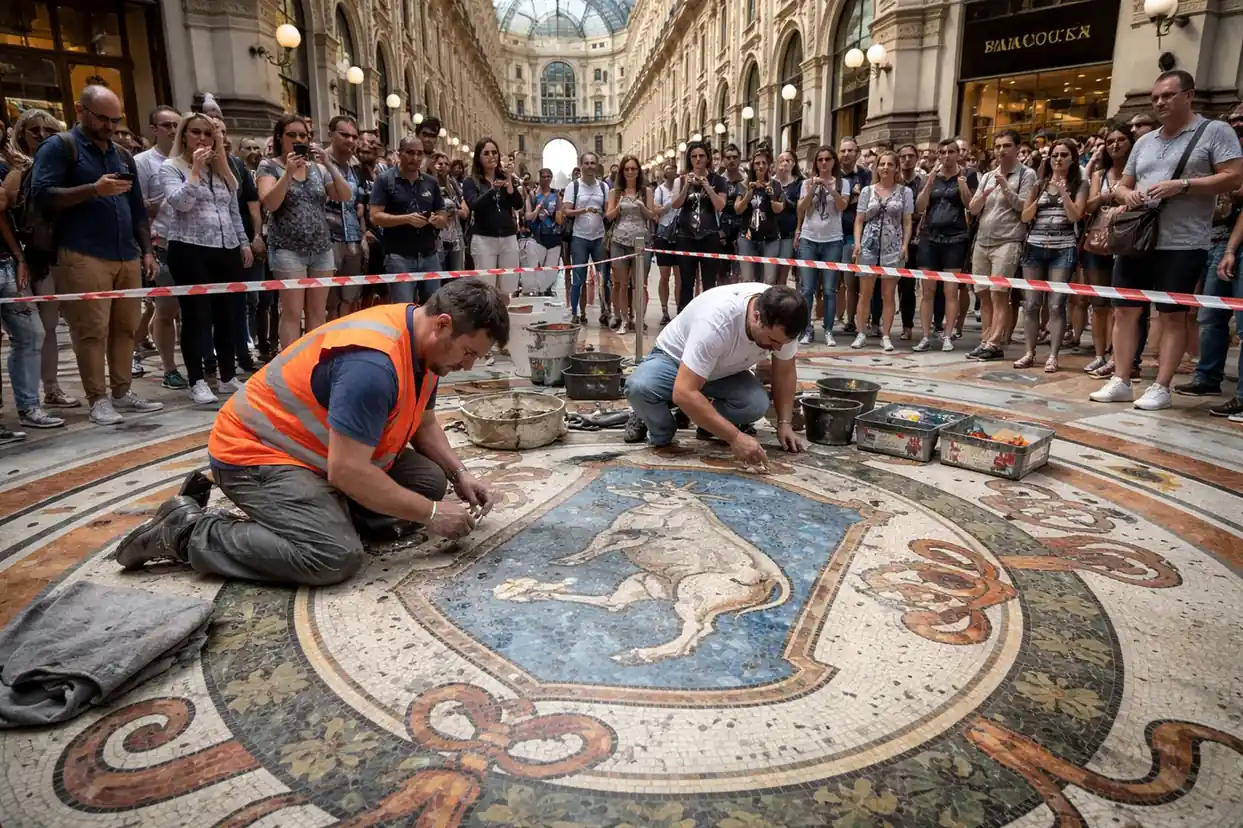
Authorities in Milan have cordoned off the famous bull mosaic in the Galleria Vittorio Emanuele II to begin essential repairs. The artwork, which represents the city of Turin, has suffered significant physical degradation due to a popular local legend that promises good fortune to those who participate in a specific spinning ritual.
What's new in this update
Artisan Gianluca Galli was seen this week hand-cutting new stone pieces to replace the worn tiles. A small construction enclosure now surrounds the site, where specialists are working to return the 19th-century floor art to its original state following years of heavy foot traffic concentrated on a single point of the mosaic.
Key details
Thousands of visitors daily perform a gesture where they place their heel on the bull's testicles and spin clockwise three times. This practice has worn away the pink tiles that make up that section of the mosaic, leaving a noticeable hole. The mosaic is a central feature of the historic arcade, which was the first capital of Italy.
Background and context
The Galleria Vittorio Emanuele II is a landmark 19th-century shopping arcade and one of Milan's most iconic sites. While the spinning ritual was popular among locals in the 1800s, modern mass tourism has accelerated the damage. The mosaic was last restored in 2017, but city officials Emmanuel Conte and Marco Granelli noted that the site requires frequent care because it is so heavily 'experienced' by the public.
What to watch next
As restoration continues, city officials emphasize that the arcade remains a living piece of heritage. It remains to be seen if Milanese authorities will eventually implement more permanent protective measures or if the site will remain open to the traditional, albeit damaging, ritual once the current repairs are complete.
Why this matters
The restoration underscores the physical impact of high-volume tourism on historical landmarks and the recurring costs of maintaining 'living heritage' in popular global destinations.
Reader context
This story belongs to Northstar Herald's world coverage, with related entities including Italy, Milan, Art Restoration, Tourism. The report is based on BBC World News source material.
Related coverage
Why it matters
The restoration underscores the physical impact of high-volume tourism on historical landmarks and the recurring costs of maintaining 'living heritage' in popular global destinations.
Read next
Follow this story through the topic hub, more world coverage, and the latest updates.
Weekly briefing
Get the week's key developments in one concise email.
Get a fast catch-up on the biggest stories, the context behind them, and the links worth your time.
Cadence
Weekly, for a quick catch-up
Coverage
AI, business, world, security, sports
Format
Clear takeaways and useful context
Request the briefing
Leave your email to open a prepared request and get on the list for the weekly briefing.
Author
See who assembled this story and follow more of their work.
Sources and methodology